As an Amazon Associate, Knives Task earns from qualifying purchases. We did not test these strips in person; this guide is based on maker and seller descriptions, published reviews and owner feedback.
A magnetic knife strip frees up counter space, keeps your knives within reach and protects their edges far better than a crowded drawer. It also shows off a nice knife collection. But not all strips are equal: weak magnets can let a heavy chef’s knife slide, and some metal faces can scuff blades. Choosing the right strip and mounting it properly makes all the difference.
This guide compares the best magnetic knife strips, explains the pros and cons of wood and stainless steel, and shows how to install one safely.
Quick Picks
- Best overall: Modern Innovations stainless steel magnetic knife bar
- Best premium wood strip: Benchcrafted Mag-Blok
- Best wood strip for the money: HOSHANHO acacia wood strip
- Best budget pick: GORILLA GRIP stainless steel strip
- Best for renters: HMmagnets no-drill strip
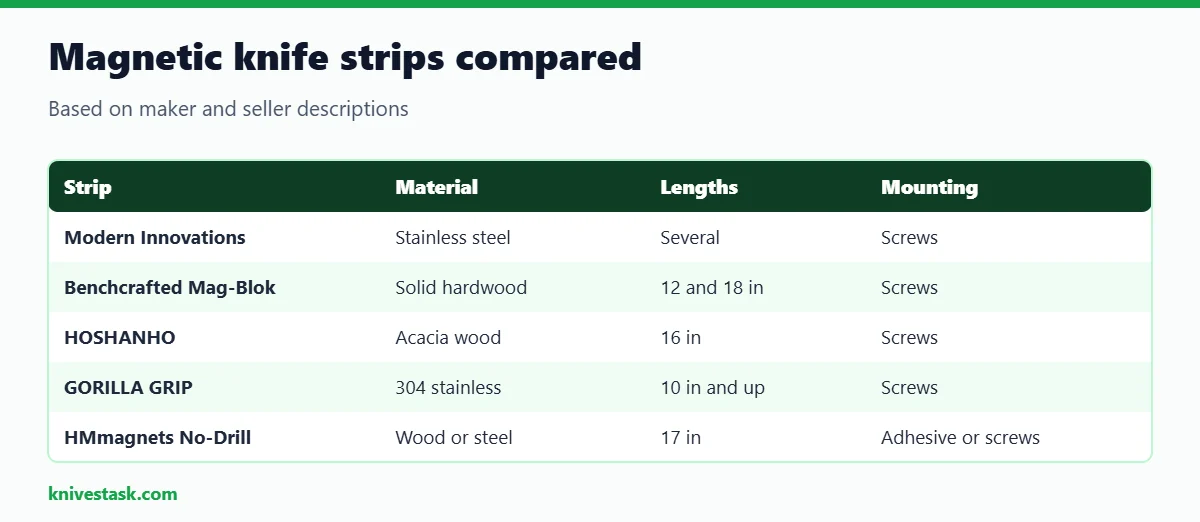
1. Modern Innovations Stainless Steel Magnetic Knife Bar
Best overall. The Modern Innovations bar is one of the best-selling magnetic knife holders online, with tens of thousands of customer ratings. Sellers describe a satin stainless steel bar with strong neodymium magnets across its full face, so you can place a knife anywhere along its length. It comes in several sizes, with the 16-inch version (about 15.75 inches of magnetic face) suiting most kitchens, and it includes screw-mount hardware.
Pros: strong full-length hold, many sizes, easy to wipe clean, affordable.
Cons: metal face can leave light scuffs on polished blades if you slide knives on and off.
Check the Modern Innovations bar on Amazon
2. Benchcrafted Mag-Blok
Best premium wood strip. The Mag-Blok is a solid hardwood bar with rare-earth magnets hidden inside. Highland Woodworking’s Mag-Blok listing notes the magnets are entirely cased in wood so they will not scratch, ding or dull tools, that it is made in the USA, and that it comes unfinished with a food-safe beeswax and mineral oil finish. It is offered in maple, walnut, cherry and white oak, in 12- and 18-inch lengths.
An owner review at HelpAtMyHome describes the hold as strong enough for cleavers and steels, and the clean look as a big part of the appeal.
Pros: gentle wood face, no visible magnets, beautiful solid hardwood, made in USA.
Cons: costs more than mass-market strips; you apply the finish yourself.
Check the Benchcrafted Mag-Blok on Amazon
3. HOSHANHO Acacia Wood Magnetic Strip
Best wood strip for the money. If you like the look and blade-friendly feel of wood but want to spend less, HOSHANHO’s 16-inch acacia strip is a popular choice. Sellers describe dual rows of magnets behind an acacia wood face, enough for a full set of kitchen knives. Like all wood strips, the face may show light marks over time, which does not affect the hold.
Pros: warm wood look, gentle on blades, good value.
Cons: magnet strength varies more than premium brands; wood needs occasional oiling.
Check the HOSHANHO strip on Amazon
4. GORILLA GRIP Stainless Steel Strip
Best budget pick. GORILLA GRIP sells compact 304 stainless steel strips that are often recommended for small kitchens. A 10-inch strip holds a handful of essential knives, such as a chef’s knife, paring knife and bread knife, in a small space beside the stove or above a short counter.
Pros: low price, compact sizes, rust-resistant 304 stainless.
Cons: shorter strips hold fewer knives; metal face.
Check GORILLA GRIP strips on Amazon
5. HMmagnets No-Drill Magnetic Strip
Best for renters. Not everyone can drill into a tiled backsplash. HMmagnets and similar brands sell strips with heavy-duty adhesive mounting, with screws included as an option. They are convenient, but adhesive mounts have weight limits, so stick to lighter knives and follow the curing time before loading the strip.
Pros: no drilling, easy to install, good for rentals.
Cons: adhesive may not suit very heavy knives or textured walls.
Check no-drill magnetic strips on Amazon
Wood vs Stainless Steel Strips
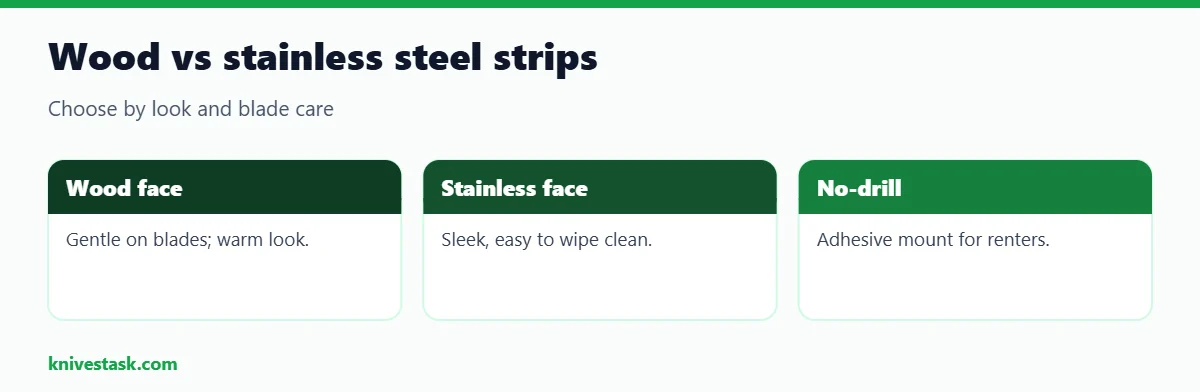
Wood strips have a softer face, so blades are less likely to scratch when you place or remove them. They look warm and natural, especially in traditional kitchens, but need occasional oiling and can show marks.
Stainless steel strips look sleek and modern, are easy to wipe clean, and usually cost less. The metal face can leave light scratches on polished or Damascus blades if you drag knives across it.
BestReviews notes that stainless strips are easier to clean, while wood suits a more traditional look. If you own fine Japanese or Damascus knives, such as those in our guide to the best Damascus steel kitchen knives, a wood face is the gentler choice.
How to Choose a Magnetic Knife Strip
Magnet strength
Look for neodymium (rare-earth) magnets that cover the whole face. A strong strip holds a heavy chef’s knife or cleaver without sliding, but should still let you remove knives without a struggle.
Length
Allow about 1.5 to 2 inches per knife. A 12-inch strip holds four to six knives; a 16- to 18-inch strip holds most home knife sets.
Material and finish
Pick wood for blade protection and warmth, or stainless steel for easy cleaning and a modern look.
Mounting
Screw mounting into studs or proper anchors is the most secure. Adhesive mounts are best for light loads and rental homes.
How to Install a Magnetic Knife Strip
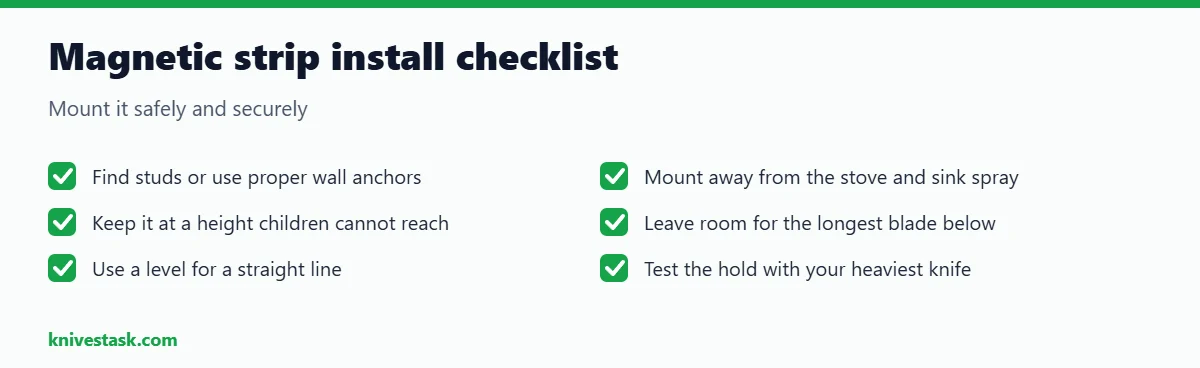
- Choose the spot: near your prep area, away from the stove’s heat and direct sink spray, and high enough to keep blades out of children’s reach.
- Check clearance: make sure the longest knife hangs freely without touching the counter or backsplash trim.
- Find studs or use anchors: use a stud finder, or appropriate anchors for drywall or tile.
- Mark and level: hold the strip in place, check it with a level, and mark the screw holes.
- Drill and mount: drill pilot holes, insert anchors if needed, and screw the strip tight.
- Test: place your heaviest knife on the strip and check that it holds firmly.
How to Use a Magnetic Strip Safely
- Place the spine first: touch the spine of the blade to the strip, then roll the blade flat. This avoids the edge snapping onto the magnet.
- Remove by rolling: lift the edge away first by rotating the knife on its spine, then pull it off. Do not drag the edge across the strip.
- Point edges the same way: keep all edges facing down or to one side so you never grab a blade by mistake.
- Store only dry knives: wet knives can leave water marks or rust spots, especially carbon steel.
Magnetic Strip vs Knife Block vs Drawer
A knife block is easy and self-contained, but slots can be hard to clean and limit which knives fit. In-drawer organisers keep knives hidden and safe, but use drawer space. A magnetic strip saves counter and drawer space, works with any knife shape, and lets air circulate so knives dry fully. For more storage ideas, read our guide on how to store kitchen knives. If you are still building your collection, see what knives every kitchen should have.
Best Places to Mount a Knife Strip
Above the main prep counter: the most practical spot. Knives are within arm’s reach of your cutting board, so you are not carrying blades across the kitchen.
On the side of a cabinet or end panel: keeps the strip out of the main sightline and away from splashes, and works well in narrow galley kitchens.
Inside a cabinet door or pantry: hides knives from view and from children, though access is a little slower and door swing must clear the handles.
Places to avoid: directly above the stove, where heat, steam and grease build up; right beside the sink, where water splashes; and anywhere a door or drawer could bump the knives.
What Size Strip Do You Need?
- Essentials only (3 to 4 knives): a 10- to 12-inch strip is enough for a chef’s knife, paring knife, bread knife and utility knife.
- A typical home set (5 to 8 knives): a 16- to 18-inch strip gives each knife room so handles do not knock together.
- Large collections: use two strips, or a 24-inch strip, and group knives by type. Long slicers and gyutos hang best at the ends.
If you are deciding which knives deserve a spot on the wall, our guides to the best chef’s knife for home cooks and best paring knives cover the essentials.
More Than Just Knives
A strong magnetic strip also holds kitchen scissors, a metal honing rod, a bottle opener, metal measuring spoons and some thermometers. In a workshop or garage, the same strips keep screwdrivers, chisels and drill bits organised. Just avoid overloading the strip, and keep heavy items near the screws where the mount is strongest. See magnetic tool strips.
Caring for Your Strip
- Stainless steel: wipe with a damp cloth and mild soap, then dry. Avoid abrasive pads that leave scratches.
- Wood: wipe clean and re-apply a food-safe oil or beeswax finish every few months to keep the wood from drying out.
- Check the mount: every few months, make sure screws are tight and the strip has not shifted, especially in humid kitchens.
Safety With Children and Pets
A magnetic strip puts sharp blades in the open, so placement matters in a family kitchen. Mount it above shoulder height for children, away from counters they can climb onto, and never directly above a kitchen stool or chair. Teach older children the spine-first rule if they help in the kitchen. If small children are around often, consider an in-drawer organiser or a strip inside a high cabinet instead.
Common Mistakes to Avoid
- Mounting into drywall without anchors: a loaded strip can pull screws straight out of plain drywall. Always hit a stud or use rated anchors.
- Buying a strip that is too short: crowded knives knock together, chip edges and are awkward to grab. Measure your collection first.
- Snapping knives onto the strip edge-first: the magnet pulls hard, and the edge can strike the face. Always lead with the spine.
- Hanging wet knives: water trapped between blade and strip encourages rust, especially on carbon steel. Dry knives fully before hanging them; our guide on removing rust from kitchen knives explains what to do if spots appear.
- Ignoring weight limits on adhesive strips: no-drill strips are convenient, but heavy cleavers and large chef’s knives can exceed their rating.
Is a Magnetic Knife Strip Worth It?
For most home cooks, yes. A good strip costs less than a quality knife block, protects edges better than a drawer, frees up counter space and keeps your most-used knives within reach. It also makes it easy to see which knife you need at a glance. The main trade-offs are that blades are on display, which matters in homes with young children, and that you need a suitable wall to mount it on. If those are not concerns, a magnetic strip is one of the simplest upgrades you can make to a kitchen.
Frequently Asked Questions
Are magnetic knife strips bad for knives?
No, when used properly. Place and remove knives spine first so the edge never drags across the strip. Wood-faced strips are the gentlest option.
Will a magnetic strip hold a heavy chef’s knife?
A good strip with strong neodymium magnets holds full-size chef’s knives and many cleavers. Test the hold before trusting it with your heaviest blade.
Do magnetic strips work with ceramic knives?
No. Ceramic and some titanium blades are not magnetic, so they need a block or sheath.
Can I mount a magnetic strip on tile?
Yes. Use a tile drill bit and suitable anchors, or a strong adhesive strip if drilling is not allowed.
Do magnets magnetize or damage knives?
Knives can pick up slight magnetism, which may make small metal filings cling after sharpening. Wipe the blade after sharpening; it does not harm the steel.
Final Verdict
For most kitchens, the Modern Innovations stainless bar offers the best mix of strength, sizes and price. Choose the Benchcrafted Mag-Blok for a premium, blade-friendly hardwood strip, the HOSHANHO acacia strip for wood on a budget, the GORILLA GRIP for small spaces, and a no-drill strip if you rent. Mount it securely, use the spine-first technique, and your knives will stay sharp, safe and easy to reach.
Browse magnetic knife strips on Amazon