As an Amazon Associate, Knives Task earns from qualifying purchases. We did not test these boards in person; this guide is based on maker and retailer descriptions, expert guidance and owner feedback.
Japanese knives are made from hard steel and ground to thin, acute edges. That is what makes them so sharp, but it also makes them more likely to chip or dull quickly on the wrong surface. The cutting board you use matters almost as much as how you sharpen. A soft, forgiving board lets the edge sink in slightly instead of slamming into a hard surface, so the knife stays sharp longer.
This guide compares the best cutting boards for Japanese knives, from professional soft-rubber boards to traditional hinoki and end-grain wood, and lists the boards you should avoid.
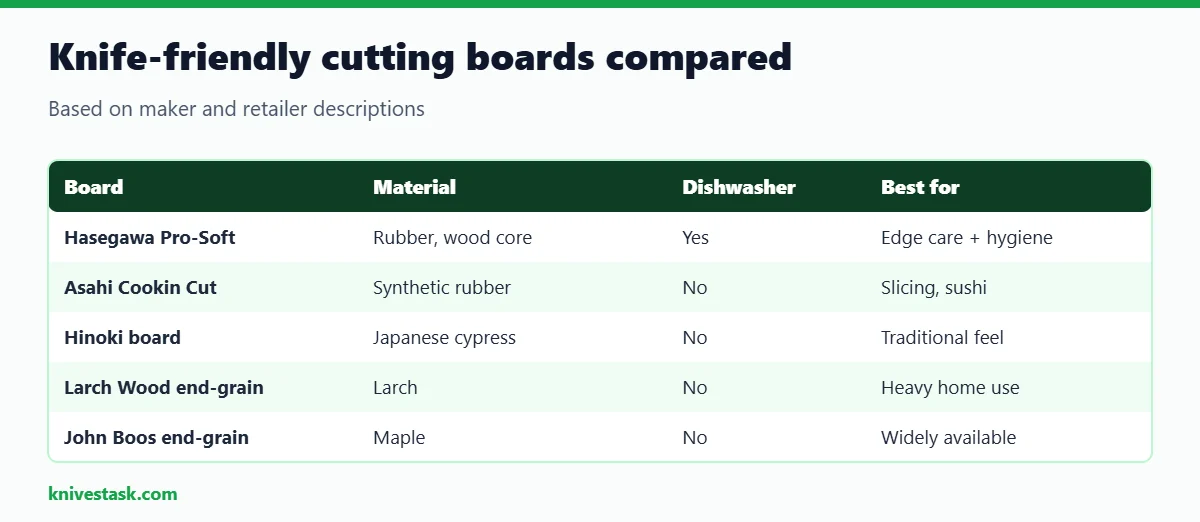
Quick Picks
- Best overall: Hasegawa Pro-Soft wood-core rubber board
- Best for sushi and slicing: Asahi Cookin’ Cut rubber board
- Best traditional Japanese wood: Hinoki cypress board
- Best premium end-grain: Larch Wood Canada end-grain board
- Best widely available end-grain: John Boos end-grain maple board
1. Hasegawa Pro-Soft Wood-Core Rubber Board
Best overall. Hasegawa boards have become a favourite of Japanese knife owners and professional kitchens. They combine a soft elastomer cutting surface with a sealed wood core. Cutlery and More’s Hasegawa listing explains that the wood core makes the boards 30 to 50% lighter than solid plastic boards, resists warping, and allows them to be cleaned in a dishwasher. The boards are made in Agawa, Kochi Prefecture, Japan.
MTC Kitchen, Hasegawa’s US distributor, says the wood core is sterilized and fully covered by thick rubber layers, and the boards are dishwasher-safe and bleach-safe. Retailers note a heat limit of about 90°C (194°F), and that the soft surface is not meant for serrated knives or heavy cleaver work.
Pros: extremely gentle on edges, dishwasher-safe, lightweight, hygienic.
Cons: expensive; can feel too soft for heavy-handed choppers; shows knife marks.
Check Hasegawa cutting boards on Amazon
2. Asahi Cookin’ Cut Rubber Board
Best for sushi and slicing. Asahi rubber boards are a common sight in Japanese restaurants and sushi bars. Sellers describe them as made in Japan from synthetic rubber, and some versions include wood powder so they feel closer to wood. They are especially good for slicing fish and delicate push cuts. Unlike Hasegawa boards, Cutlery and More notes that Asahi boards are not dishwasher-safe, so they are washed by hand.
Pros: very edge-friendly, non-porous and easy to sanitize, professional pedigree.
Cons: heavy for its size; not dishwasher-safe; can stain with beets or turmeric.
Check Asahi rubber boards on Amazon
3. Hinoki Cypress Board
Best traditional Japanese wood. Hinoki, or Japanese cypress, is the classic cutting board wood in Japan. It is soft enough to cushion the edge, light to handle, and has a pleasant natural scent. Japanese knife makers and retailers often recommend it for precise slicing. The trade-off is care: hinoki boards need to be wetted before use, dried thoroughly afterwards, and should never be soaked or put in a dishwasher.
Pros: gentle on edges, lightweight, traditional look and scent, affordable in smaller sizes.
Cons: softer wood scores easily; needs careful drying; can warp if neglected.
Check hinoki cutting boards on Amazon
4. Larch Wood End-Grain Board
Best premium end-grain. Larch Wood boards from Canada are a favourite of Knifewear, a well-known Japanese knife retailer, and are built in end-grain construction where the wood fibers stand upright like the bristles of a brush. Knife edges slip between the fibers rather than cutting across them, and the fibers close back up afterwards. Cutlery and More’s cutting board guide lists larch at roughly 830 to 1,000 lbf on the Janka hardness scale and describes it as balanced and durable, especially as end grain.
Pros: beautiful, durable, self-healing surface, great for heavy prep.
Cons: expensive and heavy; needs oiling; hand wash only.
Check Larch Wood boards on Amazon
5. John Boos End-Grain Maple Board
Best widely available end-grain. John Boos is one of the best-known American cutting board makers, and its end-grain maple boards are easy to find at many retailers. Maple is harder than hinoki or larch, but in end-grain form it is still kind to knife edges and very durable. It is a good choice if you use both Japanese and German knives and want one board that handles everything.
Pros: durable, widely available, works for all kinds of prep.
Cons: heavy; harder than hinoki; needs regular oiling.
Check John Boos end-grain boards on Amazon
Rubber vs Hinoki vs End-Grain Wood
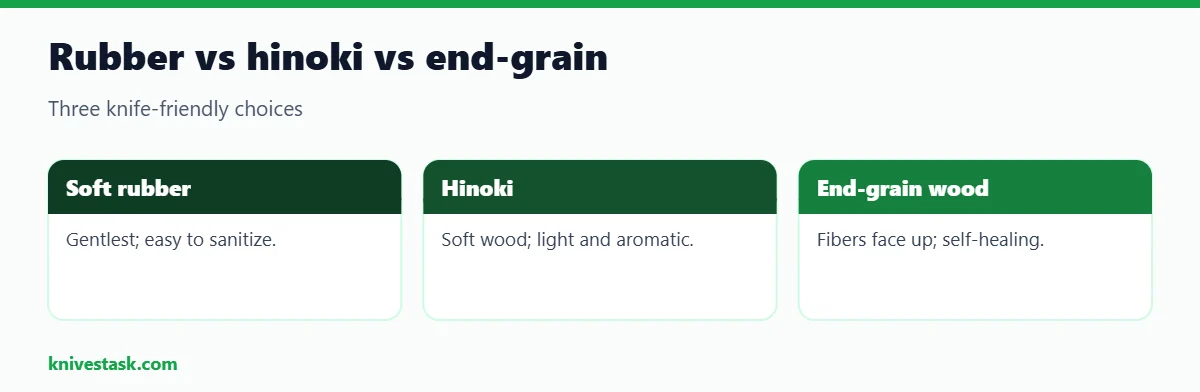
Soft rubber boards are the gentlest option for knife edges and the easiest to sanitize, which is why many professional kitchens use them. They tend to be the most expensive.
Hinoki offers a similar soft feel in natural wood, with a traditional look and scent. It needs more careful drying.
End-grain hardwood boards are durable, attractive and self-healing, and suit cooks who do a lot of heavy prep. They need oiling and hand washing.
Edge-grain wood boards (with fibers running lengthwise) are fine for everyday use, but they dull knives slightly faster and show cut marks more than end-grain boards made from the same wood.
Boards to Avoid
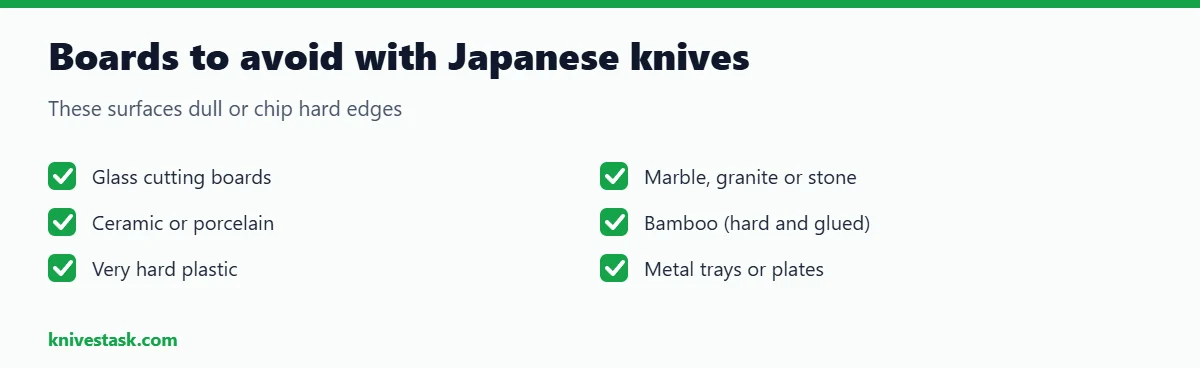
Hard surfaces are the fastest way to ruin a fine Japanese edge. Avoid glass, marble, granite, stone, ceramic and metal entirely; they can chip or roll an edge in a single cut. Bamboo boards look eco-friendly, but bamboo is hard and the boards are held together with glue, which is tough on thin edges. Very hard plastic boards are better than glass, but they still dull knives faster than soft rubber or good wood.
How to Choose the Right Board
Size
Choose a board big enough for your longest knife and the food you prep. A board around 18 by 12 inches suits most home cooks; larger boards help when breaking down vegetables or fish. Make sure it fits your sink if you plan to wash it by hand.
Thickness and weight
Thicker boards resist warping and feel more stable, but heavy boards are harder to lift and clean. Hasegawa’s wood-core design is a good compromise.
Cleaning
If you want dishwasher convenience, choose a Hasegawa board. Wood and Asahi rubber boards need hand washing.
How you cut
Push cuts, slicing and rocking cuts all work well on soft boards. If you chop hard, use a cleaver or break down bones, a durable end-grain board is a better choice, and our guide to different types of cleavers explains which blades suit heavy work.
Caring for Your Board
- Wood boards: wash with warm soapy water, dry upright, and oil with food-safe mineral oil or board cream every few weeks. See board oil.
- Hinoki: wet the surface before cutting so it absorbs fewer stains, and let it dry completely before storing.
- Rubber boards: resurface with a scraper or sandpaper when knife marks build up; this restores a smooth, grippy surface.
- All boards: use separate boards for raw meat and ready-to-eat foods, and never leave boards soaking in water.
Pair Your Board With the Right Knife Care
A good board slows dulling, but every knife eventually needs maintenance. A fine ceramic honing rod keeps the edge aligned between sharpenings, and a whetstone restores it when it gets dull. Store knives on a magnetic strip or in a block rather than loose in a drawer to protect the edge you have worked to keep.
Best Board by Budget
Under $50
A small hinoki board or a soft polyethylene board is the most affordable way to protect your edges. Hinoki boards in compact sizes are inexpensive and great for herbs, garlic and fruit. Soft, flexible plastic boards are not as gentle as rubber, but are far kinder than glass or bamboo. See small hinoki boards.
$50 to $150
This range covers medium Hasegawa boards, Asahi rubber boards and good edge-grain or smaller end-grain wood boards. For most home cooks with one or two Japanese knives, a medium Hasegawa or Asahi board is the sweet spot.
$150 and up
Large Hasegawa boards, big end-grain maple boards and Larch Wood boards fall here. They are an investment, but a good end-grain board can last decades with basic care.
Cutting Technique to Protect Your Edge
Even the best board cannot save an edge from poor technique. A few habits make a big difference:
- Do not scrape food with the edge. Flip the knife and use the spine to move chopped food across the board. Dragging the edge sideways rolls and dulls it quickly.
- Slice, do not hack. Japanese knives cut best with a forward or backward slicing motion. Hard, downward chopping into the board stresses the thin edge.
- Avoid bones and frozen food. Use a cleaver or a sturdier knife for bones and frozen items; thin Japanese blades can chip.
- Keep the board stable. Place a damp towel or non-slip mat underneath so the board does not slide while you cut.
- Clean as you go. Wipe the board between ingredients so grit and debris do not wear the edge.
Hygiene and Food Safety
Knife-friendly boards still need to be kept clean. Wood naturally draws moisture and bacteria down into its fibers, where they tend to die off as the board dries, but it must be dried thoroughly. Rubber and plastic boards are non-porous, which makes them easy to sanitize, especially in a dishwasher. Whatever you choose, clean boards right after cutting raw meat, fish or poultry, and consider color-coded or separate boards for raw proteins and vegetables. Replace any board with deep cracks or grooves that cannot be cleaned or resurfaced.
One Board or Several?
Many cooks get the most out of two boards: a large board for everyday prep and a smaller one for quick jobs, raw proteins or strongly coloured foods like beets. A popular combination is a Hasegawa or Asahi board for raw fish and meat, plus a hinoki or end-grain wood board for vegetables, bread and herbs. This spreads wear across two surfaces and keeps flavours and food safety in check. If you are building a Japanese knife kit from scratch, our guide to the best Japanese kitchen knives pairs well with any of these boards.
Signs It Is Time to Replace or Resurface
Cutting boards do not last forever. Watch for these signs:
- Deep grooves: knife marks that trap food and moisture. Wood and rubber boards can usually be sanded or scraped smooth again.
- Warping: a board that rocks on the counter is unsafe to cut on. Flip it, or replace it if it will not sit flat.
- Cracks or splits: wood boards that crack along a glue line or grain should be retired.
- Persistent odor or stains: if scrubbing with salt and lemon or a bleach solution (for rubber boards) does not help, it is time for a new board.
Resurfacing a rubber or wood board every year or two keeps the surface smooth and grippy, and helps your knives glide instead of catching in old cuts. If you notice rust spots on your knives after cutting acidic foods on a wet board, our guide on getting rust off kitchen knives will help.
Frequently Asked Questions
What cutting board do Japanese chefs use?
Many professional Japanese kitchens use soft synthetic boards such as Hasegawa or Asahi for hygiene and edge care, while traditional cooks and home kitchens often use hinoki wood.
Is bamboo bad for Japanese knives?
Bamboo is hard and glued together, so it dulls and can chip thin edges faster than soft wood or rubber. It is best avoided for good Japanese knives.
Is end-grain better than edge-grain?
For knife edges, generally yes. End-grain fibers part around the blade, while edge-grain fibers are cut across, which dulls knives a little faster.
Can Hasegawa boards go in the dishwasher?
Yes. Hasegawa’s wood-core boards are listed as dishwasher-safe and bleach-safe, with a heat limit of around 90°C.
Which board is best for a santoku or nakiri?
Any of the boards in this guide work well. Soft rubber and hinoki are especially kind to thin vegetable knives like those in our guides to the best santoku knives and best nakiri knives.
Final Verdict
For most owners of Japanese knives, a Hasegawa Pro-Soft board is the best all-round choice: gentle on edges, lightweight and dishwasher-safe. Choose Asahi rubber for sushi-style slicing, hinoki for a traditional wooden board, Larch Wood for a premium end-grain centrepiece, and John Boos end-grain maple for a durable, widely available option. Whatever you pick, steer clear of glass, stone and bamboo, and your knives will stay sharper for longer.
Browse cutting boards for Japanese knives on Amazon