Quick Summary
- Best overall: Enso HD 8-inch chef’s knife, a VG-10 Damascus knife made in Seki by Yaxell.
- Best traditional gyuto: Yoshihiro VG-10 hammered Damascus gyuto with a wooden saya.
- Best value: Yaxell Mon 8-inch chef’s knife, a simple, practical Seki-made blade.
- Best starter set: Shun Sora 5-piece student set, an affordable way into Shun.
- Key point: many “Japanese” knives online only use Japanese-style designs; check where they’re made.
Knives Task is reader-supported: if you buy through a link on this page, we may earn a small Amazon commission at no extra cost to you. That never changes which knives we recommend.
The best Japanese kitchen knives combine thin blades, hard steel and very sharp edges. Japanese kitchen knives are famous for thin blades, hard steel and very sharp edges. They make slicing vegetables, fish and boneless meat feel effortless.
The word “Japanese” is also one of the most overused terms in online knife listings. Many knives sold as Japanese are made elsewhere with Japanese-style shapes or marketing. Every pick in our list of the best Japanese kitchen knives is made in Japan.
Every knife on this list is made in Japan by an established maker. We’ve also explained the main shapes and steels so you can choose with confidence.
Table of Contents
Our Picks at a Glance
| Knife | Steel | Best for |
|---|---|---|
| Enso HD 8″ Chef’s Knife | VG-10, hammered Damascus | Best overall |
| Yoshihiro VG-10 Damascus Gyuto | VG-10, 46-layer Damascus | Traditional style |
| Yaxell Mon 8″ Chef’s Knife | Japanese stainless | Best value |
| Enso SG2 Chef’s Knife | SG2 powder steel | Edge retention |
| Yaxell Ran Plus 8″ Chef’s Knife | Damascus-clad | A premium gift |
| Shun Sora 5-Piece Student Set | VG-10 cutting core | Starter set |
How we chose: we haven’t lab-tested these knives side by side. We compared blade length and shape, steel, construction (forged or stamped), handle design and the makers’ published specifications, and we favored models with a long track record and consistent owner feedback over newer, unproven listings.
Specifications come from the manufacturers’ listings. Prices change often, so check the current price before buying.
What Makes Japanese Knives Different
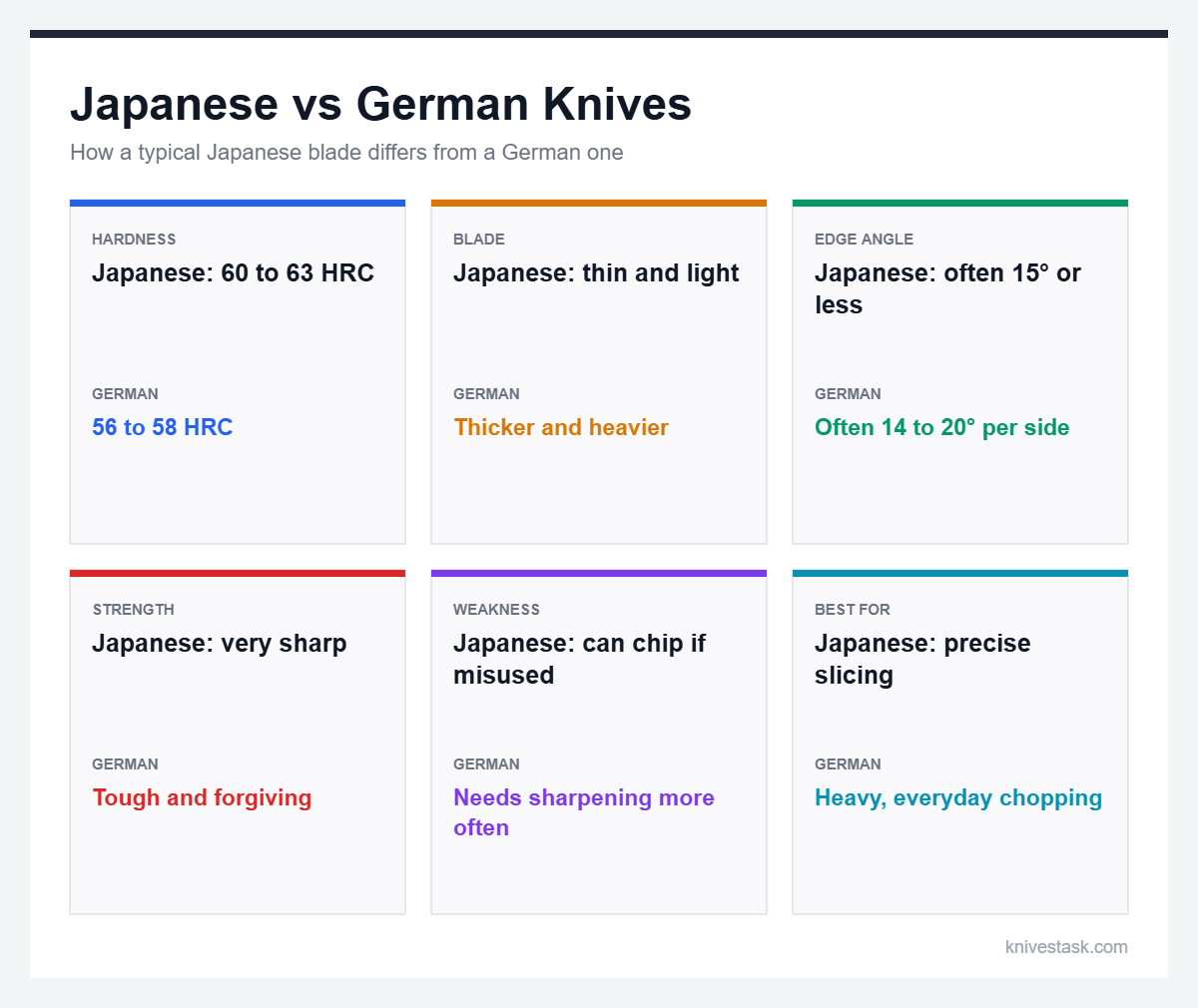
Compared with German knives, Japanese knives usually have harder steel, thinner blades and more acute edges. That makes them sharper and lighter, but less forgiving of twisting, bones or frozen food. For a wider overview of styles and construction, see Japanese kitchen knife on Wikipedia.
| Feature | Japanese knives | German knives |
|---|---|---|
| Typical hardness | 60 to 63 HRC | 56 to 58 HRC |
| Blade | Thin and light | Thicker and heavier |
| Edge angle | Often 15 degrees or less per side | Often 14 to 20 degrees per side |
| Strength | Very sharp, holds an edge | Tough, forgiving |
| Weakness | Can chip if misused | Needs sharpening more often |
For a deeper comparison, read whether Japanese or German knives are better.
The Best Japanese Kitchen Knives
1. Enso HD 8-Inch Chef’s Knife — Best Overall
Best for: home cooks who want a genuine Japanese chef’s knife without a premium price.
Enso knives are made in Seki, Japan, by Yaxell, a long-established Seki knife maker. The HD line has a VG-10 steel core clad in hammered Damascus, with a Western-style handle.
The hammered finish helps food release from the blade, and the Western handle feels familiar if you’re coming from German knives. The 8-inch length suits most kitchens.
It’s a good first Japanese knife, sharp enough to impress and sturdy enough for everyday cooking.
What we like:
- Made in Seki, Japan
- VG-10 core
- Familiar Western handle
What to consider:
- Hard edge needs care around bones
- Hand wash only
Check the current price of the Enso HD 8-inch chef’s knife on Amazon →
2. Yoshihiro VG-10 Hammered Damascus Gyuto — Best Traditional Style
Best for: cooks who want a Japanese-handled gyuto with a protective saya.
A gyuto is the Japanese equivalent of a chef’s knife. This Yoshihiro has a VG-10 core in 46-layer hammered Damascus, a double-bevel edge and an ambrosia wood handle, according to its listing.
It’s rated around 60 HRC and comes with a saya, a wooden blade cover. The Japanese-style handle is light, which moves the balance toward the blade.
If you like a nimble, blade-forward feel, a traditional gyuto is a joy to use.
What we like:
- Traditional Japanese handle
- Saya included
- Hard, keen edge
What to consider:
- Wooden handle needs drying
- Lighter handle feels different from Western knives
Check the current price of the Yoshihiro VG-10 Damascus gyuto on Amazon →
3. Yaxell Mon 8-Inch Chef’s Knife — Best Value
Best for: cooks who want a practical, made-in-Japan chef’s knife without decorative extras.
Mon is one of Yaxell’s simpler lines, with a clean satin finish rather than a Damascus pattern. It’s made in Japan, and it puts the money into the blade rather than the look.
Plain finishes are also easier to sharpen and keep looking good, because there’s no pattern to scratch. Check the listing for the current steel details.
It’s a sensible choice if you want Japanese performance on a modest budget.
What we like:
- Made in Japan
- Simple, practical design
- Easy to maintain
What to consider:
- Plainer look than Damascus knives
- Fewer size options
Check the current price of the Yaxell Mon 8-inch chef’s knife on Amazon →
4. Enso SG2 Chef’s Knife — Best Edge Retention
Best for: experienced cooks who want an edge that lasts a long time between sharpenings.
SG2 is a powder metallurgy stainless steel, also called R2, that can be hardened to a high level while staying fine-grained. That gives excellent edge retention.
Enso’s SG2 knife is Damascus-clad and made in Japan, according to the listing. It costs more than the HD, but you’ll sharpen it less often.
Powder steels take a little more effort to sharpen, so a good whetstone is worth having.
What we like:
- Outstanding edge retention
- Made in Japan
- Attractive Damascus cladding
What to consider:
- Higher price
- Harder to sharpen
Check the current price of the Enso SG2 chef’s knife on Amazon →
5. Yaxell Ran Plus 8-Inch Chef’s Knife — Best Premium Gift
Best for: gifts and cooks who want a beautiful Damascus knife from a respected Seki maker.
Ran Plus is one of Yaxell’s Damascus lines, with a striking layered pattern and a durable synthetic handle. It’s made in Japan, according to the listing.
It’s a knife you’ll enjoy looking at as well as using. Like all hard Japanese blades, it rewards careful cutting on a good board.
For a gift, it has the quality and story of a genuine Seki-made knife.
What we like:
- Beautiful Damascus pattern
- Made in Japan
- Durable handle
What to consider:
- Premium price
- Pattern can show scratches
Check the current price of the Yaxell Ran Plus 8-inch chef’s knife on Amazon →
6. Shun Sora 5-Piece Student Set — Best Starter Set
Best for: students and new cooks who want an affordable Japanese set from a well-known maker.
Shun is made in Seki by the KAI Group. The Sora line is its most affordable range, pairing a VG-10 cutting edge with a lighter stainless upper blade to keep the price down.
The student set gathers core knives in one package. Check the listing for the exact contents before buying.
It’s a sensible way to try Japanese knives without spending a lot on a single premium blade.
What we like:
- Made in Japan by a major maker
- Affordable Shun line
- Good starter kit
What to consider:
- Lighter construction than Shun’s premium lines
- Contents vary between versions
Check the current price of the Shun Sora 5-piece student set on Amazon →
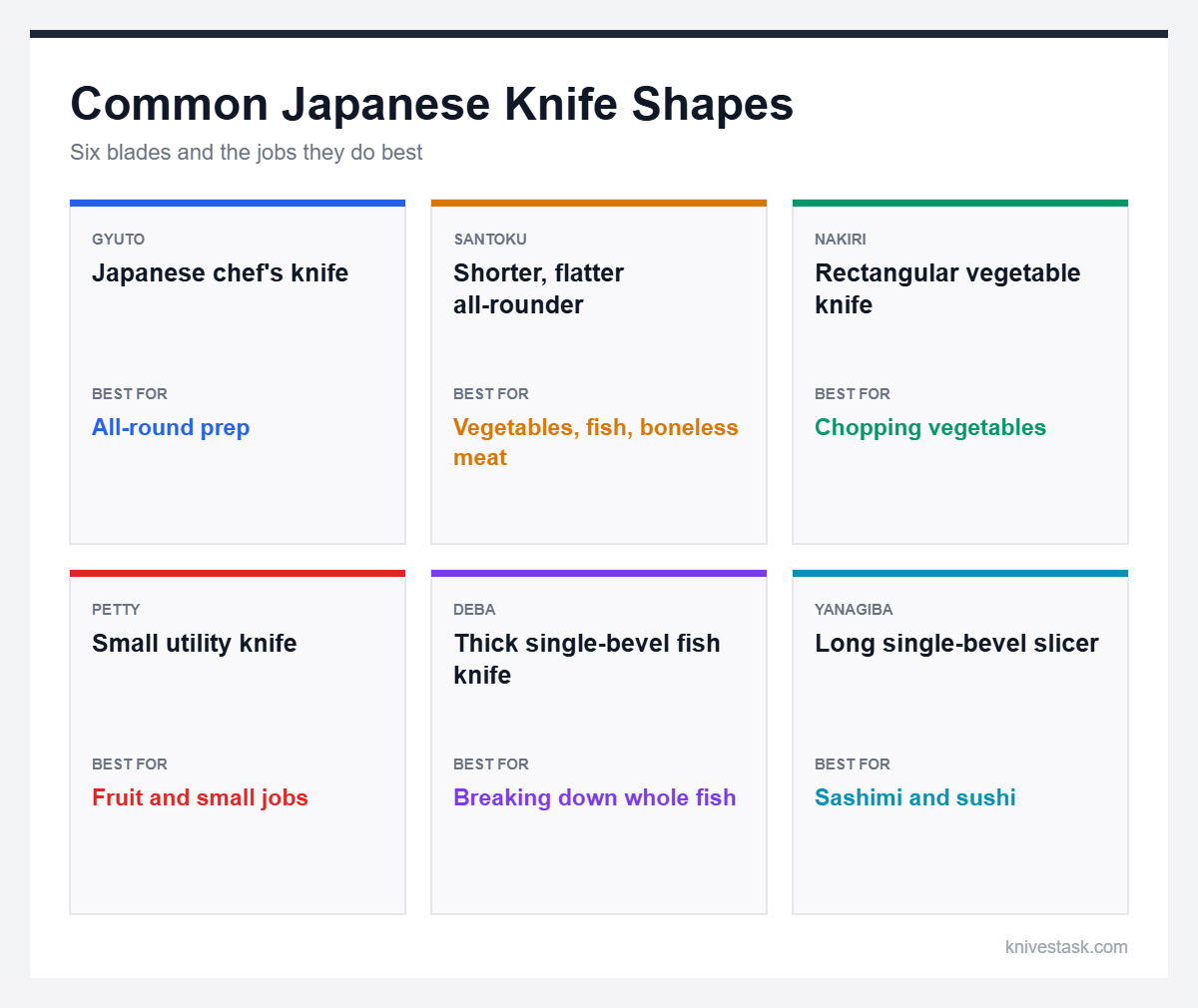
Common Japanese Knife Shapes
| Shape | What it is | Best for |
|---|---|---|
| Gyuto | Japanese chef’s knife | All-round prep, meat and vegetables |
| Santoku | Shorter, flatter all-purpose knife | Vegetables, fish and boneless meat |
| Nakiri | Rectangular vegetable knife | Chopping vegetables |
| Petty | Small utility knife | Fruit, trimming, small jobs |
| Deba | Thick, single-bevel fish knife | Breaking down whole fish |
| Yanagiba | Long, single-bevel slicer | Sashimi and sushi |
Most home cooks start with a gyuto or santoku. Read what a santoku knife is used for if you’re deciding between them. Most of the best Japanese kitchen knives for beginners are a gyuto or a santoku.
Japanese Steels Explained
- VG-10: a popular stainless steel with good edge retention and rust resistance.
- SG2 (R2): a powder steel that can be very hard and holds an edge for a long time.
- AUS-10: a tough stainless steel common in mid-priced knives.
- Shirogami and Aogami: carbon steels that take extremely sharp edges but rust if not dried.
Damascus cladding is the layered, patterned steel around the core. It looks beautiful and adds some toughness, but the core steel does the cutting. For background on the most common steel, see VG-10.
Harder steels hold an edge longer but are more brittle, which is why Japanese knives can chip if they hit bone or a hard board. Softer steels bend rather than chip, which makes them more forgiving.
Japan’s Knife-Making Centers
Most Japanese kitchen knives come from a handful of regions, each with its own traditions. Knowing them helps you understand where a knife comes from. Seki, often called the home of modern Japanese kitchen cutlery, is a good example; see Seki, Gifu on Wikipedia. Many of the best Japanese kitchen knives come from these towns.
| Region | Known for |
|---|---|
| Seki, Gifu | Large-scale production by makers such as Shun, Yaxell and Enso |
| Sakai, Osaka | Traditional single-bevel knives, including sushi and sashimi knives |
| Echizen, Fukui | Hand-forged knives and the Takefu Knife Village workshop |
| Sanjo, Niigata | Blacksmith-made kitchen and outdoor knives |
| Tosa, Kochi | Rustic, hand-forged blades with a long blacksmithing history |
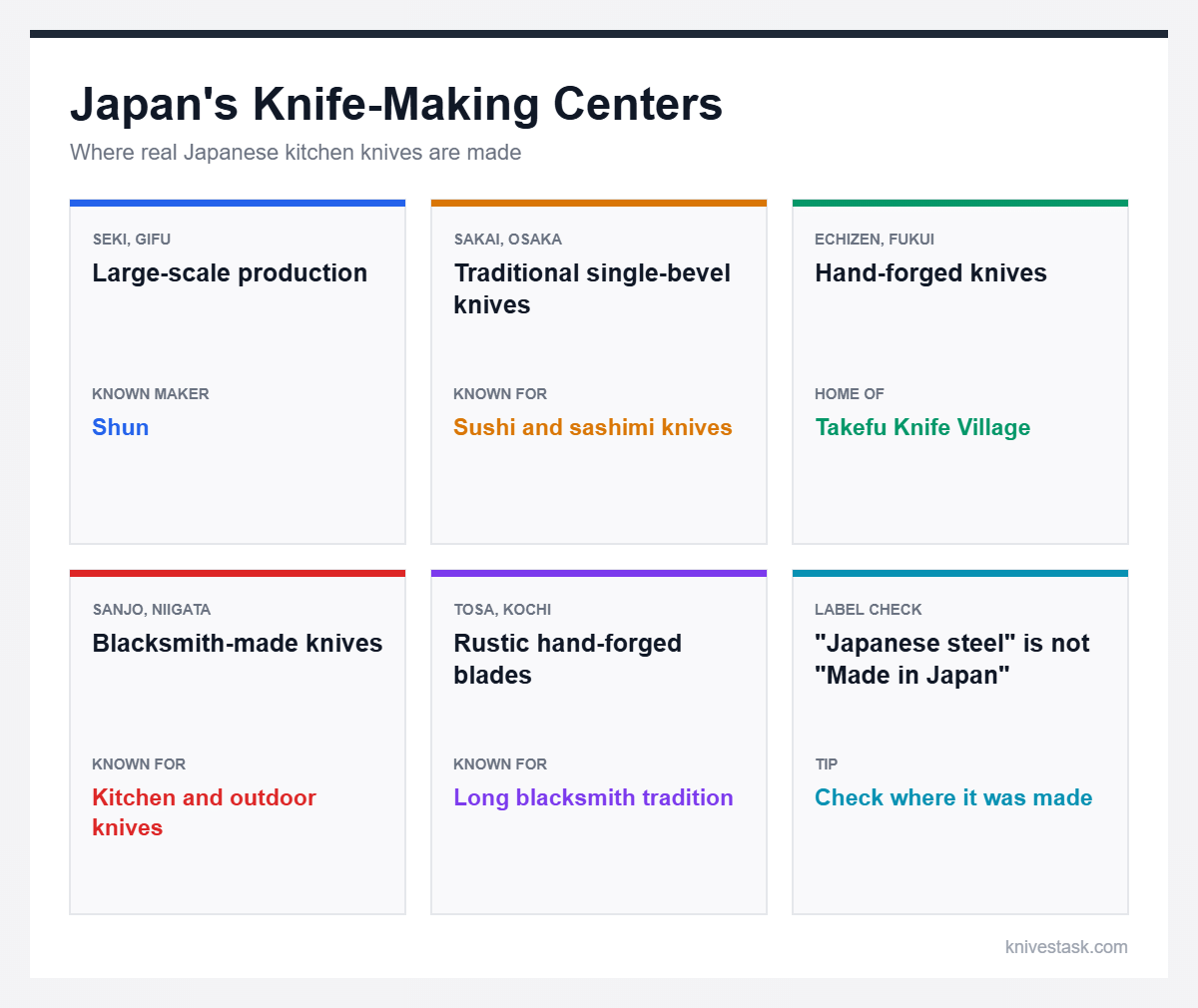
Knives from Sakai, Echizen and Tosa are often made by small workshops and cost more. Seki makers combine traditional methods with modern factories, which keeps prices more accessible.
How to Use a Japanese Knife
Japanese knives cut best with smooth push or pull strokes rather than hard chopping. Let the sharp edge glide through food instead of forcing it down. Using the right technique helps the best Japanese kitchen knives keep their fine edge.
A gyuto has a flatter profile than many German chef’s knives, so it suits slicing and push cutting more than heavy rocking. Keep twisting motions to a minimum, especially in hard vegetables like squash.
How to Spot a Genuine Japanese Knife
- Check the country of manufacture: reputable makers state it clearly.
- Look for a known maker: Shun, Yaxell, Enso, Global, Tojiro, MAC and Miyabi all make knives in Japan.
- Be wary of laser-etched patterns: some “Damascus” knives are printed, not layered.
- Ignore hype: claims like “never needs sharpening” or “hand forged for 100 days” are marketing.
Caring for Japanese Knives
- Hand wash and dry immediately: never use the dishwasher.
- Use a wood or soft plastic board: glass and stone chip hard edges.
- Avoid bones and frozen food: use a cleaver or a tougher German knife instead.
- Sharpen on whetstones: pull-through sharpeners can damage thin, hard edges.
- Store safely: use a block, magnetic strip or saya.
Our guide on sharpening with a whetstone walks through the process.
What to Spend on a Japanese Knife
You don’t need a premium knife to enjoy Japanese performance. A well-made VG-10 chef’s knife from a Seki maker is a big step up from most budget knives. Some of the best Japanese kitchen knives sit in the middle of the price range.
Spend more if you want harder powder steels like SG2, hand-finished blades or a knife from a small workshop. For most home cooks, a mid-priced gyuto or santoku is the sweet spot.
Remember to budget for a whetstone, too. A sharp Japanese knife only stays special if you keep its edge in good shape.
Western or Japanese Handle?
Western handles are heavier and shaped like German knife handles, which many cooks find familiar. Japanese wa handles are lighter and often octagonal or D-shaped, putting more weight in the blade. Both handle styles appear among the best Japanese kitchen knives.
Neither is better; it’s personal preference. If you’re unsure, a Western handle like the Enso HD is an easy transition from German knives.
Frequently Asked Questions
What is the best Japanese kitchen knife?
Of the best Japanese kitchen knives in this guide, the answer depends on your budget. For most home cooks, an 8-inch gyuto or chef’s knife from a Japanese maker such as Enso, Yaxell or Shun.
Are Japanese knives better than German knives?
They’re sharper and lighter but less forgiving. German knives are tougher and easier to maintain.
What is the best Japanese steel for kitchen knives?
VG-10 is a great all-rounder. SG2 holds an edge longer, and carbon steels take the sharpest edges but need more care.
Are knives labeled Japanese always made in Japan?
No. Many use Japanese-style designs or Japanese steel but are made elsewhere, so check the listing.
Can Japanese knives go in the dishwasher?
No. Hand wash and dry them straight away to protect the edge and handle.
What Japanese knife should I buy first?
A gyuto or santoku of about 7 to 8 inches covers most kitchen tasks.