
Shun and Miyabi are the two Japanese knife brands most home cooks end up choosing between. Both are made in Seki, Japan; both offer Damascus-clad blades with hard VG-MAX, VG10 or SG2 cores; and both cost about the same at each tier. The differences are in ownership, edge angle, handle shape, weight and feel. This Shun vs Miyabi comparison breaks down steel, hardness, edge geometry, handles, warranty and price, with three head-to-head matchups so you can pick the right knife for the way you cook.
Quick Verdict
- Made in: both in Seki, Japan — Shun by KAI Group, Miyabi by Germany’s Zwilling J.A. Henckels.
- Edge: Miyabi is hand-honed to 9.5–12° per side (Honbazuke); Shun uses 16°.
- Feel: Shun is light and blade-forward; Miyabi often feels more substantial with Western-style balance.
- Steels: Shun leans on VG-MAX; Miyabi offers FC61, VG10, SG2 and MC66.
- Choose: Shun for agility, a slightly tougher edge and the widest range of shapes; Miyabi for maximum sharpness and premium powder steels.
Knives Task is reader-supported: if you buy through a link on this page, we may earn a small Amazon commission at no extra cost to you. That never changes which knives we recommend.
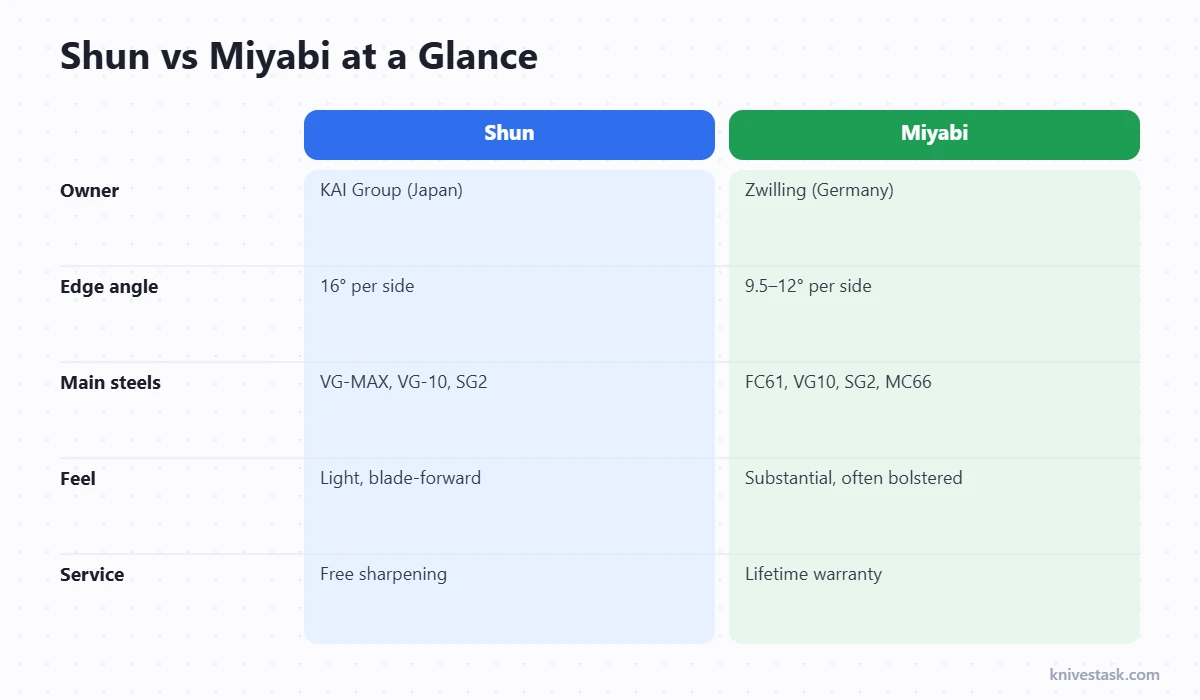
Shun vs Miyabi at a Glance
| Feature | Shun | Miyabi |
|---|---|---|
| Owner | KAI Group (Japan) | Zwilling J.A. Henckels (Germany) |
| Made in | Seki, Japan | Seki, Japan |
| Edge angle per side | 16° | 9.5–12° |
| Sharpening method | Machine and hand finished | Three-step Honbazuke |
| Typical steels | VG-MAX, VG-10, AUS10A, SG2 | FC61, VG10, SG2, MC66 |
| Typical hardness | 60–61 HRC (Hiro ~64) | 60–63 HRC (Black ~66) |
| Hardening | Conventional heat treatment | Ice-hardened (CRYODUR / FRIODUR) |
| Handles | D-shaped and round PakkaWood, polymer, tagayasan | Micarta D-shape, Karelian birch, POM, pakkawood |
| Bolster | Usually none | Many lines have one |
| Warranty | Limited lifetime + free sharpening | Limited lifetime (Zwilling) |
Both brands sell many lines, so treat these as general patterns and always check the individual knife.
Ownership and Manufacturing
Shun is KAI Group’s premium brand; KAI has made blades in Seki for more than a century. Miyabi belongs to Zwilling, the Solingen company behind Zwilling and Henckels, which builds Miyabi knives at its own Seki factory. So although one brand has German owners, both are genuinely made in Japan. Zwilling applies its ice-hardening process to Miyabi blades for extra hardness, flexibility and corrosion resistance.
Edge, Steel and Sharpness
Miyabi’s defining feature is its edge: hand-honed to 9.5–12° per side through grinding, honing and leather-strop polishing (the Honbazuke method). That’s extremely acute, so Miyabi knives often feel sharper out of the box. Shun’s 16° edge is still far finer than most German knives (14–20°) and a little more robust, which makes it slightly more forgiving.
On steel, Shun’s workhorse VG-MAX is an enhanced VG-10 with extra tungsten, cobalt and vanadium. Miyabi spans FC61 fine-carbide steel in Koh and Evolution, VG10 in Kaizen, SG2 micro-carbide powder steel in Artisan, Mizu and Birchwood, and MC66 in Black. Harder powder steels like SG2 hold an edge far longer but are more brittle and slower to sharpen.
Equivalent Lines Side by Side
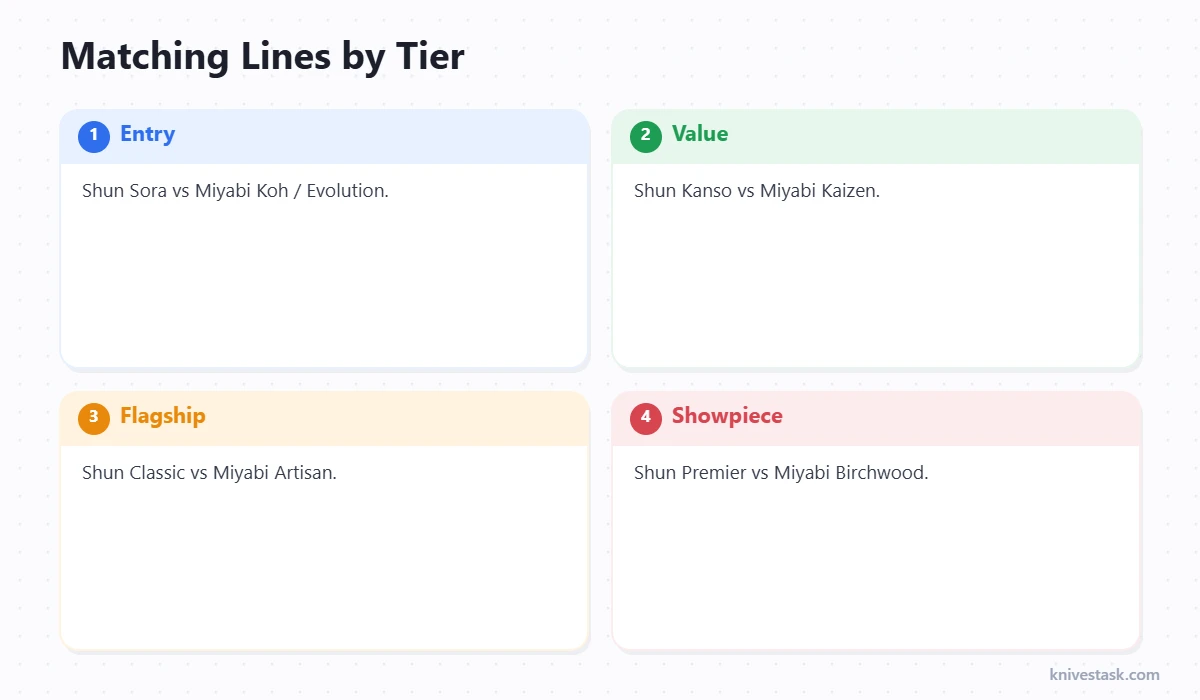
| Tier | Shun line (steel) | Miyabi line (steel) |
|---|---|---|
| Entry | Sora (VG-10 edge) | Koh / Evolution (FC61) |
| Value | Kanso (AUS10A) | Kaizen / Kaizen II (VG10 / FC61) |
| Flagship | Classic (VG-MAX) | Artisan (SG2) |
| Showpiece | Premier (VG-MAX, hammered) | Birchwood (SG2, 101 layers) |
| Enthusiast | Dual Core (VG10/VG2), Hiro (SG2) | Black (MC66) |
| Western handle | — | Fusion Morimoto (VG10) |
Handles, Weight and Balance
Shun’s best-known Classic handle is D-shaped for a right-handed pinch grip; Premier and Sora handles are rounder and suit either hand. Shun handles are light and there’s usually no bolster, so the knife feels blade-forward and agile — great for fast vegetable prep.
Miyabi uses more handle shapes and materials, from Micarta D-handles to Karelian birch, cocobolo pakkawood and triple-riveted POM. Many lines include a bolster, giving a more Western, balanced feel that cooks coming from Wüsthof or Zwilling often find reassuring.
Matchup 1: Mid-Range Chef’s Knives
| Shun Classic 8″ | Miyabi Kaizen 8″ | |
|---|---|---|
| Core steel | VG-MAX | VG10 |
| Cladding | 68-layer Damascus | 65-layer flower Damascus |
| Handle | D-shaped ebony PakkaWood | D-shaped black Micarta |
| Edge | 16° | 9.5–12° |
| Feel | Light, agile | More substantial, bolstered |
The Shun Classic is lighter and nimbler, with Shun’s widest range of matching shapes. The Kaizen has a keener edge and a bolster that some cooks find more stable for rocking cuts.
Matchup 2: Premium Chef’s Knives
The Shun Hiro SG2 8-inch chef’s knife uses an SG2 core at around 64 HRC with a dramatic hammered Damascus finish — one of Shun’s most premium knives, prized for edge retention. The Miyabi Fusion Morimoto Edition 8-inch chef’s knife blends a VG10 Damascus blade with a triple-riveted Western handle, usually for less money. Choose Hiro for edge life and looks, Fusion Morimoto for Japanese sharpness with a familiar grip. Neither is for bones or frozen food.
Matchup 3: Nakiri Knives
The Shun Premier 5.5-inch nakiri has a VG-MAX core, hammered tsuchime finish and walnut PakkaWood handle. The Miyabi Birchwood nakiri has a 101-layer SG2 blade and Karelian birch handle. SG2 is harder and holds its edge longer, while the Shun is usually less expensive. See our best nakiri knives for more options.
Warranty, Sharpening Service and Price
Shun offers a limited lifetime warranty plus a free sharpening service (you pay shipping). Miyabi is covered by Zwilling’s limited lifetime warranty against manufacturing defects. Neither covers chips from misuse. At matching tiers, prices are very similar; Shun usually offers more shapes within one line, which helps if you want to build a matching set over time.
Which Brand Should You Choose?
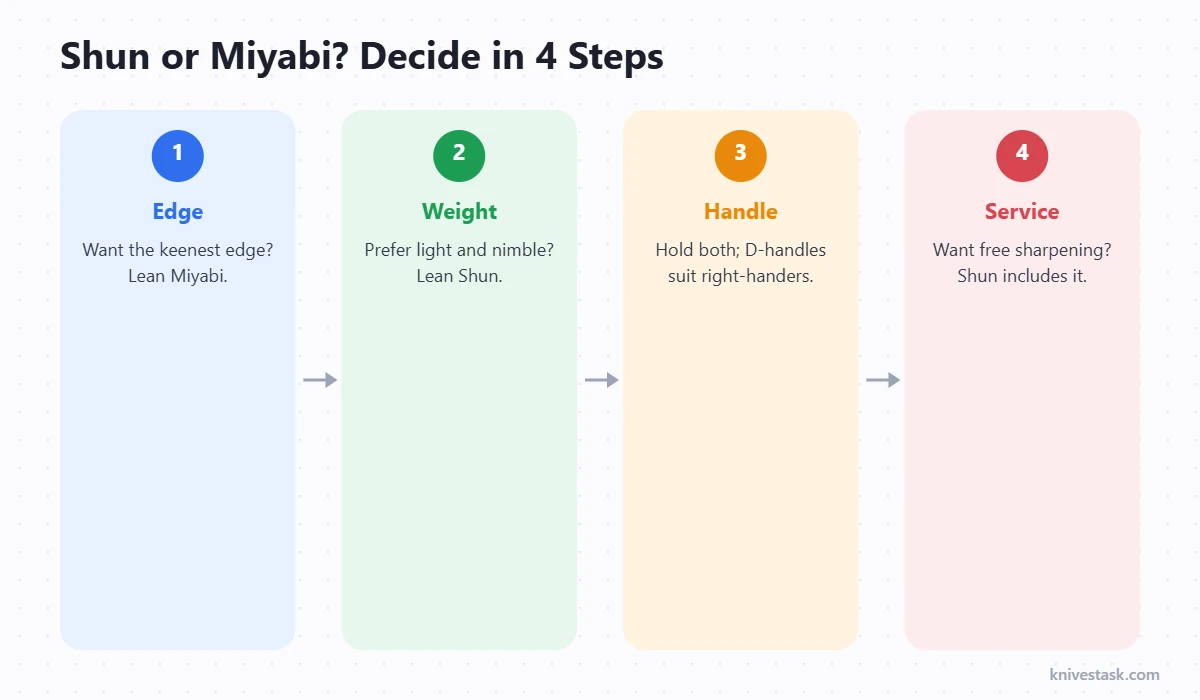
- Choose Shun if you want a light, nimble knife, a slightly tougher 16° edge, free factory sharpening and the widest choice of shapes.
- Choose Miyabi if you want the sharpest possible edge, premium SG2 or MC66 steel, and a more substantial, Western-influenced feel.
- Hold both if you can: handle shape decides comfort more than any spec sheet.
- Left-handed? Avoid D-shaped handles unless a left-handed version is offered.
For deeper dives, read our Shun knives review and Miyabi knives review. Comparing Japanese and German? See Shun vs Wüsthof.
Sharpening and Care for Both Brands
- Keep each at its factory angle — about 16° for Shun, 9.5–12° for Miyabi.
- Use 1000 and 3000–6000 grit whetstones; avoid pull-through sharpeners.
- Hone gently on a ceramic rod, not a coarse steel.
- Hand wash and dry immediately; never use a dishwasher.
- Use end-grain wood or soft plastic boards.
Our guide on how to sharpen Shun knives explains the whetstone technique, which works for Miyabi too.
Frequently Asked Questions
Is Miyabi better than Shun?
Neither is better overall. Miyabi has a keener edge and harder premium steels; Shun is lighter, slightly more forgiving and offers free sharpening.
Are Miyabi knives made in Japan?
Yes. Miyabi is owned by Germany’s Zwilling, but its knives are made in Seki, Japan.
What angle are Shun and Miyabi knives sharpened to?
Shun uses 16° per side; Miyabi uses 9.5–12° per side.
Which is better for beginners?
Shun’s slightly more robust edge and light feel are a little more forgiving, but both work well with careful use.
Which is sharper out of the box?
Usually Miyabi, thanks to its more acute Honbazuke edge.
Do Shun and Miyabi knives chip?
Any hard Japanese knife can chip if misused. Avoid bones, frozen food, twisting and hard boards.