Quick Summary
- What it is: a Japanese all-purpose kitchen knife, usually 5 to 7 inches long.
- Best for: slicing, dicing and mincing vegetables, boneless meat and fish.
- Avoid: bones, frozen food and very hard squash.
- Vs chef’s knife: shorter, flatter and lighter, suited to up-and-down chopping rather than rocking.
- Care: hand wash, dry promptly and hone regularly.
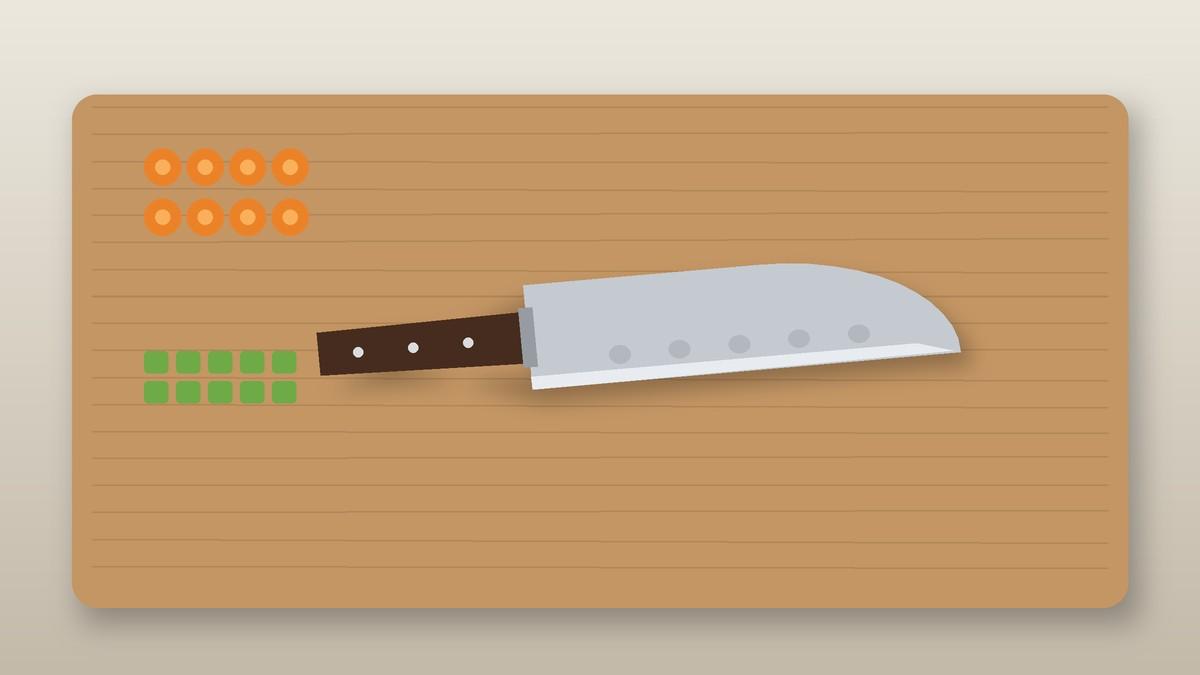
A santoku is a Japanese all-purpose kitchen knife with a flat edge and a rounded “sheepsfoot” tip. It became popular in Japanese homes in the mid-20th century and is now common worldwide.
The name is often translated as “three virtues”. That’s usually explained as slicing, dicing and mincing, or as handling meat, fish and vegetables.
What a Santoku Is Used For
| Task | Good fit? | Notes |
|---|---|---|
| Chopping vegetables | Excellent | Flat edge meets the board fully |
| Dicing onions | Excellent | Easy, controlled vertical cuts |
| Mincing herbs and garlic | Very good | Use a quick up-and-down motion |
| Slicing boneless meat | Very good | Long, smooth strokes |
| Slicing fish | Good | Use a sharp edge and single strokes |
| Carving large roasts | Fair | A longer carving knife is easier |
| Cutting through bones | No | Use a cleaver or boning knife |
| Frozen food | No | Can chip or bend the edge |
Vegetables
Vegetable prep is where the santoku shines. Its flat edge and tall blade make neat slices of carrots, peppers, cucumbers and cabbage, and the blade doubles as a scoop.
Meat and Fish
A santoku slices boneless chicken, beef and pork cleanly, and it handles fish fillets well. Use long, smooth strokes rather than sawing.
Our older version of this article said a santoku is ideal for carving meat with a sawing motion. Sawing tears meat fibers, and a santoku’s short blade struggles with large roasts, so use a carving knife for those.
Herbs and Aromatics
For herbs, gather them into a tight pile and chop with quick vertical strokes. For garlic, crush the clove with the flat of the blade, then mince.
Example: Dicing an Onion With a Santoku
Halve the onion through the root and peel it. Lay one half flat, then make vertical cuts toward the root without cutting through it, so the layers stay together.
Make one or two horizontal cuts parallel to the board, again stopping short of the root. Finally, slice across the cuts to produce even dice.
The santoku’s flat edge and controlled push cut make this quick and tidy. The tall blade then carries the diced onion straight to the pan.
Example: Slicing Chicken Breast
Chill the chicken briefly so it firms up and slices more cleanly. Use one long, smooth stroke per slice from the heel toward the tip.
Wash the knife and board straight after cutting raw poultry to avoid cross-contamination.
Common Santoku Mistakes
Rocking the knife like a chef’s knife is the most common mistake. The flat edge lifts off the board, leaving pieces joined together.
Scraping food across the board with the edge dulls the blade quickly. Turn the knife over and use the spine instead.
Twisting the blade in hard vegetables like squash can chip a thin Japanese edge. Cut straight down and lift straight up.
Finally, leaving a santoku wet in the sink can cause spots and loosen wooden handles. Wash and dry it as soon as you finish.
Is a Santoku Good for Left-Handed Cooks?
Most santoku knives sold in the West have a double-bevel edge, so they work equally well in either hand. Traditional single-bevel santokus exist, so check the listing if you’re left-handed.
Santoku vs Chef’s Knife
| Feature | Santoku | Chef’s knife |
|---|---|---|
| Length | Usually 5–7 in | Usually 8–10 in |
| Edge | Flatter | Curved belly |
| Tip | Rounded, lowered | Pointed |
| Weight | Lighter | Heavier |
| Main motion | Push cut, chop | Rock and slice |
A chef’s knife is more versatile for large items and rocking cuts. A santoku is lighter and easier to control, which many home cooks prefer.
Neither is better overall; it depends on how you like to cut. See santoku vs gyuto for the Japanese chef’s knife comparison.
Santoku vs Nakiri
Our older article said a santoku is “also known as” a nakiri or bunka. That’s incorrect; they’re different knives.
| Knife | Shape | Main use |
|---|---|---|
| Santoku | Rounded tip, mostly flat edge | All-purpose |
| Nakiri | Rectangular, completely flat edge | Vegetables only |
| Bunka | Angled “reverse tanto” tip | All-purpose, with a sharper tip |
Read nakiri vs santoku for more detail.
Granton (Hollow) Edges
Many santoku knives have scallops along the blade, called a granton or hollow edge. They create small air pockets that help potatoes, cheese and cucumbers release from the blade.
They don’t affect sharpness, and they’re a matter of preference. Some cooks notice a clear difference, while others don’t.
How to Cut With a Santoku
- Use a pinch grip: hold the blade between thumb and forefinger just in front of the handle.
- Push cut: slide the knife forward and down in one motion.
- Chop: lift and drop the blade straight down for herbs.
- Guide with a claw hand: tuck your fingertips behind your knuckles.
- Scoop: turn the blade over and use the spine to move food, protecting the edge.
Because the edge is flat, a santoku doesn’t rock as easily as a chef’s knife. Lifting the whole knife for each cut works best.
What Size Santoku Should You Buy?
A 7-inch santoku suits most home cooks and handles nearly every task. A 5 to 5.5-inch santoku is easier for small hands, small boards and quick jobs.
Many cooks end up with both: a 7-inch knife for main prep and a smaller one for fruit, cheese and quick snacks.
Blade Materials
Most santoku knives use stainless steel, which resists rust and is easy to care for. Japanese steels like VG-10 are harder and hold a finer edge, while German steels are tougher and more forgiving.
Carbon steel takes an excellent edge but must be dried promptly to prevent rust. Ceramic blades stay sharp for a long time but can chip or snap if dropped or twisted.
Caring for a Santoku
- Hand wash and dry right after use; avoid the dishwasher.
- Use a wood or soft plastic board.
- Hone regularly with a ceramic rod.
- Sharpen at about 15 degrees per side for most Japanese santokus, or follow the maker’s guidance.
- Store safely in a block, on a magnetic strip or with a blade guard.
For step-by-step help, read how to sharpen a santoku knife.
Do Chefs Use Santoku Knives?
Professional chefs more often use chef’s knives or gyutos, but many keep a santoku for vegetable prep. Home cooks often choose a santoku as their main knife because it’s light and easy to control.
Ready to buy one? Our guide to the best santoku knives compares options at every price.
Frequently Asked Questions
What is a santoku knife best for?
Slicing, dicing and mincing vegetables, boneless meat and fish.
Can you cut meat with a santoku?
Yes, boneless meat. Avoid bones and frozen food.
Is a santoku better than a chef’s knife?
It’s lighter and easier to control; a chef’s knife is more versatile for large items and rocking cuts.
What does santoku mean?
It’s usually translated as “three virtues”, referring to its versatility.
Are the scallops on a santoku necessary?
No, they just help some foods release from the blade.
Can a santoku go in the dishwasher?
It’s best not to. Hand wash and dry it to protect the edge and handle.