Quick Summary
- Start with three knives: chef’s, paring and serrated bread knife.
- Ignore piece counts: big numbers usually mean steak knives and filler.
- Pick a steel style: German (about 56–58 HRC) is tougher; Japanese (about 60–61) stays sharper.
- Match storage to space: block, magnetic strip, drawer tray or roll.
- Set a budget tier: above about $200 you pay for steel, finish and warranty, not more knives.
Choosing a knife set is mostly about knowing what to ignore. Once you know which knives you need and which specs matter, the shelf of shiny 20-piece blocks gets much easier to judge.
This guide walks through pieces, steel, construction, handles, storage and price. Each section links to our detailed buying guides when you are ready to pick a set.
Step 1: Decide Which Knives You Actually Need
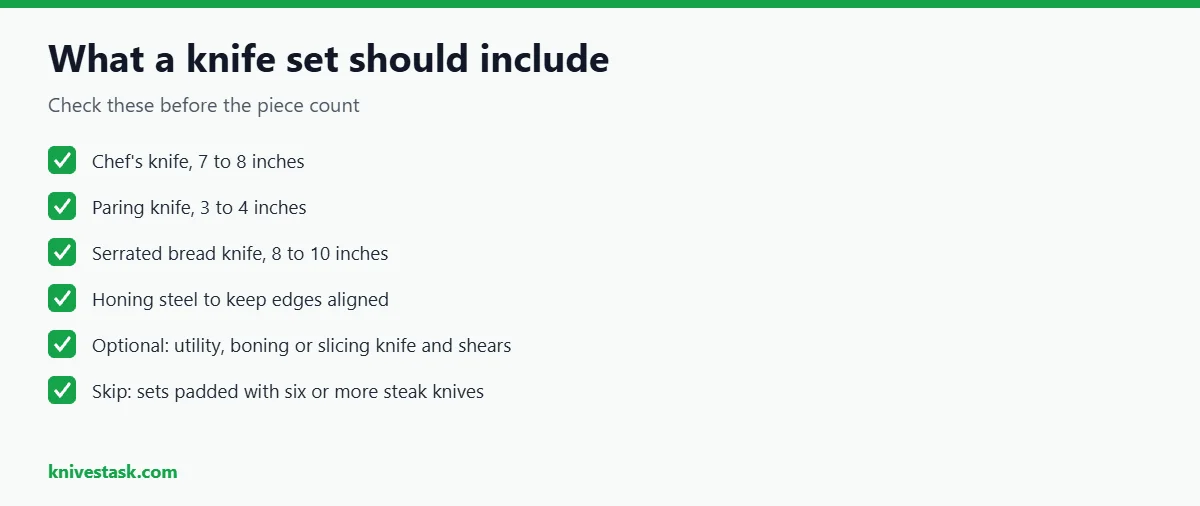
Nearly every kitchen task can be done with three knives. A set should include these before anything else.
- Chef’s knife (7 to 8 inches): the main tool for chopping, slicing and mincing.
- Paring knife (3 to 4 inches): peeling, trimming and small detail cuts.
- Serrated bread knife (8 to 10 inches): crusty bread, tomatoes and soft fruit.
Useful extras include a utility knife, a boning knife, a slicer, a honing steel and kitchen shears. Steak knives are table knives, so they should not decide which set you buy.
Chef’s knife or santoku?
Some sets include a santoku instead of, or as well as, a chef’s knife. A santoku has a flatter edge and shorter blade, which suits up-and-down chopping of vegetables.
A chef’s knife has more curve for rocking cuts and handles larger food more easily. If you mostly cook vegetables, either works; for roasts and big squash, a chef’s knife is better.
How many pieces is right?
For most homes, a set with three to five real knives plus a honing steel is plenty. Remember that the block, shears and steel each count as a “piece” on the box.
If you cook simply or have little space, a three-piece set may be all you need. Our best compact knife set guide compares the best small sets.
Step 2: Choose a Steel Style
Steel decides how sharp a knife gets, how long the edge lasts and how much care it needs. Hardness is measured on the Rockwell C scale, shown as HRC.
German-style steel
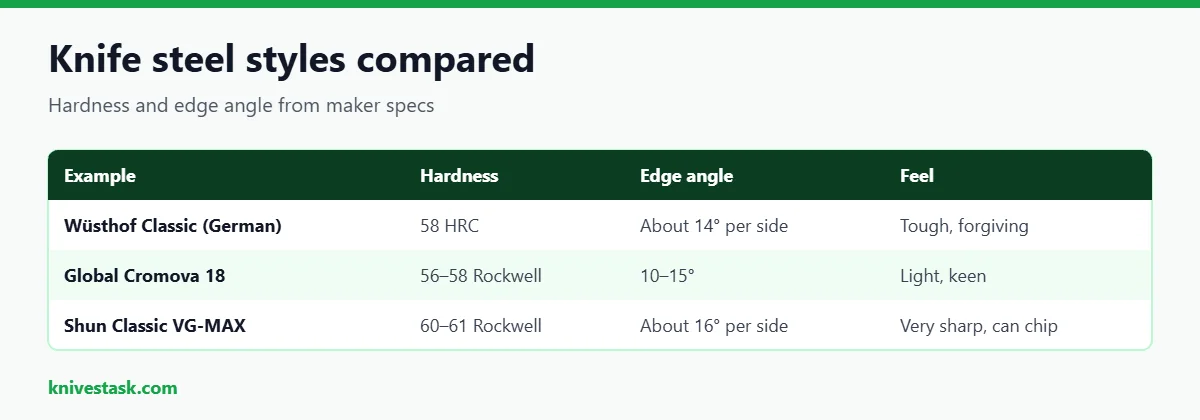
German knives use softer, tougher steel. For example, Wüsthof rates its Classic knives at 58 HRC with an edge of about 14 degrees per side.
This steel forgives twisting, bones and the odd knock against a pan. It needs honing more often, but it is easy to sharpen.
Japanese-style steel
Japanese knives use harder steel and thinner blades. Shun’s Classic line uses a VG-MAX core at 60 to 61 Rockwell, sharpened to about 16 degrees per side.
Harder steel holds a keen edge longer but can chip if misused. Global’s Cromova 18 knives sit between the two styles at 56 to 58 Rockwell with a 10 to 15 degree edge.
Not sure which suits you? Our Japanese vs German knives guide compares them in detail.
Step 3: Forged or Stamped Construction
Forged knives are shaped from a heated bar of steel and usually have a thick bolster. They feel heavier and more solid in the hand.
Stamped knives are cut from a sheet of steel, so they are lighter and cheaper. Many professional cooks happily use stamped knives every day.
Neither method guarantees quality on its own. Our forged vs stamped knives guide explains what really affects performance.
Step 4: Check Handles and Hygiene
A good handle feels secure when wet and does not leave gaps where food can collect. Textured synthetic handles are easiest to keep clean.
Commercial kitchens often look for NSF-certified knives, tested against standards such as NSF/ANSI 2 for food equipment. At home it is not essential, but it signals a hygienic design.
Step 5: Pick Your Storage
Storage protects edges as much as it organises your kitchen. Pick the option that fits your space before you choose a set.
- Knife block: convenient and protective, but uses counter space.
- Magnetic strip: saves counter space and keeps blades dry; see our best magnetic knife strip guide.
- Drawer tray: hidden and child-friendly.
- Knife roll: best for cooks who carry knives to work or school.
Step 6: Set a Budget
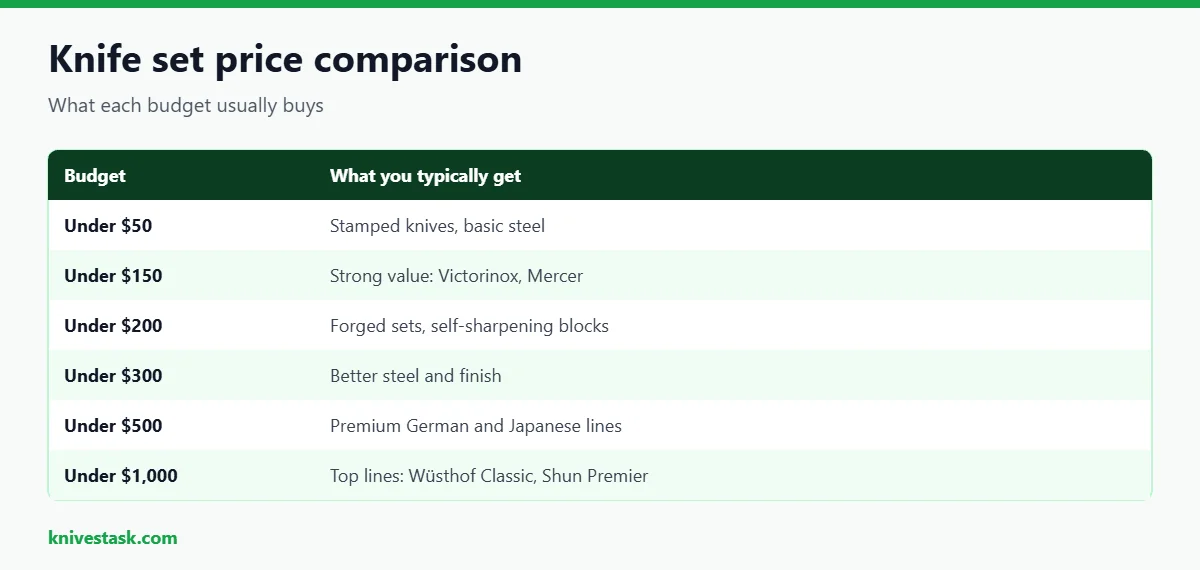
Price tells you a lot about what a set prioritises. Use this knife set price comparison to see what each tier usually buys.
| Budget | What you typically get | Our guide |
|---|---|---|
| Under $50 | Stamped knives, basic steel, few extras | Under $50 |
| Under $100 | Budget block sets, mixed quality | Block under $100 |
| Under $150 | Strong value knives like Victorinox and Mercer | Under $150 |
| Under $200 | Forged sets and self-sharpening blocks | Under $200 |
| Under $300 | Better steel and finish, fewer filler pieces | Under $300 |
| Under $500 | Premium German and Japanese lines | Under $500 |
| Under $1,000 | Top lines like Wüsthof Classic and Shun Premier | Under $1,000 |
Above about $200, extra money buys harder steel, better fit and finish and stronger warranties. It rarely buys more useful knives.
Step 7: Check the Warranty
Reputable knife brands state their warranty clearly, and many offer lifetime cover against manufacturing defects. Wüsthof, Zwilling and Misen all publish their terms.
A warranty does not cover chips from misuse or dishwasher damage. Read the care instructions so you do not void it by accident.
Hold Before You Buy, If You Can
Specs only tell half the story, because comfort is personal. If a local shop stocks the brand, hold the chef’s knife and mimic a few chopping motions.
Check that your knuckles clear the board and the handle does not press into your palm. A knife that feels balanced in your hand will get used, while an awkward one stays in the block.
Buying online? Choose retailers with easy returns, and keep the packaging until you are sure.
Set or Build Your Own?
Buying knives one at a time lets you choose the best chef’s knife from one brand and the best bread knife from another. It often costs about the same as a mid-range set.
A set makes sense when the brand you like sells its core knives together at a real discount. Price the chef’s, paring and bread knife separately before deciding.
Red Flags When Buying a Knife Set
- Steel described only as “surgical” or “high-quality” with no grade.
- Piece counts padded with six or more steak knives.
- No bread knife, or a tiny one under 7 inches.
- Hollow, loose or glued-on handles.
- No clear warranty from the brand.
Our Picks by Cook
New cooks should start with our best beginner knife set guide. Serious cooks and culinary students should see the best professional knife set guide.
For a full comparison at every price, read our hub guide to the best kitchen knife sets.
Caring for Your New Set
Hone knives every few uses and sharpen them once or twice a year. Wash and dry by hand, and always cut on wood or soft plastic boards.
Store knives so the edges never touch other metal. These simple habits matter more to long-term sharpness than the price you paid.
Frequently Asked Questions
What is the most important knife in a set?
The chef’s knife. You will use it for most tasks, so choose a set whose chef’s knife feels comfortable in your hand.
Is a bigger knife set better?
Not usually. A bigger set mostly adds steak knives and duplicate sizes, while a smaller set often has better knives for the same price.
How long should a good knife set last?
With hand washing, regular honing and occasional sharpening, a quality set can last for decades. Our guide on how to sharpen kitchen knives shows how to keep it sharp.
Should I buy a self-sharpening knife block?
It can help if you never sharpen knives otherwise. Keen cooks usually get better edges from a whetstone or a quality manual sharpener.