
The best bread knife saws through a crackly sourdough crust without crushing the open crumb inside. It also handles tomatoes, layer cakes, bagels and sandwich loaves better than any straight-edged knife. What matters most is blade length (at least two inches longer than your widest loaf) and the serration pattern — wavy scallops, pointed teeth or double serrations. Here are the best bread knives for crusty boules, soft brioche, baguettes and cakes, from a cheap Mercer to a forged Wüsthof and a bread bow.
Quick Picks
- Best overall: Mercer Millennia 10″ wide wavy edge — cheap, long and gentle on soft crumb.
- Best premium: Wüsthof Classic 9″ double-serrated — forged in Solingen.
- Best for sandwiches: Mercer Millennia 9″ offset — knuckles clear the board.
- Best for big sourdough: Tojiro F-687 270 mm, or a bread bow.
- Rule of thumb: choose a blade 2+ inches longer than your widest loaf.
Knives Task is reader-supported: if you buy through a link on this page, we may earn a small Amazon commission at no extra cost to you. That never changes which knives we recommend.
Our Picks at a Glance
| Pick | Length | Serrations | Best for |
|---|---|---|---|
| Mercer Millennia 10″ Wide Wavy Edge | 10″ | Wide wavy | Best overall |
| Wüsthof Classic 9″ Double-Serrated | 9″ | Double serrated | Premium |
| Mercer Millennia 9″ Offset | 9″ | Wavy, offset | Sandwiches, bagels |
| Tojiro F-687 Bread Slicer | 270 mm (~10.6″) | Fine scallops | Large loaves |
| Dalstrong Gladiator 10″ | 10″ | Pointed | Bigger hands |
| Henckels Classic 7″ | 7″ | Standard | Baguettes, cakes |
| TYOARO 16″ Bread Bow | 16″ frame | Fine saw | Very wide boules |
How we chose: we haven’t lab-tested these knives side by side. We compared blade length, serration style, blade thickness, offset, handle grip, construction, published specs and long-term feedback from home bakers.
The Best Bread Knives
1. Mercer Millennia 10-Inch Wide Wavy Edge — Best Overall
Best for: most home bakers who want one bread knife that simply works.
The bread knife in countless professional kitchens. The 10-inch high-carbon Japanese steel blade crosses most homemade loaves in one stroke, and the wide, wavy serrations bite into crust without ripping a soft crumb. The textured Santoprene/polypropylene handle stays grippy with floury hands.
- Pros: long enough for most loaves, gentle on soft bread, very affordable
- Cons: stamped and utilitarian, plastic handle
Check the current price of the Mercer Millennia 10″ bread knife on Amazon →
2. Wüsthof Classic 9-Inch Double-Serrated — Best Premium
Best for: a forged bread knife to match a German knife set.
Forged in Solingen with a full tang and triple-riveted handle, it feels solid and balanced. The double-serrated edge puts small teeth inside larger scallops, gripping hard crusts quickly while slicing cleanly through the middle.
- Pros: forged full tang, excellent balance, lasts decades
- Cons: several times the Mercer’s price, 9″ is short for big boules
Check the current price of the Wüsthof Classic double-serrated bread knife on Amazon →
3. Mercer Millennia 9-Inch Offset — Best for Sandwiches
Best for: halving sandwiches, bagels and anything sliced right to the board.
The offset blade sits lower than the handle, so your knuckles clear the board at the bottom of each cut — why delis love offset knives. Same wavy edge and grippy handle as our top pick.
- Pros: knuckle clearance, great for sandwiches, inexpensive
- Cons: bulky in drawers, short for big boules
Check the current price of the Mercer Millennia 9″ offset bread knife on Amazon →
4. Tojiro F-687 Bread Slicer 270 mm — Best for Large Loaves
Best for: bakers who make big boules and like a thin, light blade.
A long, slim Japanese slicer whose 270 mm blade handles wide sourdough easily. Because it’s thin, it glides rather than wedges through the loaf — a big step up from cheap serrated knives without German-forged prices.
- Pros: long blade, thin and light, good value
- Cons: needs a long slot or guard, plain handle
Check the current price of the Tojiro F-687 bread slicer on Amazon →
5. Dalstrong Gladiator 10-Inch — Best for Bigger Hands
Best for: cooks who prefer a heavier knife with a chunky handle.
A full-tang, high-carbon German steel blade and a thick G10 handle. The extra weight powers through very hard crusts, and it ships with a blade guard.
- Pros: substantial feel, comfortable for large hands, guard included
- Cons: pricier than Mercer, heavy for lots of soft bread
Check the current price of the Dalstrong Gladiator bread knife on Amazon →
6. Henckels Classic 7-Inch — Best Compact Pick
Best for: baguettes, rolls, small loaves and cake torting.
A forged, full-tang knife with a traditional handle. The shorter blade is easy to steer when slicing a baguette on the bias or leveling cake layers, and it fits blocks where longer knives won’t.
- Pros: forged and balanced, precise control, fits small blocks
- Cons: too short for wide sourdough
Check the current price of the Henckels Classic 7″ bread knife on Amazon →
7. TYOARO 16-Inch Wooden Bread Bow — Best for Very Wide Boules
Best for: weekly bakers of large, crusty loaves.
A bread bow holds a thin serrated blade under tension in a wooden frame, like a small bow saw. It crosses even the widest loaves and helps keep slices straight and even.
- Pros: handles the widest loaves, even slices, looks great
- Cons: bread only, awkward to store, hard to resharpen
Check the current price of the TYOARO bread bow knife on Amazon →
How to Choose a Bread Knife
Length: At Least 2 Inches Longer Than Your Loaf
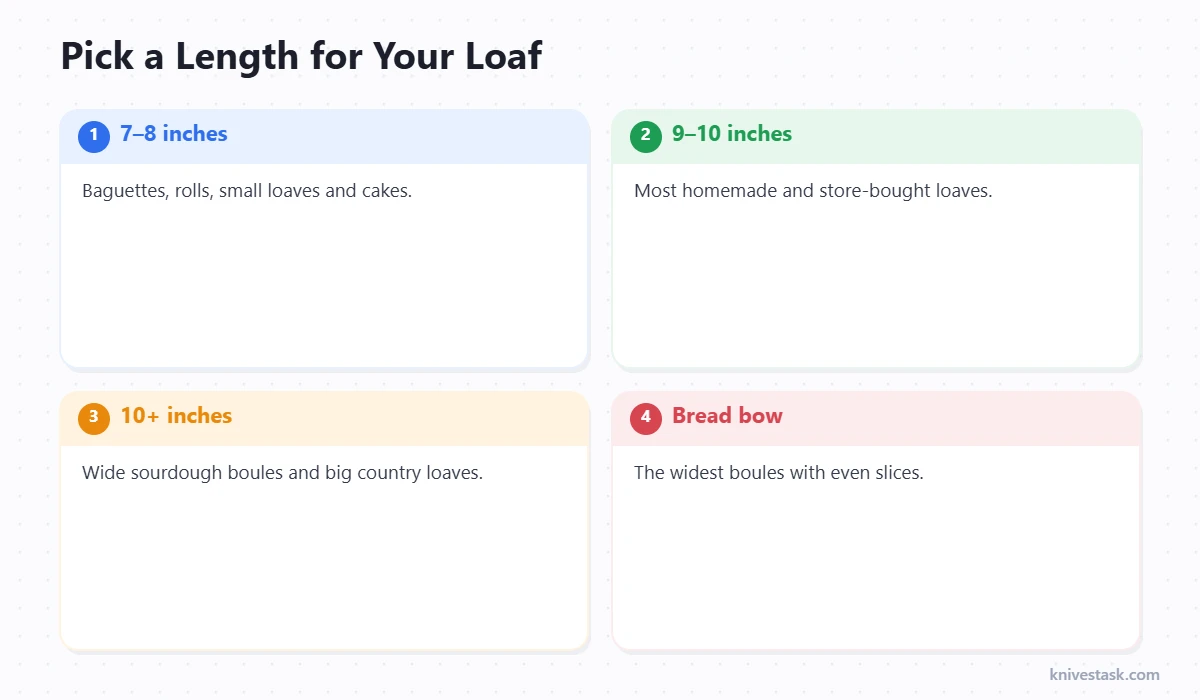
A blade a couple of inches longer than your widest bread lets you saw with long, even strokes instead of short, crushing jabs. For most homes, 9–10 inches is right; big boule bakers should go 10 inches or longer; baguette lovers can manage with 7–8.
Wavy vs Pointed vs Double Serrations
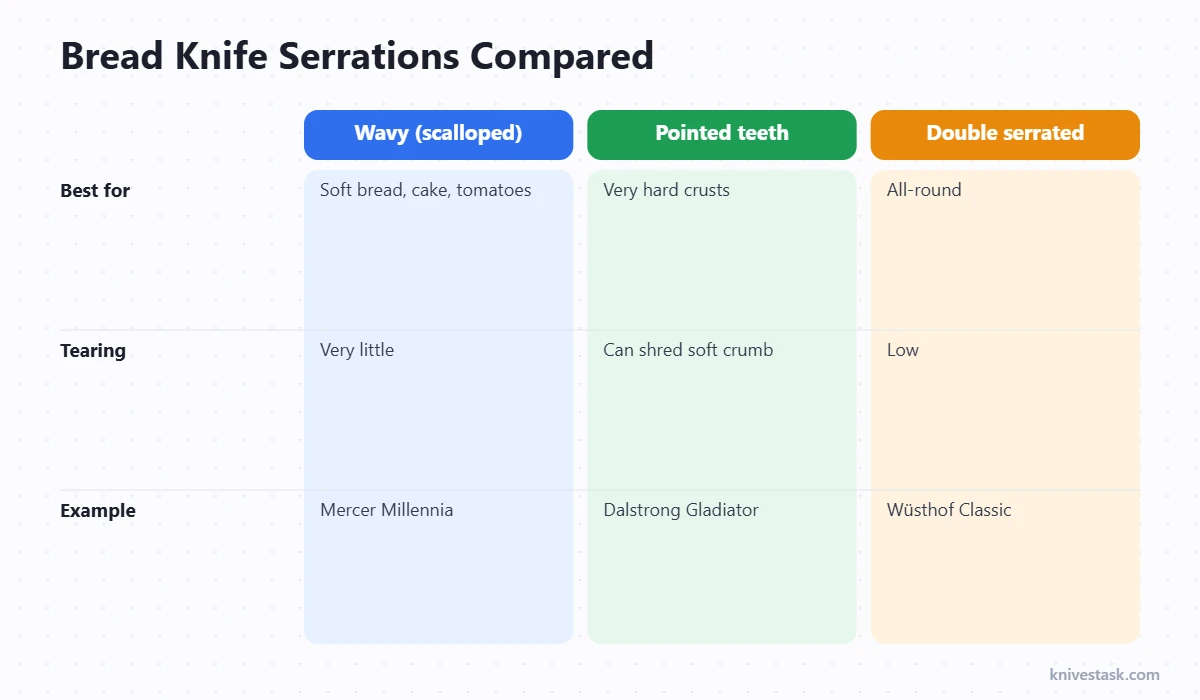
Wavy (scalloped) serrations glide through soft bread, tomatoes and cake with little tearing. Pointed, saw-like teeth bite harder into thick crusts but can shred soft loaves. Double serrations try to do both. For one all-round knife, wavy is safest — see serrated vs plain-edge knives and Wikipedia’s note on the serrated blade.
Offset or Straight
An offset handle keeps knuckles off the board; a straight blade is easier to store and better for slicing tall loaves horizontally.
Forged or Stamped, Handle and Weight
Forged Wüsthof and Henckels knives feel heavier and more balanced; stamped Mercers are lighter, cheaper and every bit as effective on bread. A textured handle is easier over a long slicing session.
Which Bread Knife for Which Bread?
| Bread | What works best | Our pick |
|---|---|---|
| Crusty sourdough boule | 10″+ wavy or double-serrated, or a bow | Tojiro F-687 or TYOARO bow |
| Soft sandwich loaf, brioche | Wavy serrations, light touch | Mercer 9″ Offset |
| Baguette | Shorter, controllable blade | Henckels Classic 7″ |
| Layer cake | Long, steady blade for level cuts | Mercer 10″ or Wüsthof 9″ |
| Tomatoes and citrus | Fine serrations | Any of our top three |
How to Slice Bread Without Squashing It
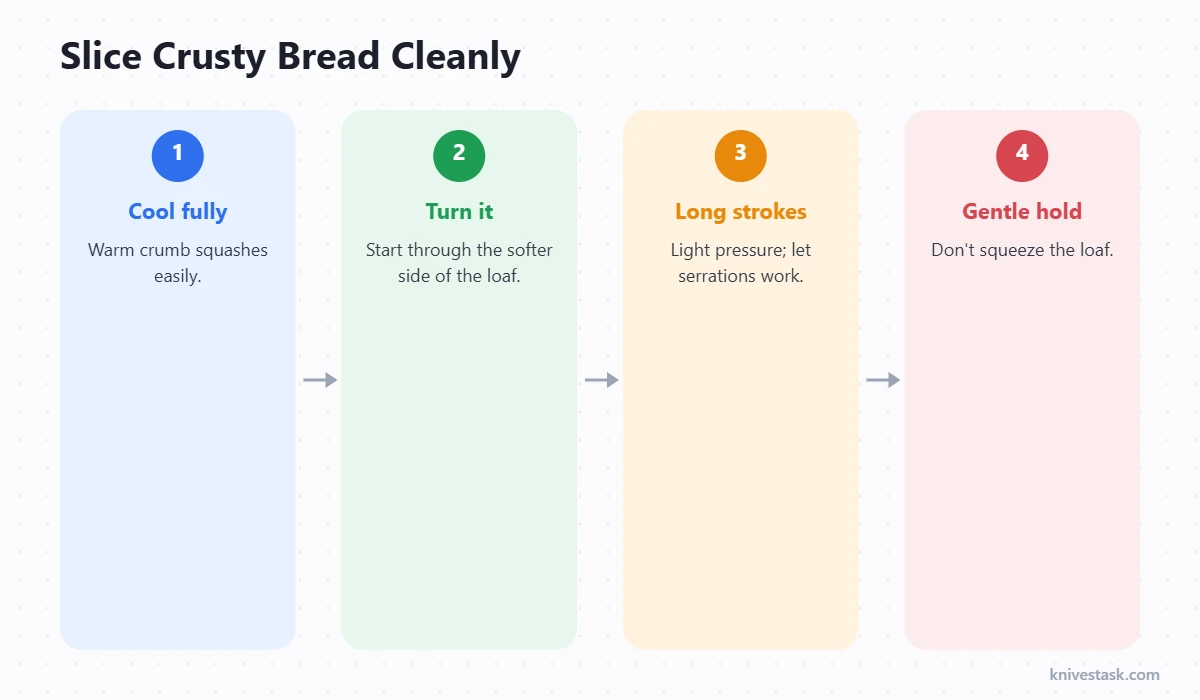
- Let fresh loaves cool completely — warm crumb compresses easily (bakers at King Arthur Baking recommend waiting until bread is fully cooled).
- Use long, light strokes and let the serrations work.
- Turn very crusty loaves on their side to start through the softer flank.
- Hold the loaf gently — squeezing flattens the crumb.
Common Bread Knife Mistakes
- Buying too short for your loaves.
- Choosing aggressive teeth for soft bread.
- Relying on the short, basic bread knife in a block set.
- Ignoring the handle — slicing a whole loaf takes a while.
Bread Knife vs Other Serrated Knives
A bread knife is the longest serrated knife in most kitchens (8–10″). A serrated utility knife (5–6″) suits tomatoes and rolls; steak knives are shorter still. If you only own one serrated knife, make it a bread knife — see what knives every kitchen should have.
How to Care for and Sharpen a Bread Knife
Hand wash and dry immediately, and store it in a block, on a magnetic strip or in a guard. Serrated knives stay useful for years because only the tooth tips touch the board. When it stops biting, touch up each scallop on the beveled side with a thin tapered rod, then remove the burr with one light pass on the flat side — or use a sharpening service. See how to sharpen kitchen knives.
Frequently Asked Questions
What size bread knife is best?
For most kitchens, 9–10 inches — at least 2 inches longer than your widest loaf.
Can you sharpen a serrated bread knife?
Yes. Use a tapered ceramic or diamond rod in each serration, then lightly deburr the flat side.
Is a bread knife worth it if I have a chef’s knife?
Yes. A chef’s knife crushes soft loaves and skids on hard crusts; a bread knife does both better.
How do I slice sourdough without crushing it?
Wait until fully cool, then use long, light sawing strokes, starting on the side if the crust is very hard.
Can I use a bread knife to slice meat?
In a pinch, yes, but serrations tear fibers. A straight carving knife gives cleaner, juicier slices.
How long does a good bread knife last?
Many years — often a decade or more — with hand washing and sensible storage.