Quick answer: to wrap a knife handle with paracord, cut 550 cord to roughly four or five times the handle length for a simple spiral (more for a woven wrap), tape or tie one end at the top of the handle, wind the cord tightly down the handle with each turn pressed against the last, then tuck the tail under the final turns, trim it and melt the end with a lighter.
A cobra or Strider-style weave takes more cord but grips better and looks neater.
Knives Task is reader-supported. We may earn a commission when you buy through links on this page, at no extra cost to you. Learn more.
How we put this together: this is a how-to guide, not a hands-on test. We compared the methods and cord-length rules published by knife makers and experienced makers on Instructables, and we link each source. Work slowly and keep fingers away from the edge while you wrap.
Why wrap a knife handle with paracord?
A cord wrap turns a bare full-tang handle, often called a skeleton handle, into something comfortable to hold. Artisan Cutlery’s paracord wrapping guide lists better grip, looks and protection for the handle as the main reasons, and notes that the stretch of the cord moulds to your hand.
- Grip: textured cord is easier to hold than bare steel, especially when wet or cold.
- Comfort: a wrap fills out a thin handle so it does not dig into your palm.
- Spare cord: a long wrap stores several feet of cord you can unwind in an emergency.
- Repair: it gives a knife a second life when the original scales crack or go missing.
- Style: colours and patterns make the knife yours.
The downsides are real too. Cord soaks up water, blood and dirt, so it is harder to clean than micarta or G10, and a loose wrap can shift in use. For a knife used mainly in a kitchen or for cleaning game, solid scales are usually the better choice.
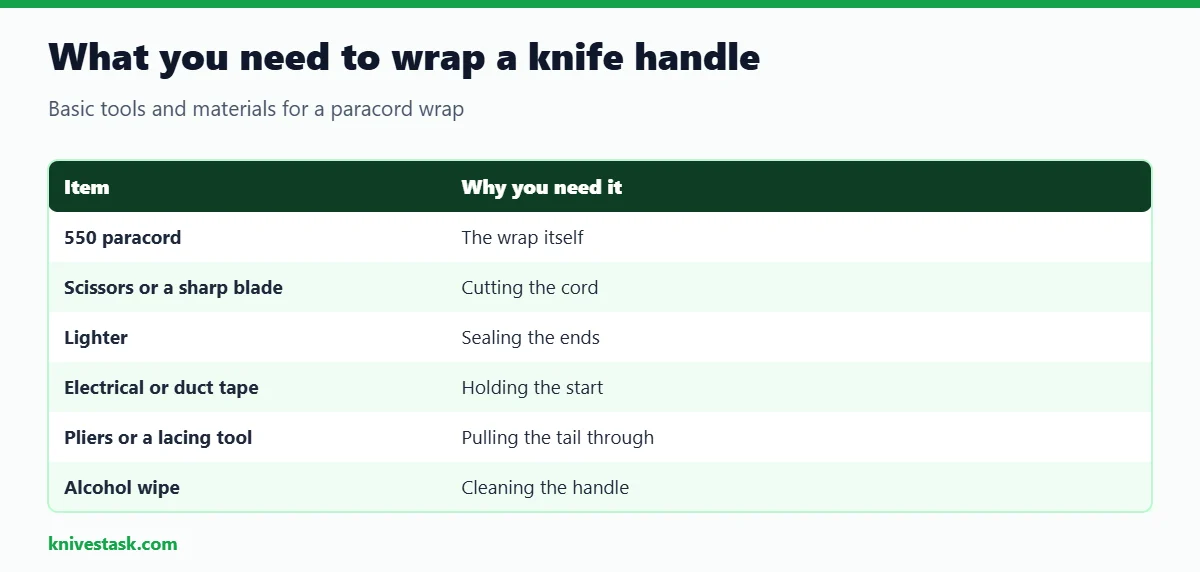
What you need to wrap a knife handle with paracord
| Item | Why you need it | Notes |
|---|---|---|
| 550 paracord | The wrap itself | Most guides use 550 type III cord |
| Scissors or a sharp blade | Cutting the cord | Cut cleanly so the end melts neatly |
| Lighter | Sealing the ends | Melt, then press flat while warm |
| Electrical or duct tape | Holding the start | Optional; a lanyard hole works too |
| Pliers or a lacing tool | Pulling the tail through | Makes the final tuck much easier |
| Alcohol wipe | Cleaning the handle | Removes oil so the wrap sits still |
These lists follow the materials named by Crate Club’s paracord wrapping guide and an Instructables paracord knife handle wrap, which adds tape, an alcohol wipe and needle-nose pliers.
How much paracord do you need?
Before you wrap a knife handle with paracord, work out the length. This is the step most people get wrong. Run short and you have to start again, so cut generously.
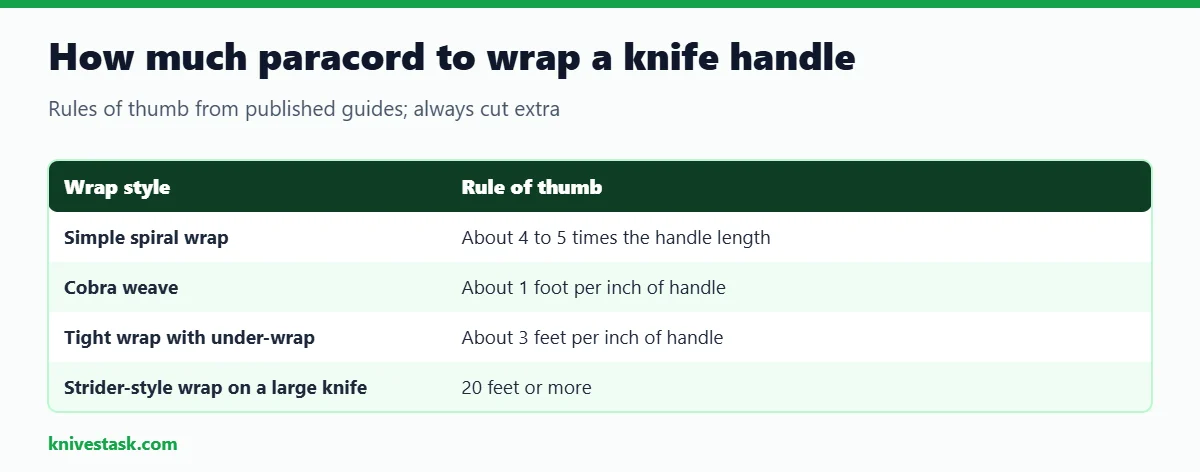
| Wrap style | Rule of thumb | Example: 4-inch handle |
|---|---|---|
| Simple spiral wrap | About 4 to 5 times the handle length | About 16 to 20 inches, plus spare |
| Cobra weave | About 1 foot per inch of handle | About 4 feet |
| Tight wrap with under-wrap | About 3 feet per inch of handle | About 12 feet |
| Strider-style wrap on a large knife | 20 feet or more | Check before you cut |
The figures come from different makers and vary because their methods vary. Crate Club suggests four to five times the handle length for a basic wrap. An Instructables cobra-weave tutorial uses about a foot of cord per inch of handle. The Instructables diving-knife wrap uses about 3 feet per inch, and its Strider-style tutorial suggests at least 20 feet for a big knife or machete.
If you are unsure, wrap a test piece of the same thickness first, or simply cut more than you think you need.
Method 1: the simple spiral wrap
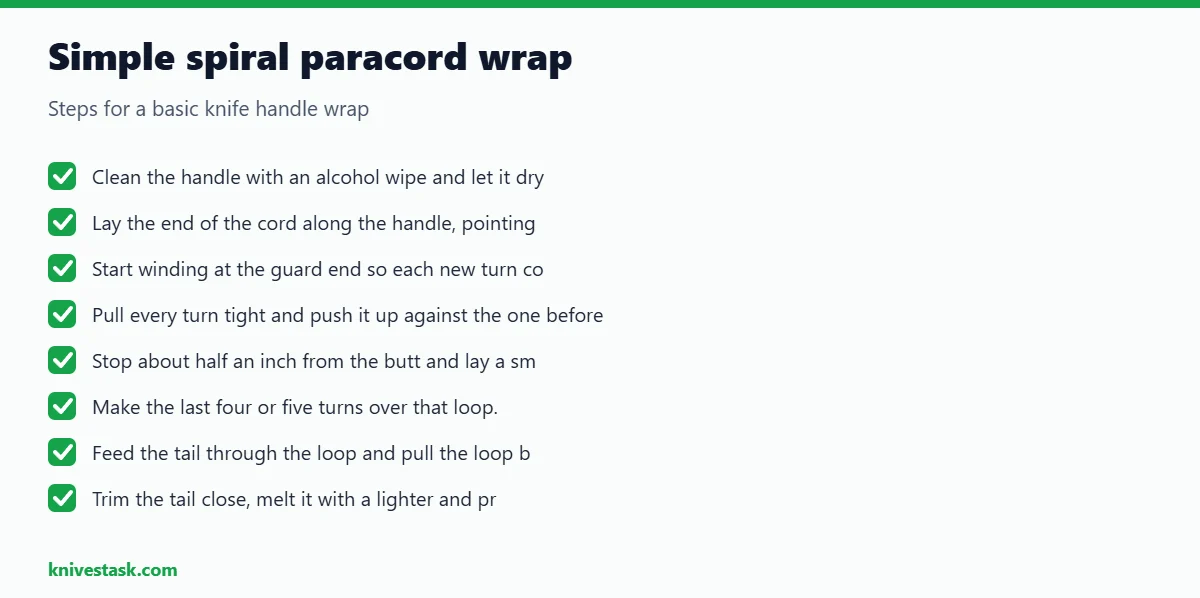
This is the quickest way to wrap a knife handle with paracord and the easiest to fix in the field.
- Clean the handle with an alcohol wipe and let it dry.
- Lay the end of the cord along the handle, pointing toward the butt, and tape it just below the guard.
- Start winding at the guard end so each new turn covers the cord you laid along the handle.
- Pull every turn tight and push it up against the one before. Gaps let the wrap slide.
- Stop about half an inch from the butt and lay a small loop of cord or thin wire along the handle.
- Make the last four or five turns over that loop.
- Feed the tail through the loop and pull the loop back under the turns to lock the tail in place.
- Trim the tail close, melt it with a lighter and press it flat with the side of the lighter, not your finger.
If your knife has lanyard holes, you can thread the cord through the top hole instead of taping it. Blade HQ’s easy paracord wrap uses a simple repeating knot, alternating sides, which is a good next step once the spiral feels easy.
Method 2: the cobra weave
To wrap a knife handle with paracord in a raised pattern, use the cobra weave, also called the Solomon bar. It makes a thicker, flatter handle with a raised pattern. It uses more cord than a spiral but holds its shape well.
- Find the middle of the cord and lay it across the top of the handle, with the two ends hanging down either side.
- Cross the left end over the handle and the right end to make a loop on the left.
- Bring the right end behind the handle and up through that loop.
- Pull both ends tight so the knot sits flat.
- Repeat, but start from the right side this time. Alternating sides is what creates the pattern.
- Keep going to the butt, then tuck both ends back under the last knots, trim and melt.
If you only ever do one knot side, the weave twists into a spiral. That looks fine too, but it is a different pattern.
Method 3: the Strider-style wrap
The Strider-style method is the tightest way to wrap a knife handle with paracord: a flat, criss-cross wrap seen on many tactical and survival knives. It takes the most cord and the most patience.
- Start with an under-wrap. Many makers remove the inner strands from a length of paracord (gutting it) and wind the outer sheath around the bare handle first. Titan Survival’s Strider weave guide says this is optional but hides the steel and adds texture.
- Fold the main cord in half and girth-hitch it through the lanyard hole or around the top of the handle.
- Pass each end across the face of the handle and around the back, crossing the other end on each side.
- Pull each pass tight before the next. The pattern only stays flat if every crossing is snug.
- Finish at the butt by tucking the ends under the last crossings, then trim and melt.
Full paracord used as the under-wrap is usually too bulky on a small handle, which is why the gutted sheath is common.
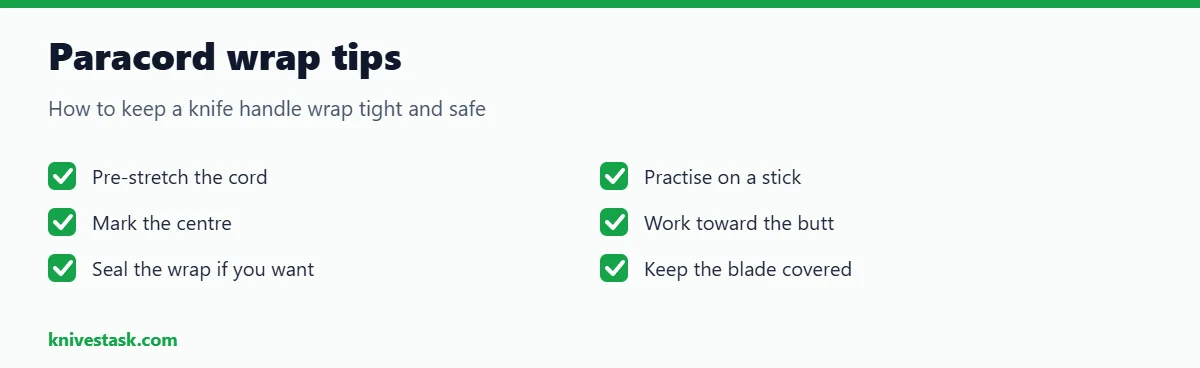
Tips for a tight, neat wrap
- Pre-stretch the cord. New paracord can stretch a little. Pull it tight along its length before you start.
- Practise on a stick. Wrap a dowel or wooden spoon handle of the same thickness first to learn the pattern and check your cord length.
- Mark the centre. For woven wraps, a pen mark at the cord’s centre keeps both sides even.
- Work toward the butt. Finishing at the butt keeps the tail away from your index finger.
- Seal the wrap if you want. A thin coat of wax, or a thin glue made for cord, can stop fraying; it also makes the cord harder to unwind later.
- Keep the blade covered. Put the knife in its sheath or tape a piece of cardboard over the edge while you work.
Which knives are good for a paracord wrap?
Full-tang fixed blades with a thin, flat tang and a lanyard hole are the easiest. If you plan to wrap a knife handle with paracord, choose one of these. Many bushcraft and survival knives are sold this way on purpose.
If you are still choosing a knife, see our guides to the best bushcraft knife under $100, the best fixed blade EDC knife under $100 and the best outdoor knives with a sheath.
Folding knives are a poor fit. Cord on a folder can foul the lock or pivot, and most folders already have scales. Kitchen knives are also a poor fit, because cord is hard to keep clean around food.
See full-tang skeleton knives on Amazon
Common mistakes
- Cutting the cord too short. Measure, then add extra.
- Leaving gaps between turns. Gaps let the wrap slide.
- Melting near the blade or a coated tang. Heat can mark finishes.
- Wrapping over oil or grime. Clean the steel first.
- Burning your fingers on molten nylon. Press the end flat with the lighter body or a metal tool.
- Wrapping over a cracked handle without checking the tang. A cord wrap does not fix a broken or loose tang.
How to clean and care for a paracord wrap
Once you wrap a knife handle with paracord, keep it clean. Rinse the wrap with warm, soapy water, then rinse clean and let it dry fully before sheathing the knife, so the tang does not stay damp.
On carbon steel, keep a light coat of oil on the exposed steel; our guide on how to get rust off kitchen knives covers what to do if rust appears. Replace a wrap that has soaked up blood or stays smelly; cord is cheap.
Frequently asked questions
What is the best paracord to wrap a knife handle?
Most guides use 550 paracord, which is thick enough to fill a handle. Thinner cord such as 275 or micro cord suits small neck knives.
How long does it take to wrap a knife handle with paracord?
If you wrap a knife handle with paracord using a simple spiral, it takes a few minutes once you have done it a couple of times. Woven wraps such as the cobra or Strider style take longer, especially the first time.
Do you need lanyard holes?
No. Tape holds the start of a spiral wrap. Holes just make it easier to anchor woven wraps.
Will a paracord wrap come loose?
A tight wrap with the tail locked under the last turns stays put in normal use. Wraps loosen if there are gaps, if the cord was not pulled tight, or if the end was not locked in.
Can you remove a paracord wrap later?
Yes. Cut the melted end and unwind it. That is also how you use the cord in an emergency.
Is it safe to use a paracord-wrapped knife for food?
It works, but cord holds moisture and food residue, so solid scales are more hygienic for kitchen work.
Last checked: November 2026. Prices, specifications and availability change, so confirm details on the maker’s or retailer’s page before you buy.