Quick Summary
- Japanese knives: harder steel (about 58–63 HRC), thinner blades and finer edges; sharper but more prone to chipping.
- German knives: softer, tougher steel (about 56–58 HRC), thicker blades and bolsters; forgiving and durable.
- Neither is better overall: it depends on how you cut, what you cook and how much care you’ll give.
- Choose Japanese for precise slicing; choose German for heavy, busy-kitchen use.
- Many cooks use both: a Japanese chef’s knife plus German utility or boning knives.
Knives Task is reader-supported: if you buy through a link on this page, we may earn a small Amazon commission at no extra cost to you. That never changes which knives we recommend.
Japanese and German knives are the two dominant styles of Western kitchen cutlery. Both can be excellent, but they’re designed around different ideas.
Japanese makers favor hard steel and thin, sharp blades. German makers favor tougher steel and sturdier blades that tolerate rough handling.
Japanese vs German Knives at a Glance
| Feature | Japanese style | German style |
|---|---|---|
| Typical hardness | About 58–63 HRC | About 56–58 HRC |
| Edge angle | About 10–16° per side | About 14–20° per side |
| Blade thickness | Thin | Thicker |
| Weight | Lighter | Heavier |
| Bolster | Small or none | Often a full bolster |
| Chip resistance | Lower | Higher |
| Edge retention | Longer | Shorter; needs frequent honing |
| Typical brands | Shun, Global, Miyabi, Tojiro | Wüsthof, Zwilling, Messermeister |
Steel and Hardness
Hardness is measured on the Rockwell C scale (HRC). Japanese knives commonly use steels like VG-10, SG2 and Aogami at about 60 to 63 HRC, which lets them take a very fine edge and keep it.
German knives usually use X50CrMoV15 stainless at about 56 to 58 HRC. It’s softer, so the edge rolls rather than chips, and a few strokes on a honing rod bring it back.
Edge Angle and Sharpness
Japanese knives are typically sharpened at 10 to 16 degrees per side, giving a keen edge that glides through food. Many German makers have moved to finer edges too; Wüsthof now sharpens to 14 degrees per side.
A finer angle cuts more easily but needs harder steel to stay stable. That’s why Japanese knives can keep thin edges that would roll quickly on softer steel.
Weight, Balance and Feel
Japanese knives feel light and nimble, which reduces fatigue during long prep sessions. Their balance often sits close to where blade meets handle.
German knives feel solid and weighty, and the heft helps push through dense vegetables. A full bolster protects your fingers but makes it harder to sharpen the heel.
Cutting Technique Differences
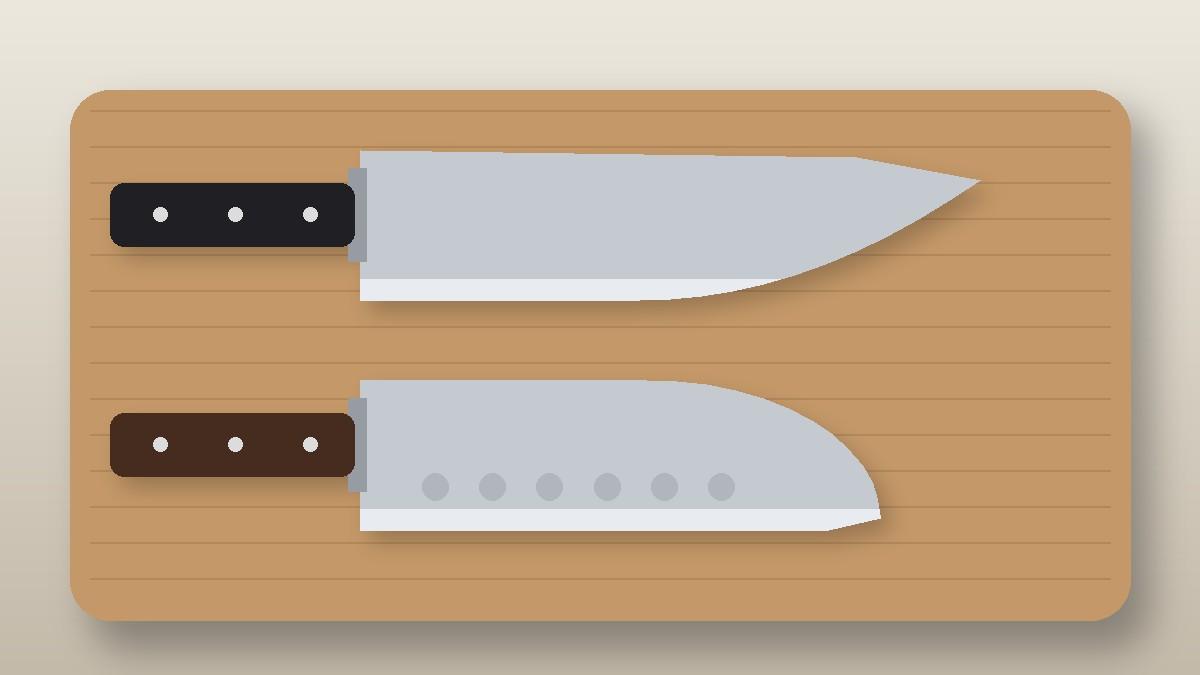
German chef’s knives have a curved belly that suits a rocking motion, where the tip stays on the board as you chop herbs or onions. The extra weight helps carry the blade through food.
Japanese gyutos and santokus are flatter and favor push cuts and pull slices, where the whole edge moves forward or back through the food. This uses the sharp edge efficiently and puts less stress on a hard blade.
Either technique works with either knife, but matching your habits to the knife’s shape makes cutting feel more natural.
Durability and Toughness
Toughness is a steel’s resistance to chipping and breaking, and it usually goes down as hardness goes up. That’s why a hard Japanese edge can chip if it hits bone, frozen food or a hard board.
German knives tolerate twisting, accidental bone contact and rough handling much better. That makes them popular in busy family kitchens.
Neither style of chef’s knife is meant for cutting through bones; use a cleaver or boning knife for that.
Example Knives
| Knife | Style | Why it’s a good example |
|---|---|---|
| Shun Classic 8″ Chef’s | Japanese | VG-MAX core, 16° edge, light |
| Tojiro DP Gyuto | Japanese | VG-10 core at a fair price |
| Wüsthof Classic 8″ Chef’s | German | Forged, full bolster, 58 HRC |
| Victorinox Fibrox Pro 8″ | Swiss (Western) | Budget, softer steel, very forgiving |
Victorinox is Swiss rather than German, but its knives follow the softer, tougher Western approach. Our older article called it German, so we’ve corrected that.
Handles: Wa vs Yo vs German
Traditional Japanese wa handles are light, often octagonal or D-shaped, and push the balance toward the blade. Many Japanese knives sold abroad use Western-style yo handles with rivets instead.
German handles are usually riveted synthetic or wood scales on a full tang, with a bolster where blade meets handle. They feel substantial and secure.
Comfort is personal, so try both styles if you can. A handle that suits your grip matters more than its country of origin.
Equivalent Knife Shapes
| Japanese knife | Closest German/Western knife | Main use |
|---|---|---|
| Gyuto | Chef’s knife | All-purpose |
| Santoku | Chef’s knife (shorter) | All-purpose, push cuts |
| Nakiri | Vegetable cleaver | Vegetables |
| Petty | Utility knife | Small tasks |
| Sujihiki | Slicing/carving knife | Slicing meat |
| Honesuki | Boning knife | Poultry |
German chef’s knives usually have more curve for rocking, while gyutos are flatter toward the heel. Santokus and nakiris have no direct German equivalent.
Price Ranges
Both styles cover every budget. Tojiro and Victorinox offer excellent entry-level knives, while Shun, Miyabi, Wüsthof and Zwilling occupy the premium tier.
At the same price, Japanese knives usually give you harder steel and a finer edge, while German knives give you more weight and toughness.
Sharpening and Maintenance
| Task | Japanese knives | German knives |
|---|---|---|
| Honing | Gently, with a ceramic rod | Often, with a steel or ceramic rod |
| Sharpening | Whetstones, less often | Stones or pull-through, more often |
| Washing | Hand wash and dry | Hand wash and dry |
| Boards | Wood or soft plastic | Wood or plastic |
Japanese knives need less frequent sharpening but more careful technique. German knives are quick to sharpen and tolerate simpler tools.
For step-by-step help, read how to sharpen kitchen knives with a stone.
Which Style Suits You?
Choose a Japanese Knife If
- You enjoy precise slicing of vegetables, fish and boneless meat.
- You prefer a light knife and use push or slice cuts.
- You’re happy to hand wash, hone gently and avoid bones.
Choose a German Knife If
- You want a tough knife that forgives mistakes.
- You like a heavier knife and a rocking motion.
- You cook in a busy kitchen where knives get knocked around.
Can You Mix Both?
Yes, and many cooks do. A Japanese chef’s knife or gyuto for daily prep, plus German boning, bread or utility knives for tougher jobs, is a practical combination.
If you’re comparing specific brands, see Shun vs Wüsthof and our guide to the best gyuto knives.
Common Myths
“Japanese knives are only for sushi” is a myth. A gyuto is an all-purpose chef’s knife, while the long yanagiba is the traditional sushi and sashimi slicer.
“German knives are always cheaper” isn’t true either. Premium German lines cost as much as many Japanese knives, and good Japanese knives exist at modest prices.
“Harder is always better” is also misleading. Harder steel holds an edge longer, but toughness and ease of sharpening matter too.
Frequently Asked Questions
Are Japanese knives sharper than German knives?
Usually, because harder steel supports a finer edge for longer.
Are German knives more durable?
They’re tougher and less likely to chip, though both can last decades.
Which is better for beginners?
A German-style knife is more forgiving while you learn.
Do professional chefs use Japanese or German knives?
Both. Many professionals favor Japanese gyutos, while others prefer German or Swiss workhorses.
Can I use a honing steel on Japanese knives?
Use a ceramic rod with light pressure; coarse steels can chip hard edges.