Quick Summary
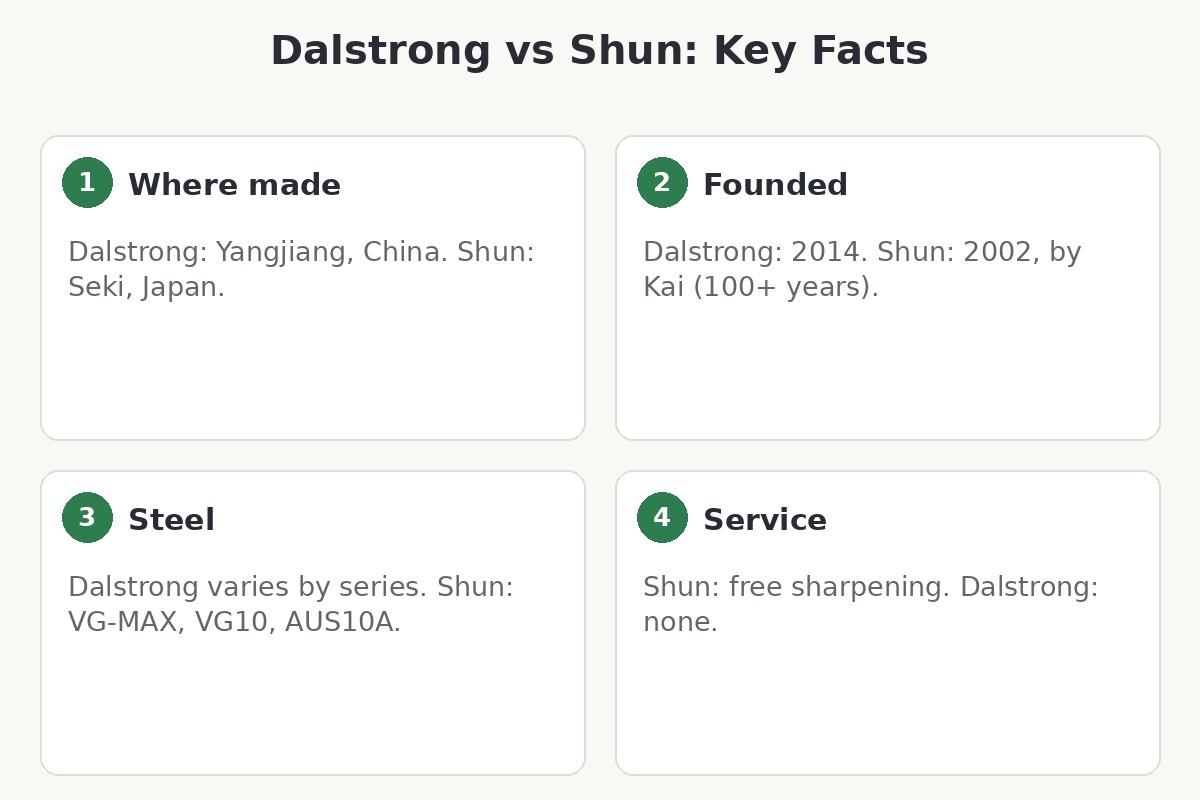
- Dalstrong was founded in 2014 in Canada; its knives are made in Yangjiang, China.
- Shun is made by the Kai Group in Seki, Japan, and launched in 2002.
- Dalstrong’s steels and hardness vary widely by series; Shun uses hard Japanese steels at about 60–62 HRC.
- Shun offers free sharpening (you pay shipping); Dalstrong doesn’t.
- Choose Shun for proven quality and service; choose Dalstrong for bold designs at lower prices.
Knives Task is reader-supported: if you buy through a link on this page, we may earn a small Amazon commission at no extra cost to you. That never changes which knives we recommend.
Dalstrong and Shun both make eye-catching knives, but they come from very different places. One is a young online brand known for dramatic designs; the other is part of a Japanese cutlery company with more than a century of history.
This comparison looks at where they’re made, what steels they use, how they’re backed and who each suits.
Dalstrong at a Glance
Dalstrong was founded in 2014 by Dave Dallaire and is based in Canada. Its own help page on where Dalstrong knives are made confirms that they’re manufactured in Yangjiang, China.
Dalstrong sells many series with very different steels, from soft German stainless in the Gladiator line to hard AUS-10V and BD1N-VX in the Shogun, Omega and Quantum lines. Kitchen review site Prudent Reviews’ Dalstrong review lists hardness from about 54 to 63 HRC across the range.
For a closer look at each series, read our Dalstrong knives review.
Shun at a Glance
Shun is made by the Kai Group in Seki, Japan. The brand launched in 2002, and Kai has made knives for more than a hundred years.
Shun knives use hard Japanese steels such as VG-MAX, VG10 and AUS10A, typically around 60–62 HRC, sharpened to 16° per side. See our Shun knives review for the main lines.
Dalstrong vs Shun Compared
| Dalstrong | Shun | |
|---|---|---|
| Founded | 2014 | 2002 (Kai: 1908) |
| Made in | Yangjiang, China | Seki, Japan |
| Steels | Varies widely by series | VG-MAX, VG10, AUS10A, others |
| Hardness | About 54–63 HRC | About 60–62 HRC |
| Edge angle | 8–18° per side, by series | 16° per side |
| Sharpening service | No | Free (you pay shipping) |
| Warranty | Limited lifetime | Limited lifetime |
| Price | Lower to mid | Mid to high |
Prudent Reviews’ head-to-head Dalstrong vs Shun comparison recommends Shun if your budget allows and calls Dalstrong a solid budget alternative.
Steel and Edge
Shun’s steels are consistent across its range: hard, fine-grained and able to take a very keen edge. The trade-off is that hard edges can chip if you twist the blade or hit bone.
Dalstrong varies more. The Gladiator series uses softer German steel that’s tough and easy to sharpen, while the Shogun and Omega series use much harder steels for long edge retention.
That variety means you need to check the steel and angle of the specific Dalstrong knife you’re considering.
Design and Handles
Dalstrong is known for bold, dramatic designs, black blades, sculpted handles and showy packaging. Many people buy them as gifts for that reason.
Shun’s designs are more restrained, with Damascus-clad blades and Pakkawood or wooden handles. The Classic has a D-shaped handle that suits right-handed users, while the Premier has a symmetrical handle.
Prudent Reviews also found that some Dalstrong knives feel blade-heavy with light handles, which can affect balance. Try one in hand if you can.
Chef’s Knives Compared
The Dalstrong Shogun 8-inch chef’s knife uses an AUS-10V core with Damascus cladding and a 10° edge, according to Prudent Reviews. It’s very sharp and striking to look at.
The Shun Classic 8-inch chef’s knife uses a VG-MAX core with Damascus cladding and a 16° edge. It’s one of the best-known Japanese chef’s knives in Western kitchens.
For more budget-friendly options, see our best chef’s knives under $100.
Service and Warranty
Both brands offer limited lifetime warranties against defects. Shun also offers free sharpening for straight-edged knives, though you pay shipping.
Dalstrong doesn’t offer a sharpening service and offers a 120-day refund policy, according to Prudent Reviews. Check current terms on each brand’s site before buying.
Which Should You Choose?
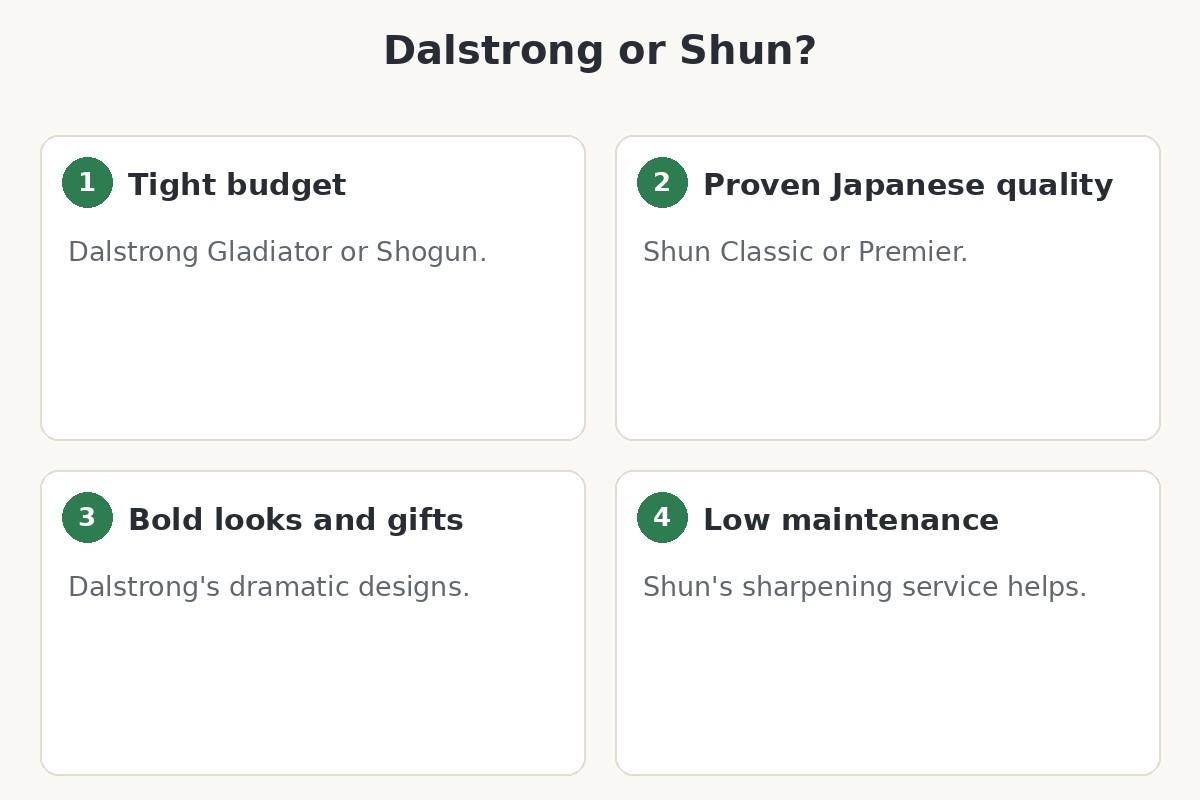
Choose Shun if you want proven Japanese quality, consistent steel and a sharpening service. It’s the safer long-term buy for most cooks.
Choose Dalstrong if you want bold designs at a lower price, or a specific series whose steel suits you. Pick the series carefully, since quality and feel vary.
Corrections from Our Older Article
Our previous version described Shun knives as hand-made from start to finish and claimed the Shun cleaver’s hole “increases balance”. It also listed a Shun Classic Chinese cleaver as a meat cleaver; that knife is a thin vegetable cleaver and shouldn’t be used on bone.
Care Tips
Hand-wash and dry both brands immediately, and never use the dishwasher. Avoid bones, frozen food and twisting cuts with hard Japanese-style blades.
Sharpen at the maker’s angle: 16° per side for Shun, and the angle listed for your Dalstrong series.
Our Verdict
Shun is the better all-round brand for performance, consistency and support. Dalstrong is a reasonable choice for design-focused buyers on a budget, as long as they choose the series with care.
Final Buying Tip
Whichever brand you lean toward, start with a single chef’s knife before buying a set. It tells you quickly whether you like the handle, weight and edge.
Which Dalstrong Series Compares Best to Shun?
If you want the closest match to a Shun, look at Dalstrong’s harder Japanese-style series, such as Shogun, which pair a hard steel core with Damascus cladding and a thin edge. They’re the most similar in feel and sharpness.
If you’re hard on knives, Dalstrong’s Gladiator series uses softer German steel that’s tougher and easier to sharpen. It’s closer to a German knife than to a Shun.
Packaging and Gifts
Dalstrong is known for dramatic boxes, sheaths and presentation cases, which make its knives popular gifts. Shun’s packaging is simpler, but the knives themselves are highly regarded.
If you’re buying a gift for a keen cook, the knife matters more than the box.
Handles and Left-Handed Users
Shun Classic’s D-shaped handle suits right-handed cooks, though left-handed versions exist; Premier, Sora and Kanso handles suit either hand. Dalstrong handles vary by series, so check the shape before buying.
Whatever you choose, a comfortable handle makes more difference to everyday cooking than small differences in steel.
Final Buying Tip
Before buying either brand, decide what matters most to you: proven consistency, design or price. That choice usually points clearly to one brand.
If you can, handle both in a store, since balance and grip differ more than specifications suggest.
How Long Will They Last?
With hand-washing and careful use, both brands can last many years. Shun has a longer track record, while Dalstrong is still relatively new, so long-term durability is less proven.
Frequently Asked Questions
Is Dalstrong as good as Shun?
Shun is more consistent and better supported; Dalstrong varies by series.
Where are Dalstrong knives made?
In Yangjiang, China, for a Canadian company.
Where are Shun knives made?
In Seki, Japan, by the Kai Group.
Does Dalstrong sharpen knives for free?
No, but Shun offers free sharpening (you pay shipping).
Which is better value?
Dalstrong is cheaper; Shun offers better long-term value for most cooks.