Quick Summary
- Yoshihiro is the brand of Yamawaki Hamono in Sakai, Japan, known for traditional single-bevel knives.
- Shun is made by Kai in Seki, Japan, and focuses on stainless, mostly double-bevel knives.
- Yoshihiro offers more traditional shapes and carbon steels; Shun offers polished, easy-care stainless knives.
- Shun includes free sharpening (you pay shipping) and is easier to find in stores.
- Both make excellent knives; the right choice depends on the style you want.
Knives Task is reader-supported: if you buy through a link on this page, we may earn a small Amazon commission at no extra cost to you. That never changes which knives we recommend.
Yoshihiro vs Shun is a choice between two respected Japanese knife brands that come from different traditions. One leans toward classic Japanese professional knives; the other toward polished, Western-friendly kitchen knives. The short answer: pick Shun if you want an easy-care stainless knife for home cooking, and pick Yoshihiro if you want traditional Japanese shapes or carbon steel.
The two brands are not made in the same city: Yoshihiro is from Sakai, near Osaka, while Shun is made in Seki, in Gifu Prefecture.
Yoshihiro at a Glance
Yoshihiro is the main brand of Yamawaki Hamono, a Sakai knife maker whose founding is dated to 1927. Australian retailer Knives and Stones’ Yoshihiro maker profile lists steels including AUS-10, Ginsan, SK and White #2.
The Wikipedia entry on Japanese kitchen knives explains the main traditional shapes and how single-bevel knives differ from Western ones.
Sakai is famous for traditional single-bevel knives such as the yanagiba, deba and usuba. Yoshihiro’s range reflects that, alongside double-bevel gyutos, santokus and nakiris for home cooks.
Learn more in our full Yoshihiro knives review.
Shun at a Glance
Shun is made by the Kai Group in Seki, a city with a long knife-making history. Shun knives are mostly stainless and double-beveled, sharpened to 16° per side.
Popular lines include Classic, Premier and Sora. The Premier chef’s knife, for example, uses Kai’s VG-MAX steel at about 60–61 HRC, according to Knives and Stones’ Shun Premier listing.
For more, read our Shun knives review.
Side-by-Side Comparison
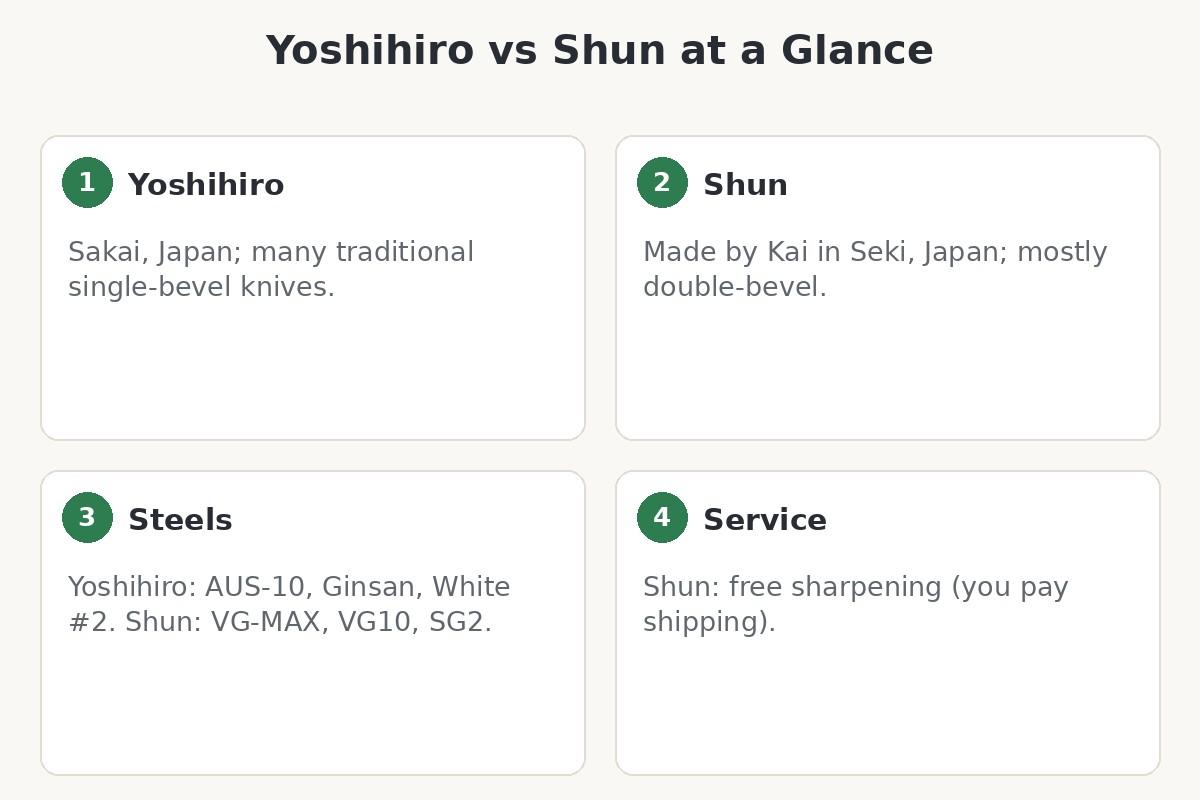
| Yoshihiro | Shun | |
|---|---|---|
| Maker | Yamawaki Hamono | Kai Group |
| Made in | Sakai, Japan | Seki, Japan |
| Style | Traditional Japanese and Western-style | Mostly Western-style Japanese |
| Bevel | Single and double | Mostly double |
| Steels | AUS-10, Ginsan, SK, White #2 | VG-MAX, VG10, SG2 |
| Finishes | Damascus, kurouchi, polished | Damascus, hammered, polished |
| Service | Varies by retailer | Free sharpening (you pay shipping) |
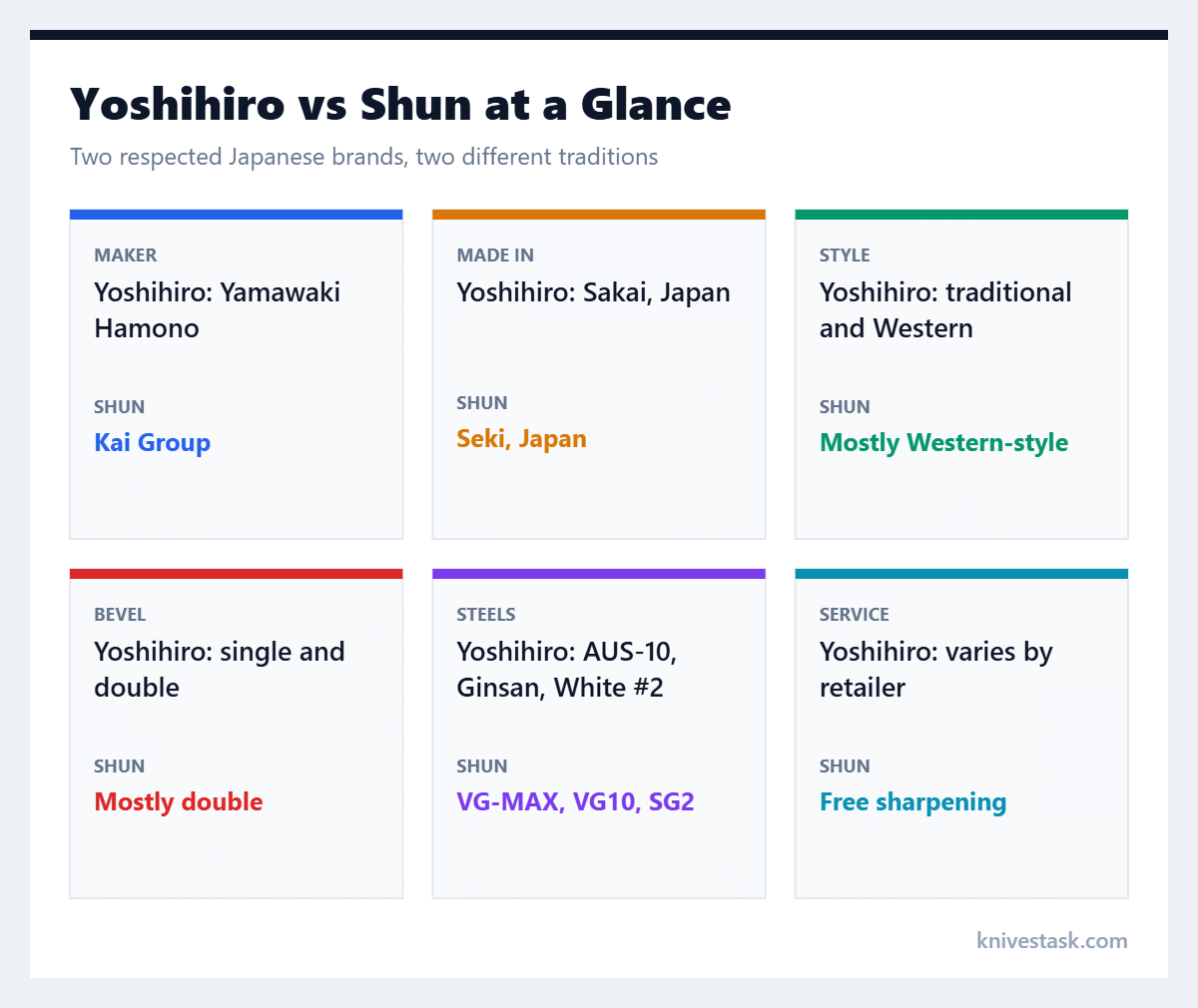
In short, the Yoshihiro vs Shun decision comes down to whether you want traditional Japanese knives and carbon steels, or polished stainless knives with a simple factory sharpening service.
Range of Knives
Yoshihiro’s strength is variety. If you want a traditional yanagiba for sushi, a deba for breaking down fish or an usuba for vegetables, it offers many sizes and steels.
Shun concentrates on versatile kitchen knives in matching lines. That makes it easier to build a consistent set, from paring knife to chef’s knife and bread knife.
Steel and Edge Retention
Both brands use hard Japanese steels that take and hold a very keen edge. Carbon steels such as White #2 sharpen beautifully but rust if left wet.
Stainless steels like VG-MAX and AUS-10 are easier to look after. All hard Japanese steels can chip if twisted or used on bones, so treat them gently.
Gyuto Comparison
For a chef’s knife, compare the Yoshihiro VG-10 Damascus Gyuto with the Shun Premier chef’s knife. Both are stainless, double-beveled and very sharp.
The Yoshihiro usually has a more traditional Japanese profile, while the Shun Premier has a hammered finish and a rounded walnut Pakkawood handle. See our best gyuto knife guide for more choices.
Which Should You Choose?
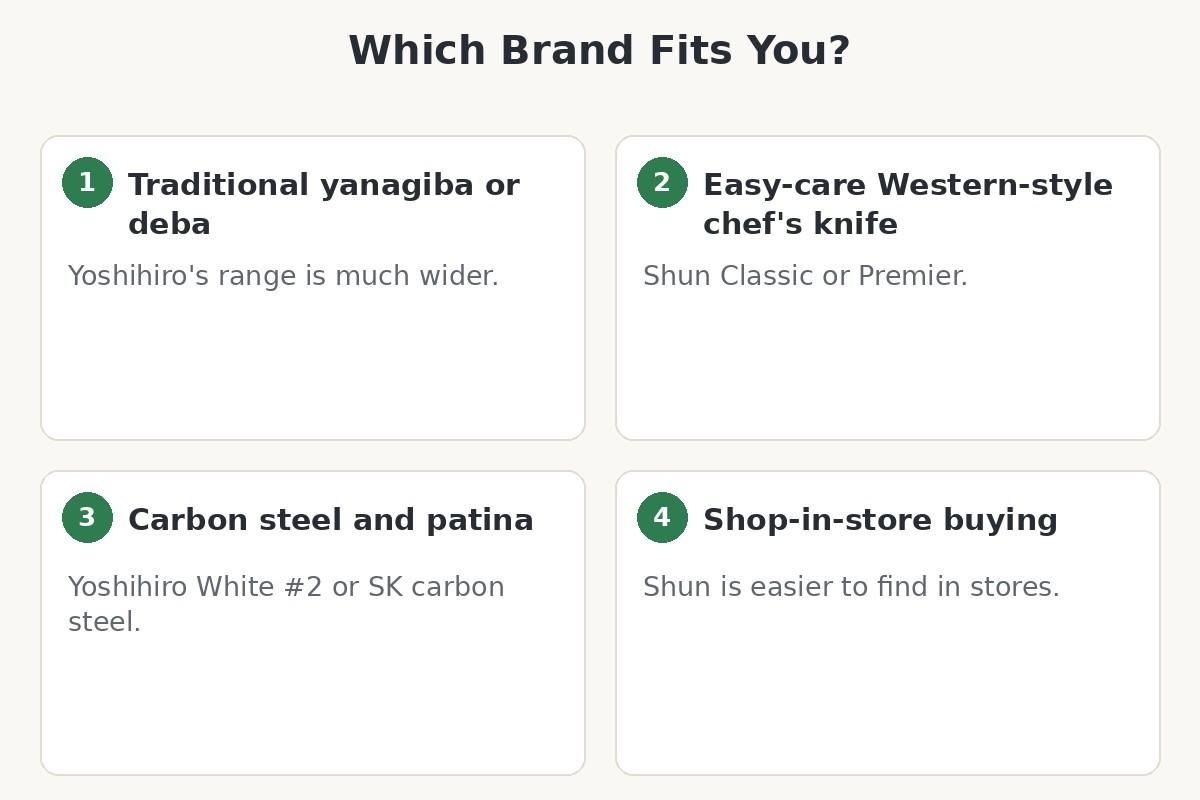
Choose Yoshihiro if you want traditional single-bevel knives, carbon steel or a wider choice of Japanese shapes. It’s a favorite among sushi chefs and enthusiasts.
Choose Shun if you want a polished, low-maintenance stainless knife, matching sets and a sharpening service. It’s easier to buy in stores and simpler for most home cooks.
Neither brand is the overall winner: both are high-quality brands aimed at slightly different buyers.
Care Tips for Japanese Knives
Hand-wash and dry immediately, especially carbon steel. Use wooden or soft plastic boards, and avoid bones, frozen food and twisting cuts.
Sharpen on whetstones at the maker’s angle. For single-bevel knives, sharpen the bevel side and only lightly flatten the back.
Price and Value
Prices overlap widely. Both brands have entry-level stainless knives and premium Damascus or handmade carbon-steel models.
Compare the specific knife’s steel, finish and handle rather than the brand name alone.
Handles
Yoshihiro offers many knives with traditional Japanese wa handles, often in magnolia or rosewood. These are light and shift the balance toward the blade.
Shun lines mostly use Pakkawood handles in a D-shape or rounded Western style. If you’re left-handed, check the handle shape, since D-shaped handles favor right-handed users unless you buy a left-handed version.
Where to Buy
Shun is sold by many kitchen stores and online retailers, so it’s easy to hold one before you buy. Yoshihiro is sold mainly online and through specialist Japanese knife shops.
Buy from authorized sellers to avoid counterfeits and to keep your warranty valid. For another Japanese brand comparison, see Shun vs Miyabi.
Sakai vs Seki: Two Knife Cities
Sakai, near Osaka, is historically known for traditional single-bevel knives used by professional Japanese chefs. Many Sakai knives are made by teams of specialist smiths, sharpeners and handle makers.
Seki, in Gifu Prefecture, is famous for knife and blade manufacturing on a larger scale. Kai’s factories there produce Shun knives with consistent quality and finish.
Single-Bevel Knives for Beginners
If you’re new to Japanese knives, start with a double-bevel gyuto or santoku from either brand. Single-bevel knives need practice to cut straight and to sharpen correctly.
Once you’re comfortable, a single-bevel yanagiba is a rewarding next step for slicing raw fish. See our best sushi knife guide for options.
Warranty and Support
Shun’s warranty and sharpening service are handled through Kai’s service center. Yoshihiro knives are mostly sold through Yoshihiro Cutlery and specialist retailers, so check each seller’s return and warranty terms.
Our Verdict
For most home cooks, Shun is the easier choice: polished stainless knives, a sharpening service and wide availability. For enthusiasts and chefs who want traditional Japanese knives, Yoshihiro’s range is hard to beat.
Damascus Finishes
Both brands sell knives with layered Damascus-style cladding. The pattern is mostly decorative and helps food release slightly, but the cutting performance comes from the hard steel core.
Don’t pay extra for Damascus alone; choose the steel, shape and handle that suit you, then pick the finish you like best.
Weight and Feel
Japanese knives from both brands are lighter and thinner than German knives. They glide through vegetables and boneless meat with little effort, but they’re not meant for heavy chopping.
Final Buying Tip
Decide first whether you want a traditional single-bevel knife or a versatile double-bevel one. That single choice narrows the field more than the brand name does.
Then compare the steel, the handle style and the price of the specific knife you’re considering.
Yoshihiro vs Shun: Who Should Buy Which?
Use this table to match the brand to the way you cook.
| You are… | Better pick | Why |
|---|---|---|
| A home cook buying a first Japanese knife | Shun | Stainless, double bevel and easy to find in stores |
| A sushi fan or a trained cook | Yoshihiro | Wide range of single-bevel yanagiba, deba and usuba knives |
| A carbon steel fan | Yoshihiro | Offers White #2 and other carbon steels |
| Building a matching set | Shun | Matching lines from paring knife to bread knife |
| Someone who does not sharpen at home | Shun | Free sharpening service; you pay shipping |
| Left-handed | Either | Check the handle shape and the bevel before you buy |
Yoshihiro vs Shun: Sharpening and Upkeep
Day-to-day care is where the Yoshihiro vs Shun choice shows most.
Shun: most knives are double bevel, sharpened to 16° per side. You sharpen them on a whetstone like other kitchen knives, or send them to Shun’s sharpening service. The steel is stainless, so hand-washing and drying is enough.
Yoshihiro: the double-bevel gyuto, santoku and nakiri knives sharpen the same way. The single-bevel knives need practice: you sharpen the bevel side and only lightly flatten the back. Carbon steel models must be dried during use and oiled before storage.
If you want the least upkeep, choose a stainless Shun or a stainless double-bevel Yoshihiro.
Frequently Asked Questions
Is Yoshihiro better than Shun?
Neither is better overall; Yoshihiro suits traditional and enthusiast buyers, Shun suits most home cooks.
Where are Yoshihiro knives made?
In Sakai, Japan, by Yamawaki Hamono.
Where are Shun knives made?
In Seki, Japan, by the Kai Group.
Are Shun knives single-bevel?
Most Shun knives are double-bevel, sharpened to 16° per side.
Does Shun sharpen knives for free?
Yes, Shun offers free sharpening; you pay shipping.
Yoshihiro vs Shun: which is better for beginners?
Shun is the easier start for most beginners. A double-bevel Yoshihiro gyuto or santoku is also a good first knife.
Which is better for sushi, Yoshihiro or Shun?
Yoshihiro has the wider range of traditional sushi knives, such as the yanagiba. Shun also makes a yanagiba.
Are Yoshihiro and Shun knives made in Japan?
Yes. Yoshihiro knives are made in Sakai and Shun knives are made in Seki.