Quick Summary
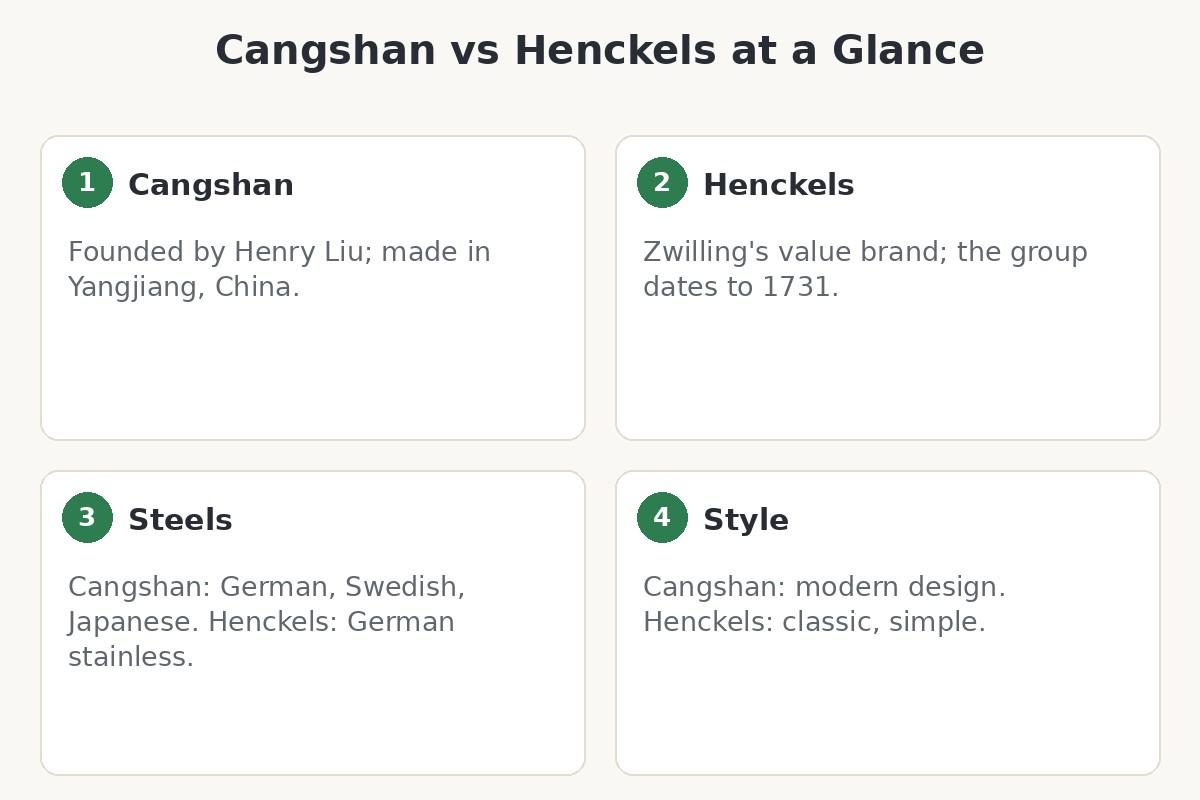
- Cangshan was founded by Henry Liu and makes design-led knives in Yangjiang, China.
- Henckels is the value brand of the Zwilling group, whose history dates back to 1731 in Solingen, Germany.
- Cangshan names its steels clearly (German, Swedish, Japanese) and many lines are forged.
- Henckels value sets are often stamped and very affordable; the premium German knives carry the Zwilling name.
- Choose Cangshan for design and steel options; choose Henckels for low prices and a familiar brand.
Knives Task is reader-supported: if you buy through a link on this page, we may earn a small Amazon commission at no extra cost to you. That never changes which knives we recommend.
Cangshan and Henckels sit in a similar price range but take very different approaches. One is a young brand built around modern design; the other is one of the oldest names in cutlery.
This comparison explains what each brand offers and who it suits.
Cangshan at a Glance
Cangshan was founded by Henry Liu, who had built a kitchenware business in China before moving to the United States. Restaurant supplier KaTom’s Cangshan vs Wüsthof guide dates the company to 2015.
The knives are made in Yangjiang, one of China’s main knife-making cities. Culinary site Chefsroll’s profile of Cangshan notes that Liu chose the factory after evaluating more than 80 manufacturers.
Our older article said the company was founded in 2014 and claimed a “1000 years” knife-making tradition. We’ve corrected the date and removed the claim, which refers to the region rather than the brand.
Learn more in our Cangshan knives review.
Henckels at a Glance
Henckels is part of the Zwilling group, founded in Solingen, Germany, in 1731. The Wikipedia entry on the Zwilling group covers the company’s long history.
Today, the group sells premium knives under the Zwilling name and more affordable knives under the Henckels name. Many Henckels value knives are made outside Germany and are stamped rather than forged.
Our Henckels Statement set review explains the difference between the two tiers in more detail.
Side-by-Side Comparison
| Cangshan | Henckels | |
|---|---|---|
| Founded | 2015 (per KaTom) | Zwilling group: 1731 |
| Made in | Yangjiang, China | Varies by line |
| Construction | Mostly forged | Value lines often stamped |
| Steels | German, Swedish and Japanese, named by line | German stainless |
| Design | Modern, sculpted, award-winning | Classic and simple |
| Price | Mid-range | Budget to mid-range |
Steel and Construction
Cangshan publishes the steel used in each line, from German X50CrMoV15 to Swedish and Japanese steels in higher-end series. Many lines are forged with full tangs and bolsters.
Henckels value knives use German stainless steel and are often stamped, which keeps them light and inexpensive. They’re easy to sharpen and practical for everyday cooking.
Design and Handles
Design is Cangshan’s biggest selling point. Many lines have sculpted handles, angled bolsters and wooden sheaths, and the brand has won design awards.
Henckels keeps things simple, with traditional triple-riveted handles or plain synthetic ones. If you prefer a classic look, Henckels will feel familiar.
Knife Sets Compared
For a full set, compare the Cangshan S1 Series 17-piece block set with the Henckels Statement 14-Piece set.
The Cangshan set offers forged knives with a more distinctive look. The Henckels set costs less and covers everyday tasks with light, stamped knives.
Which Should You Buy?
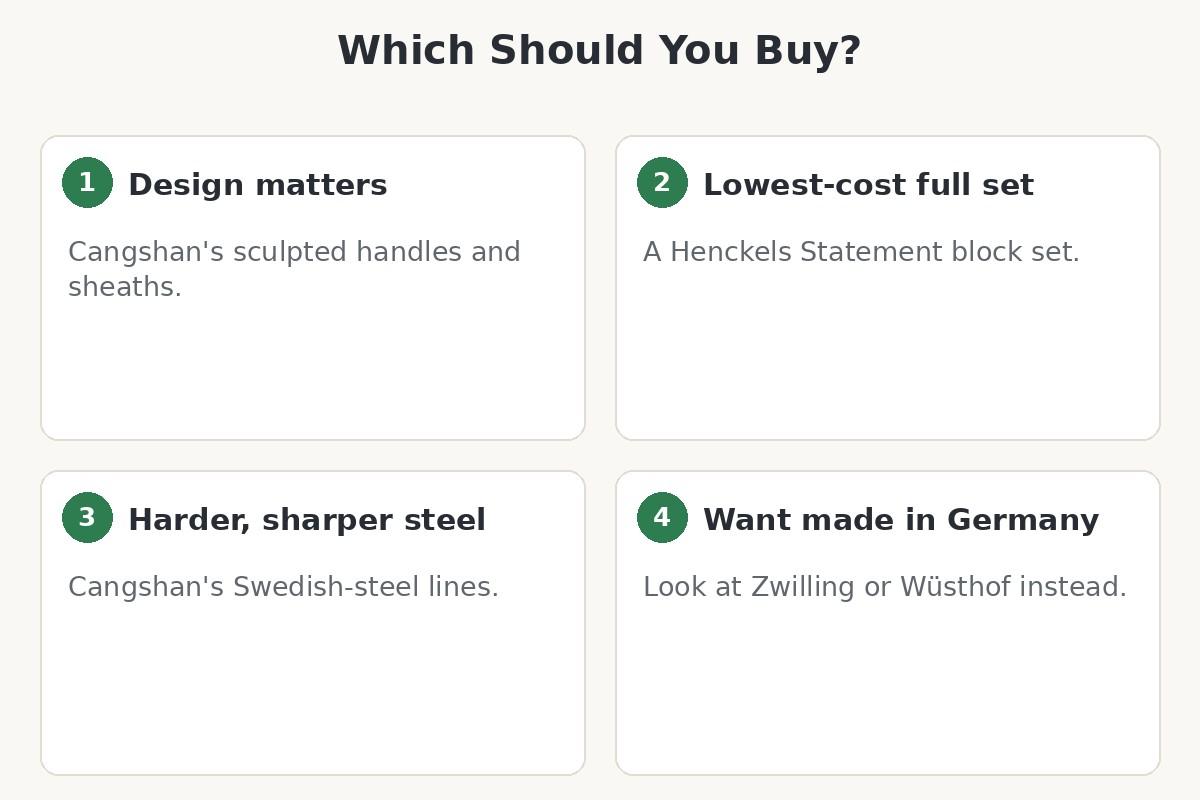
Choose Cangshan if you care about design, want forged knives with clearly named steels and are happy to pay mid-range prices.
Choose Henckels if you want the lowest price for a complete set and prefer a simple, traditional style. If you specifically want a German-made premium knife, look at Zwilling or compare Wüsthof vs Henckels.
Our older article claimed Cangshan suits larger hands and Henckels smaller hands. Handle fit varies by line, so try before you buy if you can.
Care Tips
Hand-wash both brands and dry them straight away; never use the dishwasher. Hone regularly and sharpen at the maker’s recommended angle.
Store knives in a block, on a magnetic strip or in their sheaths so edges don’t knock together.
Warranty
Both brands offer warranties against manufacturing defects, but terms vary by product and retailer. Keep your receipt and check the current terms before buying.
Removed from Our Older Article
Our earlier version included a long list of unrelated questions, such as what a boning knife is and what the sharpest knife in the world is. We’ve removed them to keep this page focused on the comparison.
Which Is Better Value?
For a complete set on a tight budget, Henckels usually wins on price. For a few really good knives with distinctive design, Cangshan often offers more for the money.
A smart approach is to buy one chef’s knife from the brand you like most, use it for a few weeks and then add more pieces.
Sharpening
Both brands sharpen easily on a medium whetstone or a good pull-through sharpener. Keep to the maker’s angle, usually around 15–20° per side for these Western-style knives.
Cangshan’s harder Swedish and Japanese steels take longer to sharpen but hold their edges for more time.
Cangshan’s Main Lines
Cangshan sells many series, which can be confusing at first. Broadly, the German-steel lines such as V2 and S1 are the most affordable, while lines using Swedish or Japanese steel cost more and stay sharp longer.
Many Cangshan knives come with wooden sheaths or in sets with a block. Compare the steel and handle style of each series rather than the series name.
Henckels’ Main Lines
Henckels value lines such as Statement and Classic cover a wide range of prices. Some are stamped and light; others have a forged-style look at budget prices.
If you want the German-made, fully forged experience, the group’s premium knives carry the Zwilling name, such as Zwilling Pro and Four Star.
Our Verdict
Both brands give good value, but in different ways. Cangshan offers more design and better steels for a mid-range budget, while Henckels offers the lowest prices for a complete, practical set.
Comfort and Balance
Cangshan’s forged knives tend to feel heavier, with the balance close to the bolster. Henckels’ stamped value knives feel lighter and move quickly through vegetables.
Neither feel is better; it comes down to whether you prefer a solid, weighty knife or a nimble one. Hold both if you can before buying a whole set.
Where to Buy
Both brands are sold by major kitchen retailers and online stores. Buy from authorized sellers so your warranty is valid, and compare prices, since both brands are often discounted.
Final Buying Tip
Before buying a large set, check which knives you’ll actually use. Many cooks rely on just three: a chef’s knife, a paring knife and a bread knife.
Buying those three from the brand you prefer often gives better value than a big block full of knives that rarely leave it. You can always add more pieces later.
Frequently Asked Questions
Is Cangshan better than Henckels?
Cangshan offers more design and steel options; Henckels is usually cheaper.
Where are Cangshan knives made?
In Yangjiang, China.
Are Henckels knives made in Germany?
The premium Zwilling-branded knives are; many Henckels value knives are made elsewhere.
Is Henckels the same as Zwilling?
Both belong to the same group; Zwilling is the premium brand and Henckels the value brand.
Are Cangshan knives forged?
Most Cangshan lines are forged.