As an Amazon Associate, Knives Task earns from qualifying purchases. We did not test these rods in person; this guide is based on retailer specifications, expert guidance and owner feedback.
A honing rod is the simplest way to keep a kitchen knife cutting well between sharpenings. A few light strokes before cooking straighten the edge, so you sharpen less often and your knives last longer. But the classic steel rod that comes in many knife blocks is not the best choice for every knife, especially hard Japanese blades. That is where a ceramic honing rod comes in.
This guide compares the best ceramic honing rods, explains how they differ from steel and diamond rods, and shows how to hone safely.
Quick Picks
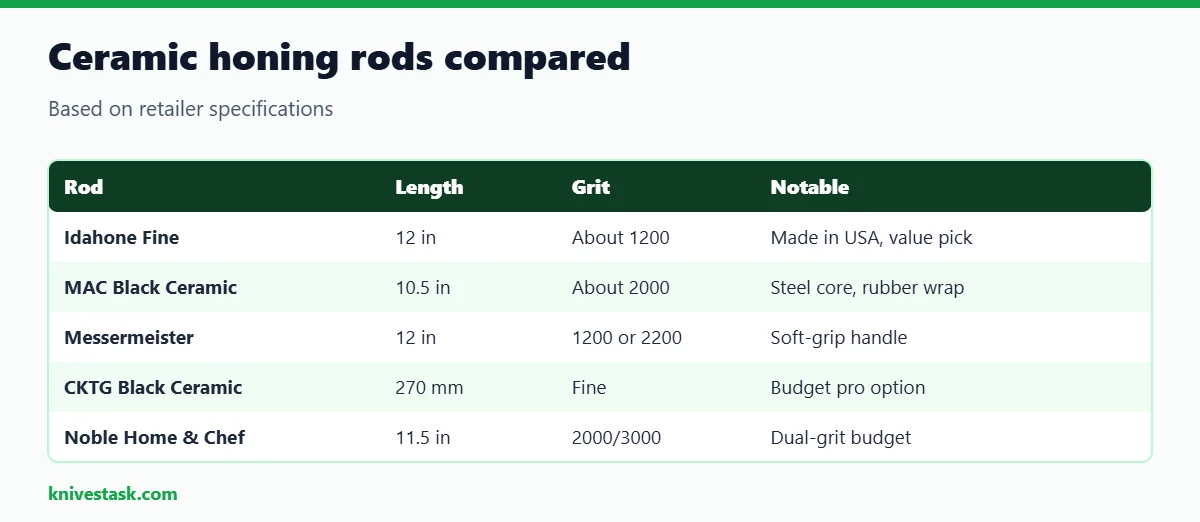
- Best overall: Idahone Fine Ceramic Rod 12″
- Best premium pick: MAC Black Ceramic Honing Rod 10.5″
- Best for long knives: Messermeister 12″ Ceramic Rod
- Best value for pros and students: CKTG Black Ceramic Rod 270mm
- Best budget pick: Noble Home & Chef dual-grit ceramic rod
Why Choose Ceramic?
Steel honing rods work well on softer Western knives, but they are not ideal for harder steels. Cutlery and More’s honing guide explains that steel rods suit softer stainless knives below about 60 Rockwell, such as German and French styles, while ceramic rods work on all knives, including harder Japanese steels, and are less likely to scratch the blade. Japanese knives often run at 60 HRC or higher, and their hard, thin edges tend to chip rather than roll, so a fine ceramic rod is the safer tool.
Ceramic rods are also slightly abrasive. As well as realigning the edge, they remove a tiny amount of metal, which helps restore bite between full sharpenings.
1. Idahone Fine Ceramic Rod 12″
Best overall. The Idahone is one of the most recommended ceramic rods among knife enthusiasts and culinary forums. Chef Knives To Go’s Idahone listing shows a fine grit of about 1200, a 12-inch rod and a 17.5-inch overall length. It is made in the USA from high-alumina ceramic, and it is relatively affordable. Its light color also makes it easy to see when metal residue builds up and the rod needs cleaning.
Pros: excellent value, long rod, fine grit suits most knives, easy to clean.
Cons: solid ceramic can break if dropped on a hard floor.
Check the Idahone 12″ rod on Amazon
2. MAC Black Ceramic Honing Rod 10.5″
Best premium pick. MAC’s black ceramic rod is a favourite of owners of MAC and other Japanese knives. Retail specifications list a medium 2000-grit black ceramic surface over a steel core wrapped in rubber, which adds shock resistance. It also has two grooved sides for slightly more aggressive honing when needed. The rod is 10.5 inches long, with a 15.75-inch overall length.
Pros: very hard, durable steel-core design, fine finish, grooved sides for flexibility.
Cons: shorter than 12-inch rods; dark color hides residue; costs more than the Idahone.
Check the MAC Black Ceramic rod on Amazon
3. Messermeister 12″ Ceramic Rod
Best for long knives. Messermeister makes 12-inch ceramic rods in different grits, including a fine 1200-grit version and an ultra-fine black version around 2200 grit with a break-resistant ceramic core. The long rod comfortably covers 10-inch chef’s knives and slicers, and the soft-grip handle is comfortable for daily use.
Pros: long, choice of grits, comfortable handle, reputable knife brand.
Cons: check which grit version you are buying.
Check Messermeister ceramic rods on Amazon
4. CKTG Black Ceramic Sharpening Rod 270mm
Best value for pros and students. Chef Knives To Go sells its own black ceramic rod as an alternative to the Idahone for professional users and culinary students. Owners describe it as a strong performer for quick touch-ups on hard blades at a reasonable price. At 270mm (about 10.6 inches), it suits most home and professional knives.
Pros: good price, fine finish for hard steels.
Cons: mainly sold through the retailer’s own store; dark color hides residue.
Check black ceramic honing rods on Amazon
5. Noble Home & Chef Ceramic Rod
Best budget pick. If you want to try ceramic honing without spending much, budget brands such as Noble Home & Chef sell 11.5-inch ceramic rods with a hand guard and hanging ring, including dual-grit versions with a finer and a coarser side. They are a sensible starting point for home cooks, though build quality and durability vary more than with premium brands.
Pros: low price, dual-grit option, hand guard.
Cons: less proven durability; grit labeling varies by seller.
Check budget ceramic honing rods on Amazon
Steel vs Ceramic vs Diamond Rods
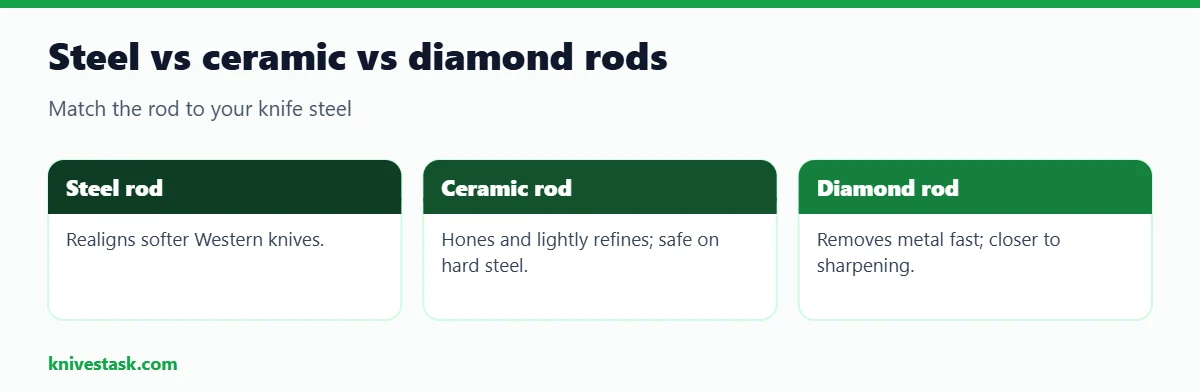
Steel rods realign the edge without removing much metal. They are durable and inexpensive, and work best on softer German and French knives.
Ceramic rods hone and lightly refine the edge. They are suitable for nearly every double-bevel kitchen knife, including hard Japanese steels, but can break if dropped.
Diamond rods remove metal quickly and act more like a sharpener than a hone. They are useful for quick repairs, but daily use wears blades down faster.
If you are not sure what steel your knife uses, check the maker’s details or our guide to types of knives and their uses.
How to Choose a Ceramic Honing Rod

Length
Choose a rod at least as long as your longest knife’s blade, so you can hone the whole edge in one stroke. A 10- to 12-inch rod covers most kitchens.
Grit
Fine grits around 1000 to 2000 are ideal for regular honing. Coarser rods remove more metal; very fine rods polish but do less to restore bite.
Construction
Solid ceramic is hard and effective but brittle. Rods with a steel core or shock-absorbing design survive accidental knocks better.
Color
White or light rods show gray metal streaks clearly, so you know when to clean them. Black rods hide residue.
How to Hone a Knife on a Ceramic Rod
- Hold the rod vertically with the tip resting on a towel or cutting board. This is safer and more stable than honing in the air.
- Set the angle: hold the blade at roughly the same angle as its edge, around 15 degrees for most Japanese knives and up to 20 for Western knives. Our guide on knife sharpening angles explains how to judge this.
- Stroke lightly: draw the blade down and toward you, sweeping from heel to tip in one smooth motion. Use very light pressure, about the weight of the knife.
- Alternate sides: do the same on the other side. Five to eight strokes per side are usually enough.
- Test the edge: slice a sheet of paper or a tomato. If it still struggles, it is time to sharpen.
- Clean the rod: wipe it or scrub gently with a damp cloth and mild abrasive cleaner to remove metal streaks.
Single-bevel Japanese knives such as yanagiba and deba should not be honed on a round rod; maintain them on whetstones instead.
How Often Should You Hone?
Many cooks hone before each cooking session, or every few uses. Ceramic rods remove a little metal, so there is no need to hone hard or often if the knife still cuts well. When honing no longer brings the edge back, sharpen on a stone or sharpener. Our guide to the best whetstones for beginners is a good place to start, or try the best electric knife sharpeners for a faster option.
Best Honing Rod by Knife Type
German and Western chef’s knives
Softer stainless knives from brands like Wüsthof, Zwilling and Victorinox respond well to both steel and ceramic rods. A fine ceramic rod such as the Idahone gives a slightly crisper edge, while a smooth steel rod is more durable in a busy kitchen. Many cooks keep both.
Japanese gyuto, santoku and nakiri
Hard Japanese steels are where ceramic really earns its place. Use a fine rod, a low angle and very light pressure to avoid chipping. If you own knives from our guides to the best gyuto knives or best santoku knives, a fine ceramic rod is the safest way to touch them up between whetstone sessions.
Boning, fillet and utility knives
Flexible and narrow blades hone quickly. A shorter rod is fine, but keep the angle consistent along the curve of the blade. Butchers and hunters who process a lot of meat often hone every few minutes during long sessions.
Ceramic Rod vs Leather Strop
A leather strop is another way to maintain an edge. Instead of realigning the edge against a hard surface, you drag the edge backwards across leather, often loaded with a fine polishing compound. Strops remove the tiny burr left after sharpening and polish the edge to a very fine finish. They are excellent for Japanese knives and straight razors, but they take a little more space and technique than a rod. Many sharpening enthusiasts use a ceramic rod for quick touch-ups and a strop after whetstone sessions. See leather strops.
Caring for Your Ceramic Rod
- Clean it often: metal streaks clog the surface and reduce its effect. Scrub with water and a mild abrasive cleaner, or use a pencil eraser for light marks.
- Store it safely: keep it in a knife block slot, a drawer insert or on a hook, not loose in a drawer where it can knock against other tools.
- Avoid drops: solid ceramic can chip or snap if it hits tile or stone floors.
- Do not use it as a pry bar or tenderizer: sideways force can crack the rod.
- Replace damaged rods: a chipped rod can catch and damage your edge.
Honing Mistakes to Avoid
- Too much pressure: heavy strokes can chip hard edges or round over the bevel.
- Too steep an angle: honing at a much higher angle than the edge creates a rounded, dull edge.
- Fast, flashy strokes: slow, controlled strokes are safer and more effective.
- Honing instead of sharpening forever: honing only maintains an edge. A truly dull knife needs sharpening.
Honing in a Busy Kitchen
Professional cooks often hone several times during a shift, because a knife that cuts cleanly is faster and safer. At home, building honing into your routine is simple: give your chef’s knife a few strokes when you take it out, before you start prepping. It takes under thirty seconds and keeps the edge feeling fresh for weeks.
Keep the rod where you store your knives so it is always within reach. A knife block with a rod slot, a wall-mounted magnetic strip with a hook, or a drawer insert all work. Proper storage also protects the edge you have just honed; read our guide on how to store kitchen knives for options. If rust or stains appear on your blades, our article on removing rust from kitchen knives explains how to clean them before honing.
Frequently Asked Questions
Is a ceramic rod better than a steel rod?
For hard Japanese knives, yes. For soft German knives, both work. Ceramic is the more versatile choice if your knife block mixes both styles.
Can a ceramic rod sharpen a knife?
It can lightly refine an edge, but it does not replace sharpening a dull knife. Once honing stops working, sharpen.
Why is my ceramic rod turning gray?
That is metal removed from your knives. Clean it with water and a mild abrasive cleaner or eraser to keep it cutting well.
Will a ceramic rod break?
Solid ceramic can crack or snap if dropped on a hard surface. Store it in a block or on a hook, and consider a steel-core model if you are worried.
Can I use a honing rod on serrated knives?
Round rods are not designed for serrations. Serrated knives rarely need honing; use a tapered serrated sharpener when needed.
Final Verdict
The Idahone Fine Ceramic Rod 12″ is our top pick for its value, length and proven performance. Choose the MAC Black Ceramic Rod for a durable premium option, the Messermeister 12″ for long knives and grit choice, the CKTG Black Ceramic for a pro-style rod at a fair price, and a Noble Home & Chef rod if you want to try ceramic on a budget. Use light pressure, clean the rod regularly, and your knives will stay sharp much longer.
Browse ceramic honing rods on Amazon