As an Amazon Associate, Knives Task earns from qualifying purchases. We did not test these sharpeners in person; this guide is based on maker and retailer specifications, published test results and owner feedback.
Not everyone wants to learn to sharpen on a whetstone. An electric knife sharpener puts a fresh edge on a dull kitchen knife in about a minute, with guides that hold the angle for you. The best models are fast, consistent and gentle enough for good knives, while cheap ones can grind away more steel than they need to.
This guide compares the best electric knife sharpeners for home kitchens, explains the difference between fixed-angle and belt sharpeners, and covers how to use one without damaging your knives.
Quick Picks
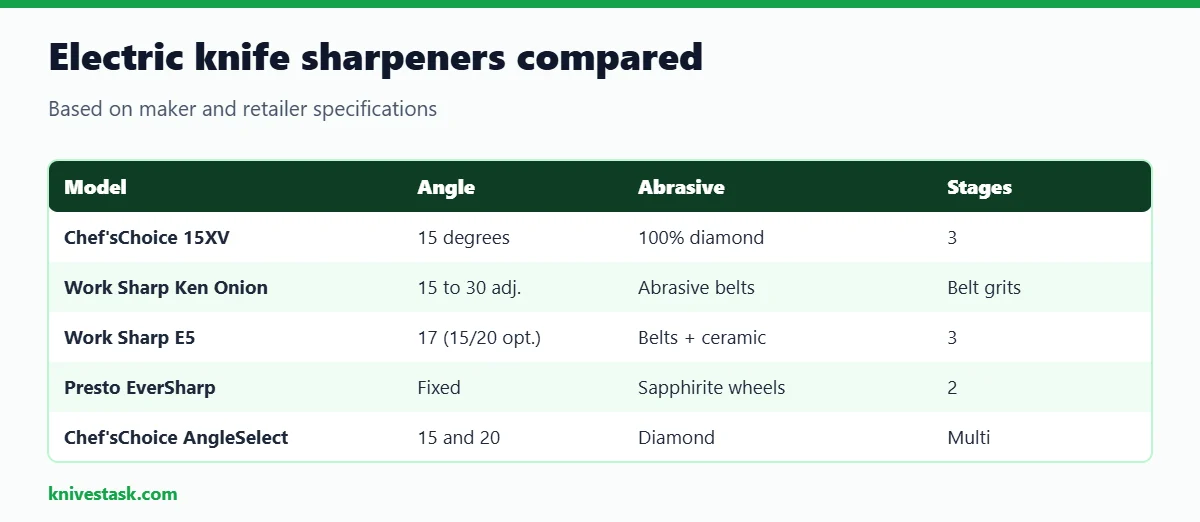
- Best overall: Chef’sChoice 15XV (Trizor XV EdgeSelect)
- Most versatile: Work Sharp Ken Onion Edition
- Best easy belt sharpener for the kitchen: Work Sharp Culinary E5
- Best budget pick: Presto 08800 EverSharp
- Best for mixed 15 and 20 degree knives: Chef’sChoice AngleSelect
1. Chef’sChoice 15XV (Trizor XV EdgeSelect)
Best overall. The 15XV is the most widely recommended electric sharpener for home cooks, and it was chosen as the winner in America’s Test Kitchen’s knife sharpener testing. It uses three stages: two with 100% diamond abrasives to sharpen and hone, and a third with flexible stropping disks that polish the edge. Spring-loaded guides hold the blade at a 15-degree angle.
Retail listings such as Cutlery and More’s 15XV page list a 125-watt motor, 110V power, US manufacture and a three-year warranty. The 15XV handles straight and serrated blades, Asian-style knives, and can convert a traditional 20-degree Western edge to a finer 15-degree edge.
Pros: very consistent results, easy to use, works on serrated and Japanese knives, polishing stage.
Cons: expensive; converting a 20-degree knife the first time removes noticeable metal.
Check the Chef’sChoice 15XV on Amazon
2. Work Sharp Ken Onion Edition
Most versatile. Instead of fixed slots, the Ken Onion Edition uses flexible abrasive belts and an adjustable guide that sets angles from about 15 to 30 degrees. Belts range from coarse grits for repair to a 6000 extra-fine belt for polishing. Outdoor Life named the Work Sharp Ken Onion Edition Elite Mk.2 its best overall electric sharpener, praising its edges and adjustability, while noting it takes practice and is pricey.
It sharpens kitchen knives, outdoor knives, scissors and tools, making it a good choice if you own more than kitchen cutlery. The trade-off is a learning curve: you guide the blade yourself, so even bevels take a little practice.
Pros: adjustable angle, sharpens almost anything, can repair damaged edges, excellent results.
Cons: learning curve, belts need replacing, higher price.
Check the Work Sharp Ken Onion on Amazon
3. Work Sharp Culinary E5
Best easy belt sharpener for the kitchen. The E5 brings Work Sharp’s belt system to a simpler, kitchen-focused design. Retail listings describe a default 17-degree angle with optional 15- and 20-degree guides, three sharpening programs, and a ceramic honing rod included for touch-ups between sharpenings. Belts flex to follow the blade’s curve, so the tip and heel get sharpened evenly.
Pros: belt sharpening with less skill required, bonus ceramic hone, compact.
Cons: replacement belts add ongoing cost; less adjustable than the Ken Onion.
Check the Work Sharp E5 on Amazon
4. Presto 08800 EverSharp
Best budget pick. The Presto EverSharp is a simple two-stage sharpener with Sapphirite grinding wheels: one coarse stage to sharpen and one finer stage to finish. Reviewers commonly describe it as a fast, reliable workhorse for a fraction of the cost of premium models. It is meant for straight-edge knives only, and its angle is fixed, so it is not ideal for Japanese knives.
Pros: very affordable, quick, simple.
Cons: no serrated support, fixed angle, removes more metal than premium sharpeners.
Check the Presto EverSharp on Amazon
5. Chef’sChoice AngleSelect
Best for mixed knife collections. Many kitchens have both German-style knives with roughly 20-degree edges and Japanese knives with roughly 15-degree edges. Chef’sChoice’s AngleSelect models include slots for both, so you can keep each knife at its original angle rather than converting everything to 15 degrees.
Pros: two angles in one machine, diamond abrasives, Chef’sChoice build.
Cons: larger footprint; check the exact model’s stages before buying.
Check Chef’sChoice AngleSelect models on Amazon
Types of Electric Sharpeners
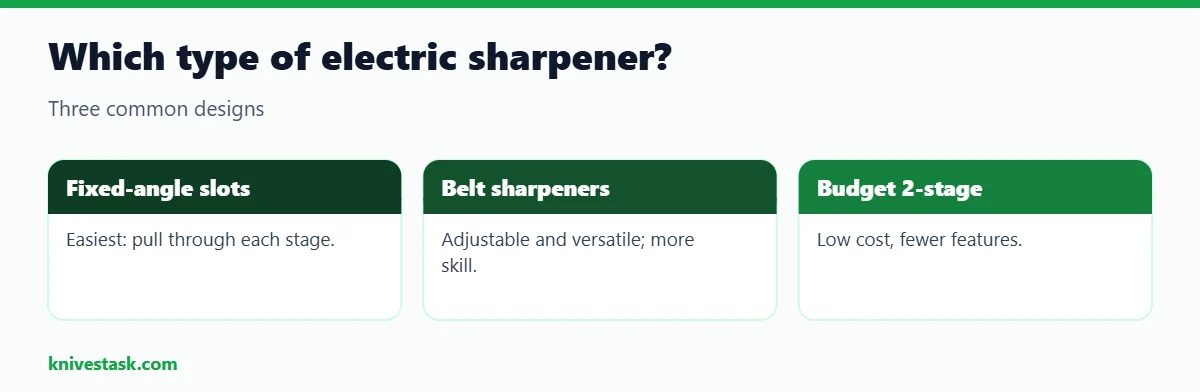
Fixed-angle slot sharpeners (Chef’sChoice, Presto) are the easiest to use. You pull the knife through each slot a set number of times, and guides hold the angle. They are best for people who want sharp knives with no learning curve.
Belt sharpeners (Work Sharp) use a moving abrasive belt. They are adjustable and versatile, but you control the blade, so they take a bit more skill. They are popular with people who sharpen hunting, pocket and kitchen knives.
Budget two-stage sharpeners cost less and work fine on inexpensive knives, but they generally remove more metal and lack fine polishing stages.
What to Look For
Edge angle
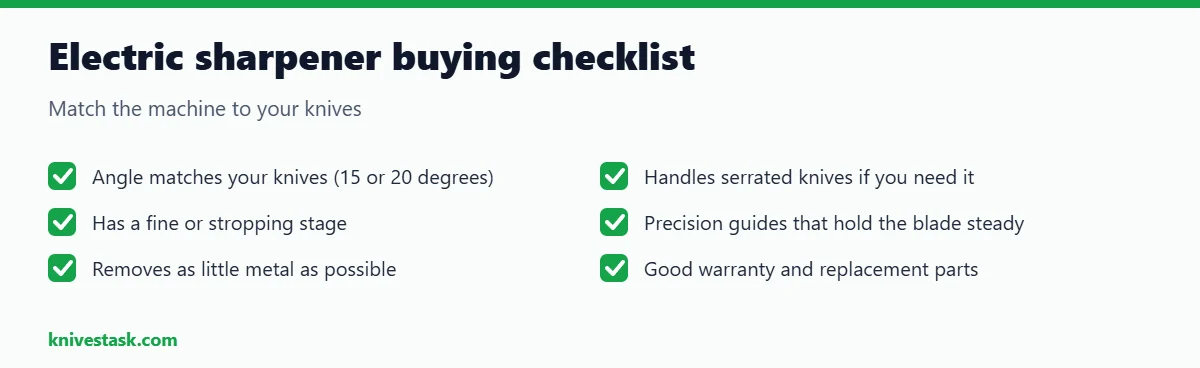
Western kitchen knives traditionally use about 20 degrees per side, and Japanese knives about 15. Choose a sharpener that matches your knives, or one with both angles. Our guide on what angle to sharpen kitchen knives explains this in detail.
Abrasive type
Diamond abrasives cut quickly and handle hard steels. Ceramic and Sapphirite wheels are common on budget models. Flexible belts adapt to the blade’s shape.
Number of stages
More stages generally mean a finer finish. A final stropping or polishing stage makes a noticeable difference in how smoothly a knife slices.
Serrated knife support
If you want to sharpen bread knives, make sure the model lists serrated blades. Our picks for the best bread knives cover blades that benefit from this.
How to Use an Electric Knife Sharpener
- Clean and dry the knife.
- Start in the coarsest stage only if the knife is dull. For touch-ups, skip straight to the finer stages.
- Pull the blade through the slot slowly and steadily, from heel to tip, letting the guide set the angle. Do not push down.
- Alternate sides as the instructions direct, using the same number of pulls on each side.
- Finish in the polishing or stropping stage.
- Wipe the blade to remove metal filings, and empty the sharpener’s filing tray occasionally.
Electric Sharpener vs Whetstone
An electric sharpener is faster and requires no skill, which makes it a great choice for busy home cooks. A whetstone takes longer and needs practice, but removes less metal and gives you full control over the angle and finish, which matters for expensive Japanese knives. Many people use both: an electric sharpener for everyday knives and a whetstone for prized blades. If you want to try stones, see our guide to the best whetstone for beginners, or compare all options in our knife sharpener comparison.
Common Mistakes to Avoid
- Using the coarse stage every time: it removes metal quickly. Save it for dull knives.
- Pressing down: let the guides and abrasives do the work.
- Sharpening single-bevel knives in a double-bevel machine: traditional single-bevel Japanese knives need a compatible sharpener or a whetstone.
- Skipping the honing rod: regular honing between sharpenings means you sharpen less often and your knives last longer.
Best Electric Sharpener by Knife Type
German and other Western kitchen knives
Knives from brands such as Wüsthof, Henckels and Victorinox usually come with edges around 20 degrees and use softer stainless steel. A 15-degree machine like the 15XV will convert them to a sharper edge, which many cooks prefer for slicing. If you want to keep the original angle, an AngleSelect model with a 20-degree slot is the safer choice.
Japanese knives
Japanese gyuto, santoku and nakiri knives typically use harder steel and thinner edges. A diamond 15-degree sharpener or an adjustable belt sharpener set to a low angle works best. Use the finest stages for maintenance and avoid heavy pressure, which can chip very hard edges. If you own one of the knives in our guide to the best Japanese kitchen knives, check the maker’s sharpening advice first.
Serrated, bread and steak knives
Only some electric sharpeners handle serrations, usually in the final stage. Serrated knives stay sharp for a long time, so they rarely need sharpening; when they do, a model that lists serrated support is essential.
Outdoor, hunting and pocket knives
Thicker blades, recurved edges and tools like scissors are where belt sharpeners shine. The Work Sharp Ken Onion handles these far better than slot-style kitchen sharpeners.
Electric vs Manual Pull-Through Sharpeners
Manual pull-through sharpeners use the same basic idea as electric slot sharpeners, but you supply the motion. They are cheaper, quieter and need no outlet, which makes them handy for small kitchens or camping. Electric models work faster, are more consistent, and usually include more stages for a finer edge. If you sharpen a full knife block several times a year, the electric model saves real time; for occasional touch-ups on one or two knives, a quality manual sharpener can be enough. See manual sharpeners.
Care and Maintenance
- Empty the filings: many sharpeners collect metal dust in a tray or with a magnet. Clean it regularly so it does not build up.
- Keep it dry: wipe the outside with a damp cloth only. Never immerse the sharpener in water.
- Replace belts on schedule: belt sharpeners cut slower and less evenly as belts wear.
- Use clean knives: food residue and grease clog abrasives.
- Store safely: keep the sharpener unplugged and out of reach of children.
Is It Cheaper Than Professional Sharpening?
Professional sharpening services typically charge per knife, and costs add up quickly for a full knife block sharpened a few times a year. A mid-range electric sharpener can pay for itself within a couple of years for a household with several knives, and it means you never have to go without your favourite knife while it is away being sharpened. For very expensive or single-bevel Japanese knives, many owners still prefer a professional or a whetstone.
How to Tell When Your Knife Needs Sharpening
Before reaching for the sharpener, check whether the knife actually needs it. Over-sharpening shortens a blade’s life, so a quick test saves steel:
- The tomato test: a sharp knife bites into tomato skin with almost no pressure. If it slides or squashes the tomato, it needs attention.
- The paper test: hold a sheet of printer paper by one corner and slice down. A sharp edge cuts cleanly; a dull edge tears or catches.
- The onion test: a dull knife crushes onion layers and makes your eyes water more.
- Look at the edge: under a bright light, a dull edge reflects light along its length; a sharp edge shows almost no reflection.
If the knife only feels slightly off, try honing first. A honing rod straightens the edge without removing much metal, and often restores the bite. Only move to the sharpener when honing no longer helps. You can learn more about storing knives so they stay sharp longer in our guide on how to store kitchen knives.
Frequently Asked Questions
Do electric knife sharpeners ruin knives?
Good ones do not, when used correctly. Problems usually come from pressing too hard, using the coarse stage too often, or using a cheap machine that removes a lot of metal.
Can I sharpen Japanese knives in an electric sharpener?
Yes, with a 15-degree model like the Chef’sChoice 15XV or an adjustable belt sharpener. Avoid fixed 20-degree budget models for Japanese knives.
How often should I use an electric sharpener?
For most home cooks, every few months is enough, with honing in between. Over-sharpening wears blades down faster.
Can electric sharpeners do serrated knives?
Some can. The Chef’sChoice 15XV lists serrated support; the Presto EverSharp is for straight edges only.
Is an electric sharpener worth it?
If you do not want to learn a whetstone and want sharp knives quickly, yes. A good one pays for itself compared with professional sharpening over a few years.
Final Verdict
The Chef’sChoice 15XV is our top pick for most kitchens: easy, consistent and suitable for both Western and Japanese knives. Choose the Work Sharp Ken Onion if you sharpen many kinds of blades, the Work Sharp E5 for a simpler kitchen belt sharpener, the Presto EverSharp on a tight budget, and the Chef’sChoice AngleSelect if your knife block mixes 15- and 20-degree knives.
Browse electric knife sharpeners on Amazon