Quick Summary
- Secure your board with a damp towel or non-slip mat before you start.
- Use a firm handshake grip and keep your free hand well out of the way.
- Let the weight do the work: a short, controlled lift from the elbow, not a big swing.
- If the blade sticks, press down on the spine with your flat palm instead of hacking again.
- A Chinese vegetable cleaver is not a bone chopper; use a heavy meat cleaver for bone.
Knowing how to use a meat cleaver safely matters, because it is the heavyweight of the kitchen. Its thick, rectangular blade and solid weight let it chop through poultry joints, ribs and small bones that would damage a regular knife.
Because it works by momentum rather than slicing, it needs a different technique from a chef’s knife.
Meat Cleaver vs Chinese Cleaver
| Meat cleaver | Chinese vegetable cleaver (cai dao) | |
|---|---|---|
| Blade | Thick and heavy | Thin and lighter |
| Main job | Chopping through bone and joints | Slicing, dicing and mincing vegetables and boneless meat |
| Bone? | Yes, small to medium bones | No; it will chip |
| Technique | Controlled drop | Push and slice cuts |
Our older version of this guide treated the Chinese cleaver as a bone chopper. Most Chinese cleavers are vegetable cleavers; only heavier bone-chopper versions are made for bone.
Compare models in our best Chinese cleaver guide.
Step 1: Set Up Your Work Area
Use a thick, sturdy wooden or plastic board that won’t move. Place a damp kitchen towel or non-slip mat underneath.
Clear the area around you and make sure nothing is near the edge of the counter. Glass, stone and ceramic surfaces will damage the edge and can shatter.
Step 2: Grip the Cleaver
For chopping, use a handshake grip: wrap your fingers firmly around the handle, close to the blade. You can rest your thumb on the spine for extra control if your hand is strong enough.
For slicing cooked meat, switch to a pinch grip, with your thumb and index finger on either side of the blade.
Step 3: Chop with Control
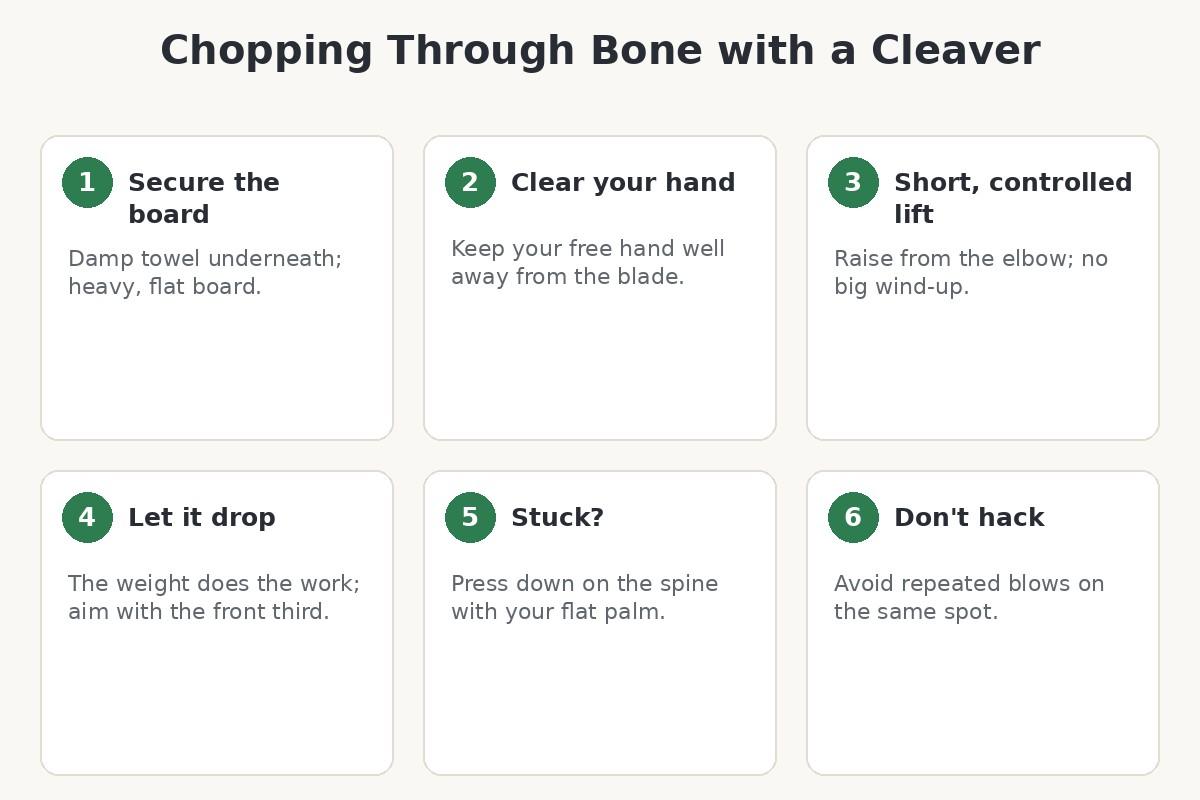
America’s Test Kitchen’s guide on how to use a meat cleaver advises against a big wind-up. Raise the cleaver a short way from the elbow and bring it down, letting its weight do the work.
- Aim with the front third of the blade for the most leverage.
- Keep your wrist firm and your eyes on the target.
- Keep your free hand well away, or hold the food at the far end.
- Chop once, cleanly, rather than hacking repeatedly.
Our older article told readers to “throw” the knife’s edge at the meat using momentum. A controlled drop is much safer and more accurate.
If the Blade Gets Stuck
If the cleaver lodges partway through a bone, don’t lift and swing again. Lay your flat palm on the spine and press down firmly to finish the cut.
Repeated blows rarely land in the same place and leave splintered bone and mangled meat.
What You Can Cut with a Meat Cleaver
| Good for | Avoid |
|---|---|
| Chicken and duck joints | Large beef or pork leg bones |
| Pork and lamb ribs | Frozen meat |
| Oxtail and small bones | Cutting on glass or stone |
| Hard squash, carefully | Delicate slicing of raw fish |
Very large or dense bones need a bone saw, which a butcher can use for you.

Keep this checklist in mind every time you pick up the cleaver. Most cleaver injuries happen when a blade glances off bone or a board slips, and both are easy to prevent.
More Ways to Use a Cleaver

A cleaver is more versatile than it looks. Knife maker Cutco’s guide on using a cleaver lists several handy tricks.
- Crush garlic and ginger by laying the flat of the blade on top and pressing with the heel of your hand.
- Transfer food by scooping chopped ingredients onto the wide blade.
- Tenderize thin cuts by tapping with the spine through plastic wrap.
- Split poultry by resting the blade in place and pressing down with a folded towel on the spine.
Safety Tips
- Keep the cleaver sharp; a dull blade bounces and slips.
- Never try to catch a falling cleaver.
- Work slowly until you’re used to the weight.
- Store it safely on a strong magnetic strip, in a sheath or hung up.
UK supplier Butchers Equipment’s cleaver techniques guide gives the same warning: don’t chop too forcefully, and sharpen the blade rather than adding force.
Caring for Your Meat Cleaver
Wash the cleaver by hand with hot, soapy water after use, especially after raw meat, and dry it straight away. Carbon steel cleavers need a thin wipe of food-safe mineral oil to prevent rust.
Meat cleavers have a thicker, more durable edge than most kitchen knives, often around 25° per side. Hone and sharpen it like any other knife, keeping that wider angle.
For an overview of when to use which knife, see the best knives for cutting meat and our guide to the different types of cleavers.
Getting Used to a Cleaver
A cleaver feels heavy at first. Start with easy jobs like crushing garlic and splitting chicken wings before moving on to ribs and joints.
Step-by-Step: Cutting a Whole Chicken into Pieces
Splitting a chicken is the best way to practise with a meat cleaver. Work on a large board and pat the bird dry first.
- Remove the legs by cutting through the skin, popping the hip joint and chopping through it.
- Separate thigh and drumstick with one firm drop at the joint.
- Split the bird along the backbone, pressing on the spine of the cleaver if needed.
- Chop the breast into pieces through the bone, keeping each stroke controlled.
- Halve the wings at the joints.
For Chinese-style dishes, the pieces are often chopped small through the bone. Keep your free hand well back and the pieces flat on the board.
Choosing the Right Meat Cleaver
A good home meat cleaver weighs enough to chop without strain but not so much that it tires your wrist. Most home cooks find a 6- to 7-inch blade easy to manage.
Look for a full tang, a secure handle and steel that’s tough rather than very hard, since harder steels can chip on bone.
Common Cleaver Mistakes
The most common mistake is gripping too far back on the handle, which reduces control. Hold it close to the blade.
Another is chopping on a thin or flexible board, which bounces and wastes the cleaver’s force. Use a thick board that sits flat.
Cleaning Up After Chopping Bone
Chopping bone leaves small splinters on the board and in the meat. Wipe the board with a damp cloth between jobs and check pieces before cooking.
Sanitize the board and cleaver after raw poultry, and wash your hands thoroughly. Check the edge afterward too, since bone work can leave small dents that need honing.
Frequently Asked Questions
How do you use a meat cleaver safely?
Secure the board, use a firm grip, keep your free hand clear and let the weight do the chopping.
Can a meat cleaver cut through bone?
Yes, small to medium bones such as poultry joints and ribs; use a saw for large bones.
Should I swing a cleaver hard?
No, a short, controlled drop is safer and more accurate.
What do I do if my cleaver gets stuck in bone?
Press down on the spine with your flat palm to finish the cut.
Can I use a Chinese vegetable cleaver on bone?
No, its thin edge will chip; use a heavy meat cleaver instead.