Quick Summary
- Angle: Wüsthof recommends 14.5° per side for standard blades and 10° for Asian-style knives like santokus.
- Hone often: a few strokes on a honing steel keep the edge aligned between sharpenings.
- Sharpen rarely: Wüsthof suggests using the coarse slot of its hand-held sharpener only about once a year or two.
- Whetstones give the most control; start coarse, finish fine, and keep a steady angle.
- Serrated knives shouldn’t go through hand-held pull-through sharpeners; use a professional service.
Learning how to sharpen a Wüsthof knife properly keeps one of the best German kitchen knives performing like new. Wüsthof is a family-owned knife maker based in Solingen, Germany, known for forged stainless steel kitchen knives. Like any knife, a Wüsthof stays sharp longer with regular honing and the right sharpening angle.
Table of Contents
This guide follows Wüsthof’s own published advice, covering a honing steel, a whetstone and the brand’s hand-held two-stage sharpener. For more on the knives themselves, read our Wüsthof knives review.
What Angle Should You Sharpen a Wüsthof Knife?
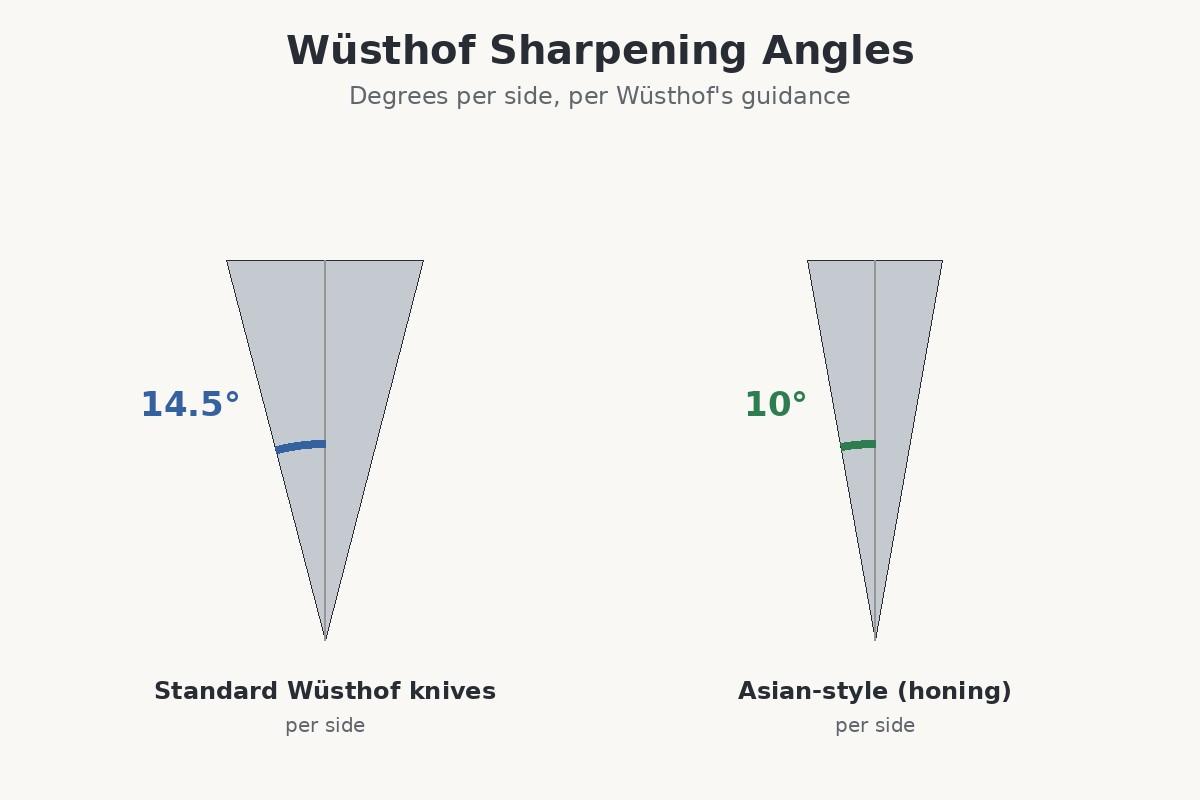
Wüsthof’s guide on how to sharpen your Wüsthof knives recommends holding the blade at 14.5° to the steel or stone. For Asian-style knives, it recommends a 10° angle.
| Wüsthof knife type | Angle per side | Examples |
|---|---|---|
| Standard (Western) blades | 14.5° | Chef’s knife, paring knife, utility knife, carving knife |
| Asian-style blades | 10° | Santoku, nakiri, Asian-style chef’s knives |
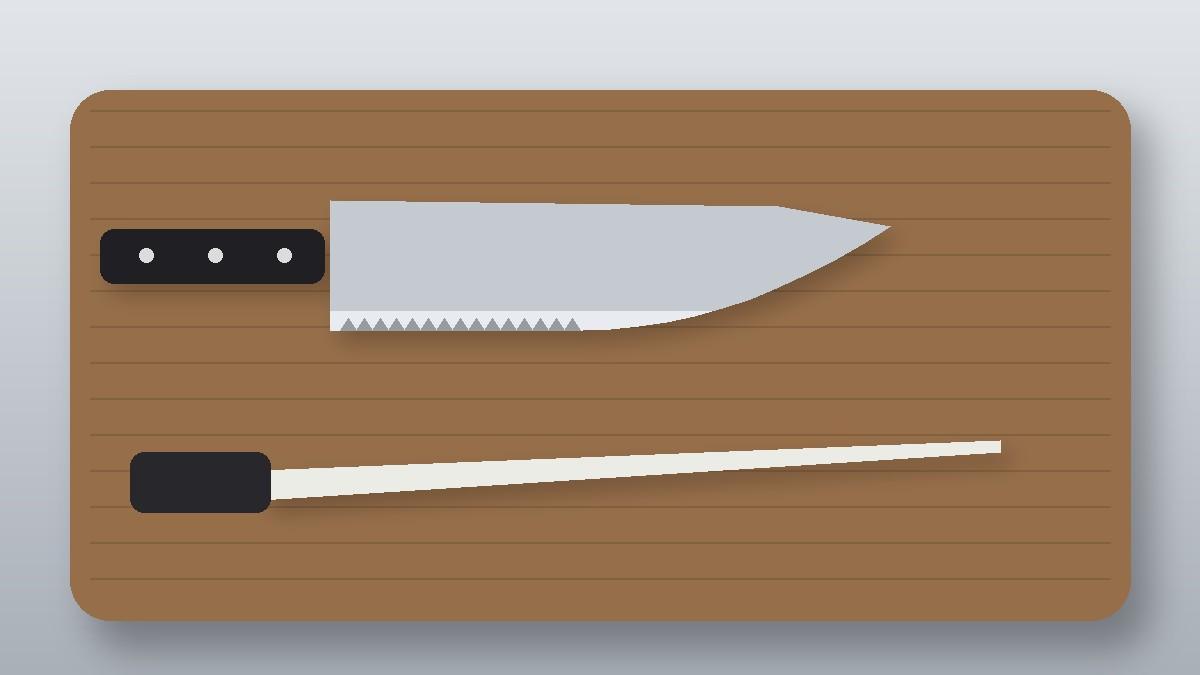
| Serrated blades | Not for home pull-through sharpeners | Bread knife, serrated utility knife |
Our older article said the angle didn’t matter. That isn’t right: matching the factory angle keeps the edge geometry Wüsthof designed and makes each sharpening quicker.
Honing vs Sharpening
| Honing | Sharpening | |
|---|---|---|
| What it does | Realigns a bent or rolled edge | Removes metal to create a new edge |
| Tool | Honing steel or fine ceramic slot | Whetstone, coarse sharpener slot or professional service |
| How often | Regularly, even before each use | Occasionally, when honing no longer restores the edge |
Most dull-feeling knives just need honing. Sharpening removes steel, so doing it too often shortens the life of the blade.
How to Hone a Wüsthof Knife with a Steel
Wüsthof describes a simple, safe method that keeps the steel planted on the counter.
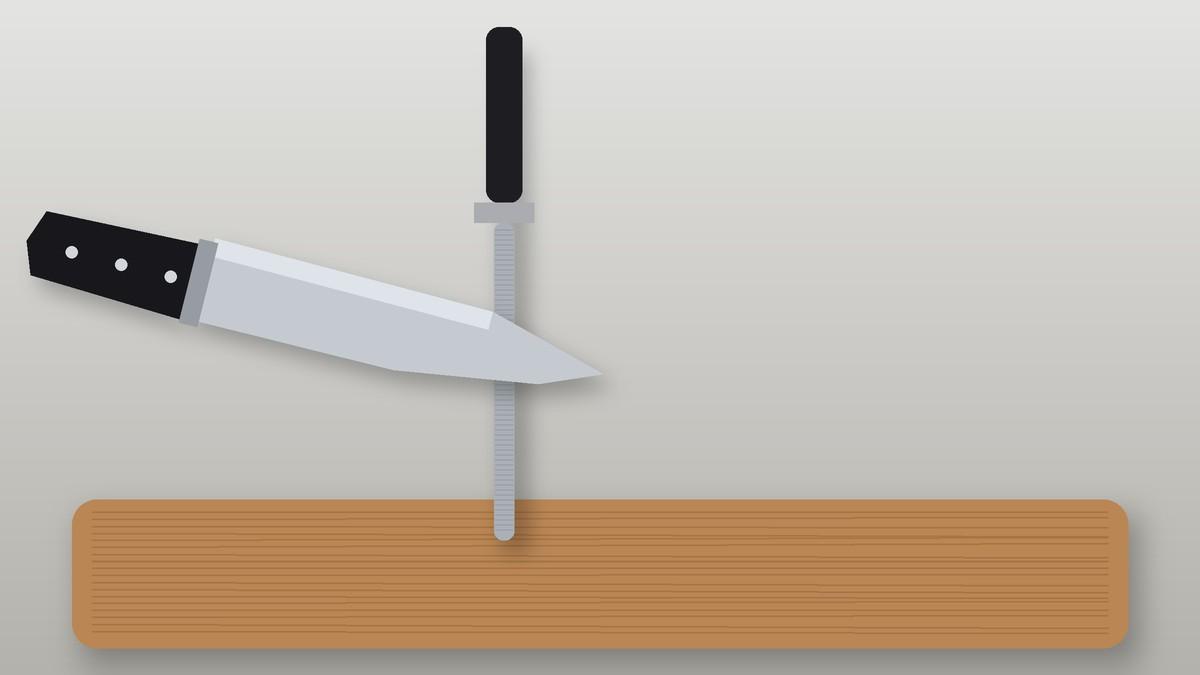
- Hold the steel vertically with the tip resting on a non-slip surface, such as a damp towel on a cutting board.
- Place the heel of the blade against the steel at 14.5° (or 10° for Asian-style knives).
- Draw the blade down the steel from heel to tip in one smooth stroke, with light pressure.
- Alternate sides and repeat about 6 to 8 times.
- Wipe the blade clean before cutting.
For a deeper look at rods, see how to sharpen kitchen knives with a rod.
How to Use the Wüsthof Two-Stage Hand-Held Sharpener
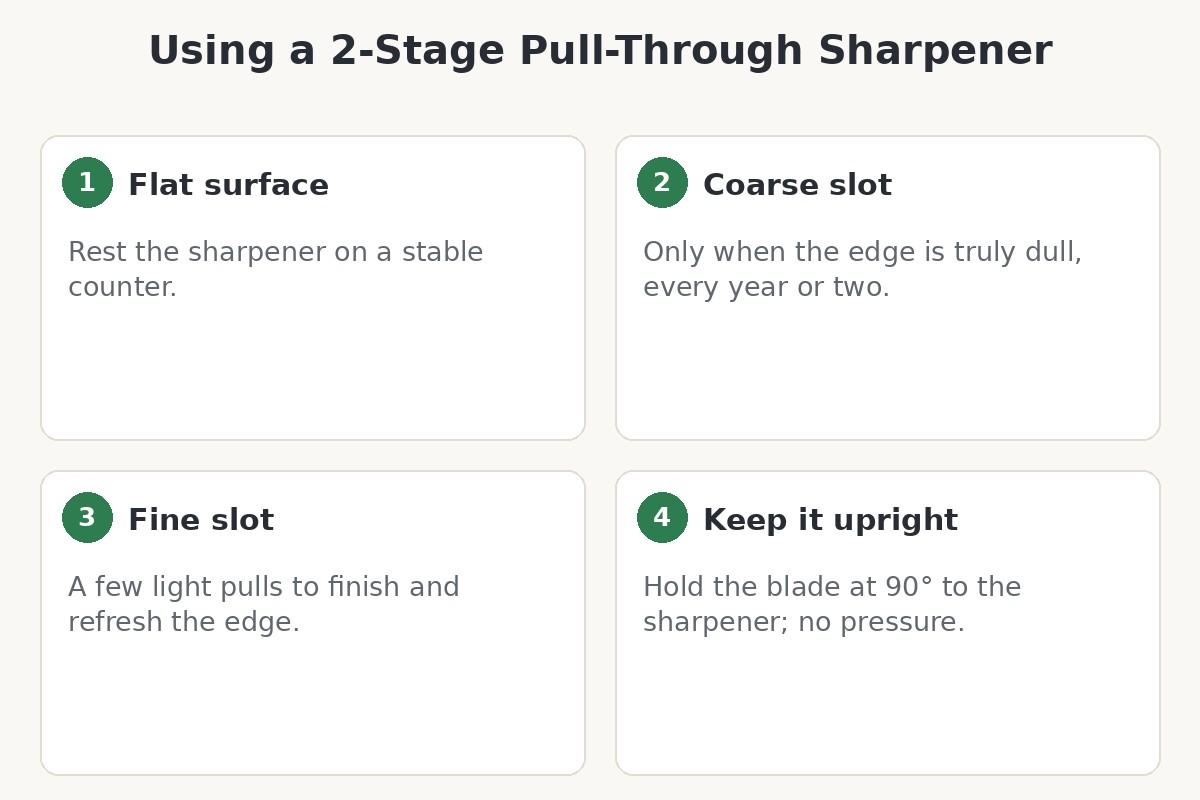
Wüsthof’s two-stage hand-held sharpener has a coarse carbide slot to set the edge and a fine ceramic slot to finish and maintain it. It’s designed for the brand’s standard blades at roughly 14° per side.
- Place the sharpener on a flat, stable surface and hold the handle firmly.
- Insert the blade fully into the slot, straight up at 90° to the sharpener.
- Pull the knife back toward you a few times, keeping it upright and using only light pressure.
- Use the coarse slot only when the knife is truly dull, about once every year or two.
- Finish in the fine slot, which you can also use regularly for honing.
Don’t lean the knife to either side, and don’t press down hard. Wüsthof also notes this sharpener isn’t meant for serrated knives or Asian-style blades.
How to Sharpen a Wüsthof Knife on a Whetstone
A whetstone gives you the most control and the best edge, though it takes some practice.
Step 1: Prepare the Stone
Soak a water stone if the maker recommends it, then place it on a damp towel or stone holder so it can’t slip. Start with the coarse side if the knife is dull.
Step 2: Set the Angle
Hold the blade at 14.5° to the stone, or 10° for Asian-style knives. If you find it hard to judge, a clip-on angle guide attached to the spine helps you hold it steady.
Step 3: Sharpen Each Side
Push the blade across the stone in smooth strokes from heel to tip, keeping the angle steady and the pressure light. Work one side until you feel a small burr along the opposite edge, then switch sides.
Step 4: Refine and Clean
Repeat on the fine side with lighter strokes to polish the edge and remove the burr. Finish with a few strokes on a honing steel, then wash and dry the knife.
For a full walkthrough with grit advice, read how to sharpen kitchen knives with a stone.
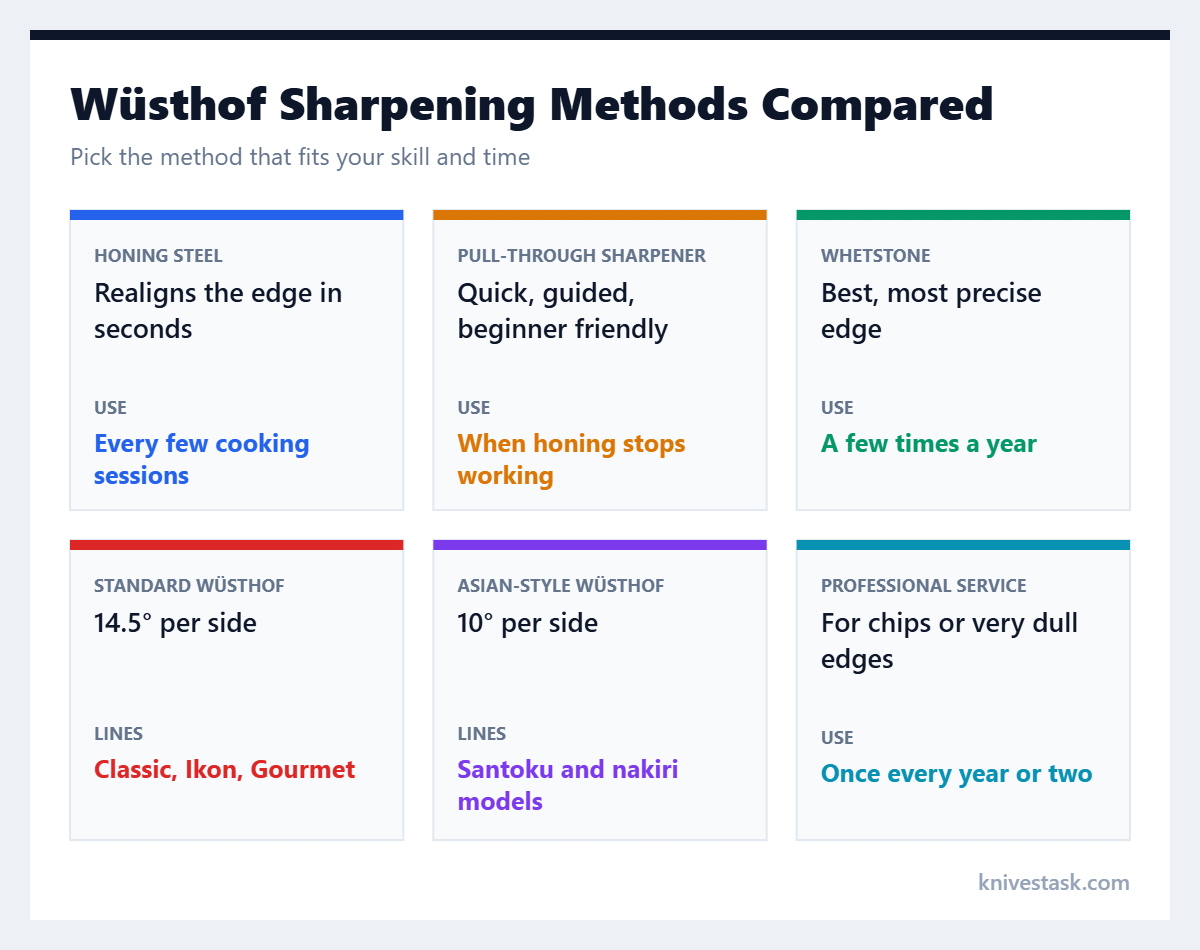
Most home cooks get the best results by combining methods: hone often, use a guided sharpener or stone when the edge stops responding, and send badly damaged knives to a professional.
Common Sharpening Mistakes
- Pressing too hard, which grinds away more steel than needed and can create an uneven edge.
- Changing the angle mid-stroke, which rounds the edge instead of sharpening it.
- Skipping the fine stage, leaving a rough, burred edge that dulls quickly.
- Sharpening when honing would do, which shortens the knife’s life.
- Sawing back and forth in a pull-through sharpener; pull in one direction only.
Signs Your Wüsthof Needs Sharpening
If the knife slips on tomato skin or crushes herbs instead of slicing them, try honing first. If a few strokes on the steel don’t bring the edge back, it’s time to sharpen.
Visible nicks or a shiny line along the edge when you look at it under a light also mean the edge has worn and needs sharpening.
How to Test Sharpness Safely
Slice a sheet of printer paper held upright. A sharp knife glides through cleanly; a dull one tears or snags.
A ripe tomato is another good test. Never test an edge by running your finger along it.
Daily Care to Keep Your Wüsthof Sharp
- Use a wood or plastic cutting board, never glass, stone or ceramic.
- Hand-wash with warm water and mild soap, then dry straight away.
- Keep it out of the dishwasher, where heat and detergent dull edges and damage handles.
- Store it safely in a block, drawer tray, magnetic strip or blade guard.
- Use the right knife for the job; don’t cut bones or frozen food with a chef’s knife.
These tips match Wüsthof’s own cleaning and care advice. Our older article told readers never to put water on the knife; washing by hand in warm water is fine as long as you dry it right away.
Which Method Should You Choose?
| You want | Best option |
|---|---|
| Quick, easy maintenance | Honing steel or the fine slot of the hand-held sharpener |
| Simple sharpening without skill | Wüsthof two-stage hand-held sharpener |
| The sharpest, longest-lasting edge | Whetstone |
| Serrated or badly damaged knives | Professional sharpening service |
Frequently Asked Questions
What angle are Wüsthof knives sharpened at?
Wüsthof recommends 14.5° per side for standard blades and 10° for Asian-style knives.
How often should I sharpen my Wüsthof knife?
Hone it regularly and sharpen only when honing no longer restores the edge, often once or twice a year for home cooks.
Can I use a Wüsthof hand-held sharpener on a santoku?
The two-stage model is designed for standard blades; Wüsthof’s Asian-style knives need a 10° tool.
Can I sharpen a Wüsthof bread knife at home?
Not in a pull-through sharpener; Wüsthof recommends professional sharpening for serrated edges.
Is honing the same as sharpening?
No, honing realigns the edge, while sharpening removes metal to create a new one.