When must a knife be cleaned and sanitized? More often than most people think. A knife can carry Salmonella, Campylobacter or E. coli from raw chicken to a salad in a single slice. That’s why food-safety rules — including the FDA Food Code that most US health departments adopt — spell out exactly when knives and other food-contact utensils must be cleaned and sanitized. The short answer: after each task, whenever you switch from raw to ready-to-eat food or between raw proteins, after any possible contamination, and at least every 4 hours during continuous use. Here’s what that means in home and professional kitchens, and how to clean and sanitize a knife properly.
Quick Summary
- After every task: clean and sanitize when you finish with the knife.
- Raw to ready-to-eat: always clean and sanitize before switching.
- Between raw proteins: clean and sanitize when changing from beef to poultry, fish or pork.
- Every 4 hours: during continuous use with perishable (TCS) food.
- Whenever contaminated: after interruptions, drops or any doubt.
Cleaning vs Sanitizing
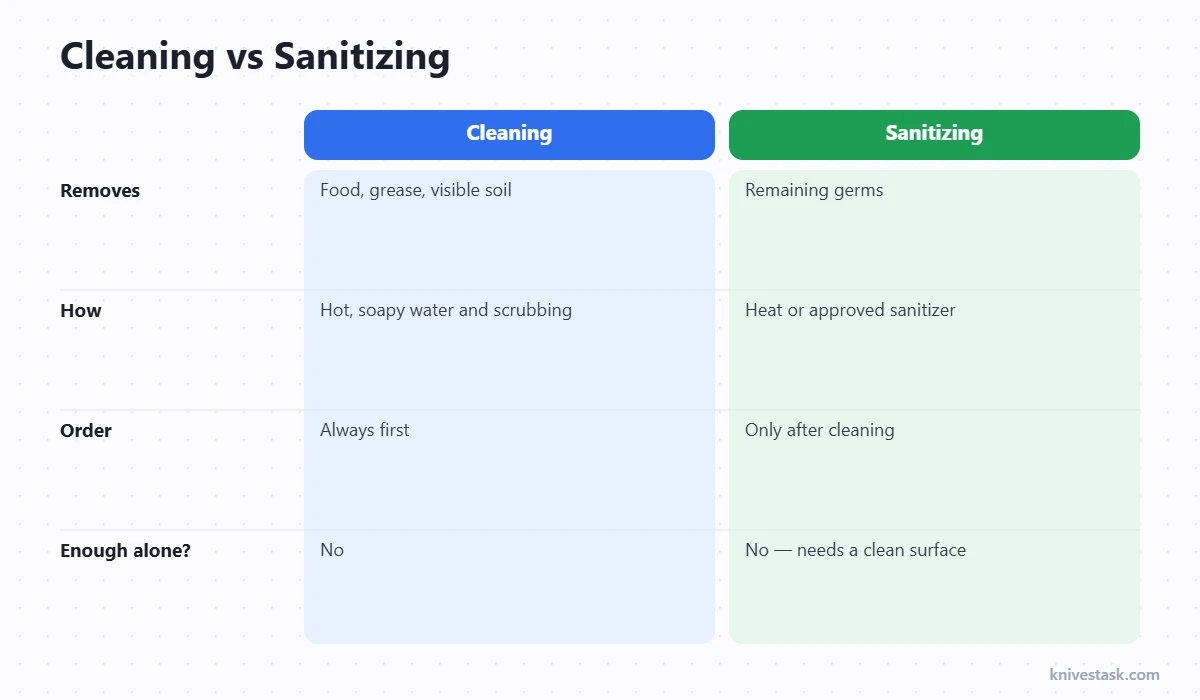
Cleaning removes food, grease and visible soil with hot, soapy water. Sanitizing reduces the remaining microorganisms to safe levels using heat or an approved chemical sanitizer. You must clean first — sanitizer can’t penetrate a layer of food residue or fat.
When a Knife Must Be Cleaned and Sanitized
The FDA Food Code sets cleaning frequencies for food-contact surfaces and utensils, and states adopt versions of it — for example Minnesota’s food code cleaning-frequency rules. The main points:
| Situation | What to do | Why |
|---|---|---|
| After you finish a task | Clean and sanitize | Stops residue and bacterial growth |
| Raw food → ready-to-eat food | Clean and sanitize first | Prevents cross-contamination |
| Between raw meat, fish and poultry | Clean and sanitize between types | Different pathogens and cooking temperatures |
| After an interruption or contamination | Clean and sanitize | Hands, phones and surfaces contaminate blades |
| Continuous use with TCS food | At least every 4 hours | Bacteria multiply over time |
After Each Task
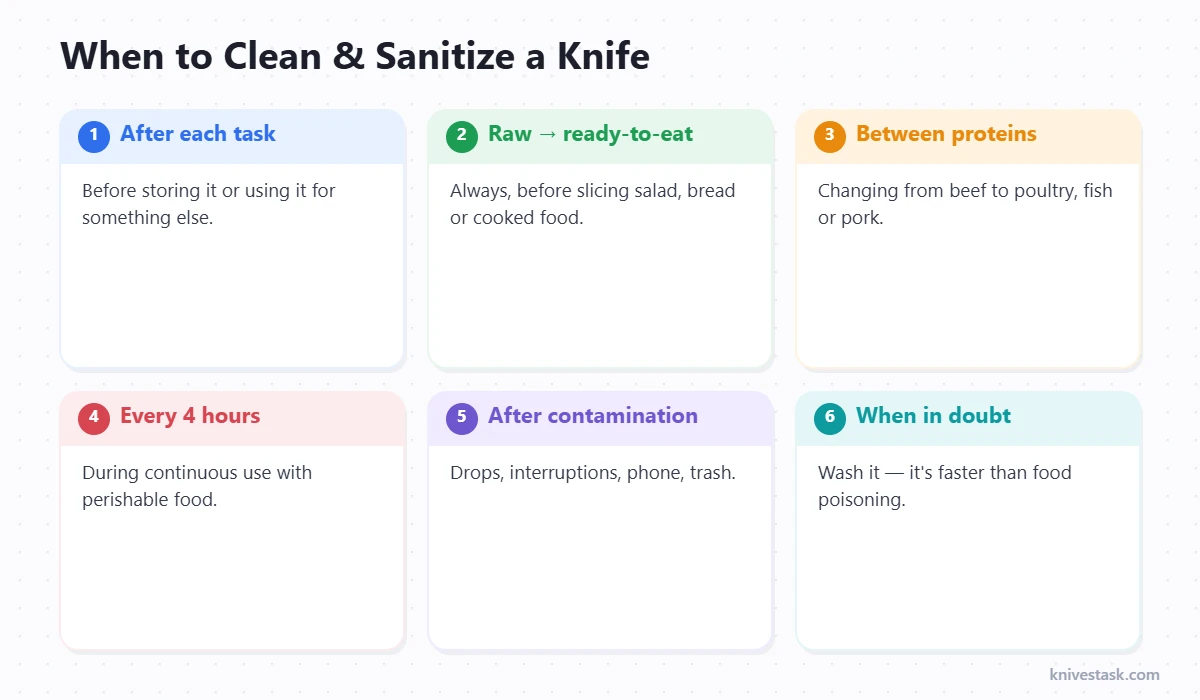
Once you finish cutting, clean and sanitize the knife before storing it or using it for something else. Dried-on residue lets bacteria grow and is harder to remove later.
Raw to Ready-to-Eat
The most important rule. If you cut raw chicken and then slice lettuce or bread with the same knife, any pathogens go straight onto food that won’t be cooked. Clean and sanitize — or grab a separate knife — before switching.
Between Different Raw Proteins
Professional kitchens clean utensils between raw animal foods such as beef and poultry. The exception is preparing foods in order of increasing required cooking temperature (for example, fish before beef before poultry). At home, simply clean and sanitize whenever you change proteins.
Every 4 Hours of Continuous Use
When a knife is used continuously with time/temperature control for safety (TCS) foods — on a busy prep line, for example — it must be cleaned and sanitized at least every 4 hours. Some codes allow longer intervals for utensils kept in refrigerated rooms below 41°F (5°C).
After Interruptions or Contamination
Answer the phone, take out the trash, drop the knife or touch your face? Clean and sanitize before continuing. When in doubt, wash it.
How to Clean and Sanitize a Knife
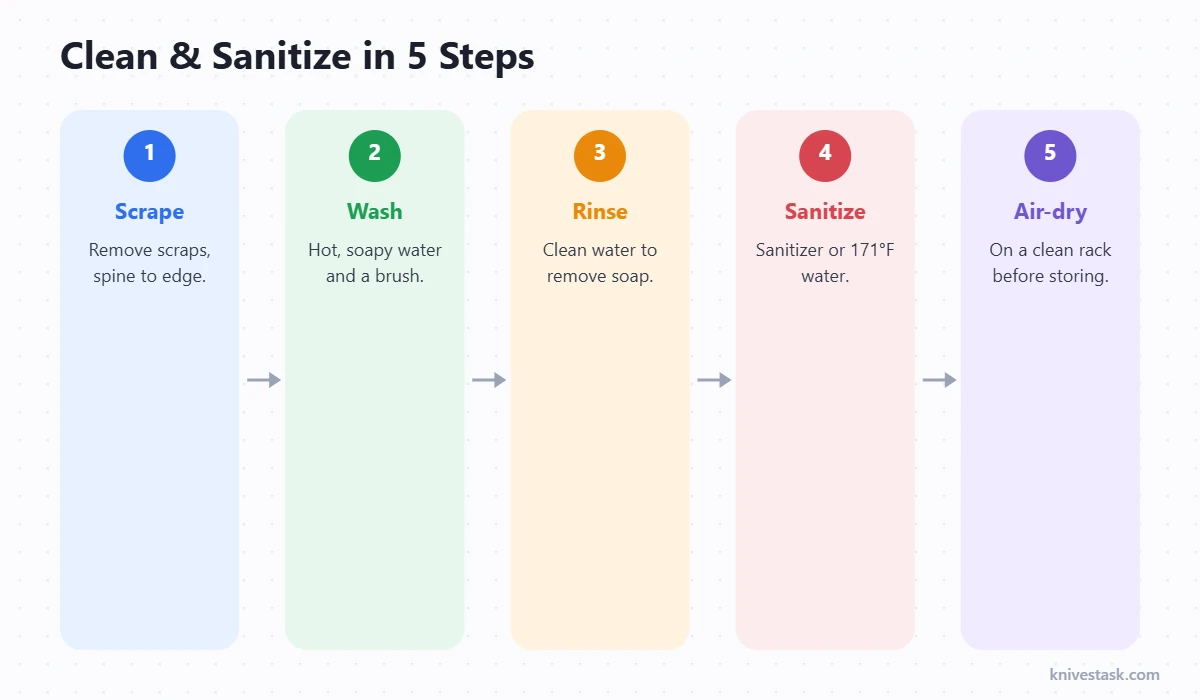
- Scrape: remove food scraps into the bin, wiping from spine to edge.
- Wash: hot, soapy water and a brush or sponge, holding the handle with the edge facing away.
- Rinse: clean water to remove soap and loosened debris.
- Sanitize: immerse or wipe with sanitizer, or use hot water at the required temperature.
- Air-dry: on a clean rack, or dry carefully from spine to edge with a clean towel.
Commercial kitchens use a three-compartment sink — wash, rinse, sanitize — in that order.
Sanitizing Options
| Method | Typical requirement | Where used |
|---|---|---|
| Hot water immersion | At least 171°F (77°C) for 30 seconds | Commercial manual sanitizing |
| Chlorine (bleach) | Roughly 50–100 ppm, per label | Commercial and home |
| Quaternary ammonium (“quat”) | Per label, often 200–400 ppm | Commercial |
| Commercial dishwasher | High-temp or chemical sanitizing cycle | Restaurants |
Always follow your local health code and the sanitizer label for concentration and contact time, and verify strength with test strips.
A Home Sanitizing Solution
For home kitchens, a commonly recommended solution is 1 tablespoon of unscented liquid chlorine bleach per gallon of water — guidance from the USDA Meat and Poultry Hotline as reported by UW Extension. Apply, let stand a few minutes, rinse and air-dry. Mix fresh solution regularly and never combine bleach with other cleaners.
Common Mistakes
- Wiping a knife on a towel between foods — it spreads bacteria rather than removing them.
- Sanitizing a dirty knife — food residue shields bacteria.
- Leaving knives in a sink of water — a hidden cutting hazard that also dulls edges.
- Over-strong bleach — more isn’t better; it can pit steel and leave residue.
- Forgetting the cutting board — a clean knife on a contaminated board is still a risk.
Cleaning Specific Knives
- Serrated knives: scrub along the teeth with a brush.
- Folding knives used for food: clean and dry the pivot area carefully.
- Carbon steel: dry immediately after sanitizing and wipe with food-safe oil — see how to get rust off kitchen knives.
- Stainless steel: see how to clean stainless steel knives.
Don’t Forget the Handle
Bacteria move from hands to handles and then to the next person or food. Clean the handle as carefully as the blade, especially around rivets and the bolster. Don’t soak wooden handles — wash, sanitize and dry promptly to prevent cracking. Store knives only when fully dry.
Why Not the Dishwasher?
Commercial sanitizing dishwashers are fine in professional kitchens. At home, dishwashers dull edges (blades knock against other items) and damage handles, so many cooks hand wash and use a sanitizing solution instead.
Habits That Prevent Cross-Contamination
- Use separate knives and boards for raw meat and ready-to-eat foods.
- Use color-coded boards (e.g., red for raw meat, green for produce).
- Prep ready-to-eat foods first, then raw meat.
- Wash your hands as often as the knife — at least 20 seconds with soap.
- Store clean knives in a clean block, on a magnetic strip or in guards — see how to store kitchen knives and how to clean a knife block.
Frequently Asked Questions
When must a knife be cleaned and sanitized?
After each task, before switching from raw to ready-to-eat food, between different raw proteins, after any possible contamination, and at least every 4 hours in continuous use.
Is rinsing a knife enough?
No. Rinsing doesn’t remove grease or reliably reduce bacteria — wash with soap, then sanitize.
What temperature sanitizes a knife?
For commercial manual sanitizing, the Food Code requires hot water of at least 171°F (77°C) for 30 seconds.
Can I use vinegar to sanitize knives?
Vinegar helps with odors and cleaning but isn’t as reliable as a properly mixed bleach solution or approved sanitizer.
Do I need to sanitize a knife used only for vegetables?
Wash it after use; sanitizing matters most if it touched raw meat, poultry, fish or soil-covered produce.
How often should I sanitize knives at home?
Every time they touch raw meat, poultry or fish, and after any task where cross-contamination is possible.
Do home cooks need to follow the same rules?
The Food Code is written for restaurants, but the same logic protects your family. At home, wash your knife in hot, soapy water every time you finish with raw meat, poultry or seafood, and before it touches anything that will not be cooked. A quick rinse is not enough, because grease and food residue can shelter bacteria.