
As an Amazon Associate, Knives Task earns from qualifying purchases. We did not test these stones in person; this guide is based on maker descriptions, retailer specifications, published reviews and owner feedback.
A whetstone is the best way to get a truly sharp edge on a kitchen knife, but the choice can feel overwhelming. Stones come in dozens of grits, some need soaking and some do not, and prices run from under $25 to well over $100. The good news is that a beginner only needs one or two stones to get started, and the most popular starter stones are inexpensive.
This guide compares the best whetstones for beginners, explains what grit numbers mean, and shows how to choose between soaking stones and splash-and-go stones.
Quick Picks
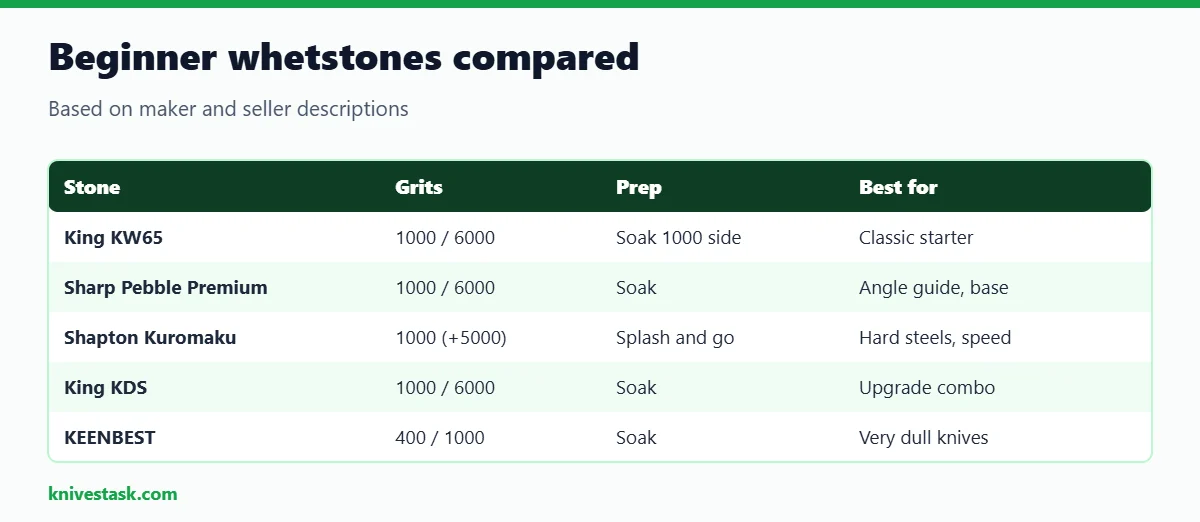
- Best overall for beginners: King KW65 1000/6000 combination stone
- Best complete starter kit: Sharp Pebble Premium 1000/6000
- Best splash-and-go stone: Shapton Kuromaku (Pro) 1000
- Best upgrade combo stone: King KDS 1000/6000
- Best for very dull knives: KEENBEST 400/1000
1. King KW65 1000/6000 Combination Whetstone
Best overall for beginners. The King KW65 is a classic Japanese waterstone with a 1000 grit side for sharpening and a 6000 grit side for polishing, set in a plastic base. King stones are a common first stone in Japanese homes, and the 1000/6000 combination covers the full routine of most home cooks: raise an edge on the 1000, then refine it on the 6000.
The 1000 side is a soaking stone. Owners commonly soak it for a few minutes before use, while the denser 6000 side often only needs a splash of water. The instructions on the box are in Japanese, so it is worth watching a short sharpening video before your first session.
Pros: affordable, made in Japan, good feedback that helps you learn, covers sharpening and polishing.
Cons: softer 1000 side wears and dishes faster; no angle guide included.
2. Sharp Pebble Premium 1000/6000 Whetstone Kit
Best complete starter kit. Sharp Pebble is one of the best-selling whetstone brands online. Its Premium kit pairs a 1000/6000 corundum stone with a non-slip bamboo base and a clip-on angle guide. Several reviewers point out that the angle guide is especially helpful for beginners, because holding a consistent angle is the hardest part of learning to sharpen. GearJunkie’s review of the Sharp Pebble 1000/6000 describes it as a well-thought-out aluminum-oxide dual-grit kit, while noting that whetstone sharpening still takes practice.
Pros: angle guide, stable bamboo base, everything in one box, low price.
Cons: smaller stone surface than some Japanese stones; long knives take more passes.
Check the Sharp Pebble Premium kit on Amazon
3. Shapton Kuromaku (Pro) 1000
Best splash-and-go stone. If soaking a stone before each session sounds like a chore, Shapton’s Kuromaku stones are the answer. Cutlery and More’s Shapton Kuromaku 1000 listing notes that these ceramic stones are made in Japan, measure about 8.25 by 2.75 inches and 5/8 inch thick, never need soaking, and come in a storage case that doubles as a sharpening base. The retailer also describes them as harder and denser than many ceramic waterstones, which means they wear slowly and cut quickly.
The trade-off is feel: harder stones give less feedback than soft King stones, so absolute beginners may find it slightly harder to tell what the edge is doing. It is single-grit, so pair it with a 5000 Kuromaku or another finishing stone if you want a polished edge.
Pros: no soaking, fast cutting, durable, case doubles as a base.
Cons: higher price per grit, less feedback, need a second stone for polishing.
Check the Shapton Kuromaku 1000 on Amazon
Check Shapton Kuromaku sets on Amazon
4. King KDS 1000/6000
Best upgrade combo stone. The KDS is a step up from the KW65 within King’s range. Sellers describe it as harder and longer-lasting, while keeping the 1000/6000 grit combination. It is a good choice if you sharpen often or have several knives to maintain, and want a combination stone that dishes more slowly.
Pros: harder than the KW65, lasts longer, Japanese-made.
Cons: costs more; still needs soaking.
5. KEENBEST 400/1000 Whetstone
Best for very dull knives. If your knives are badly dull or have small chips, a 1000 grit stone can take a long time to restore them. A coarser 400 grit side removes metal faster and resets the edge, then the 1000 side sharpens it. KEENBEST and similar budget brands sell 400/1000 combination stones with non-slip bases at low prices. Pair one with a 6000 grit stone later if you want a polished edge.
Pros: fixes neglected edges quickly, inexpensive.
Cons: no fine polishing grit; coarse grit removes metal quickly, so use it only when needed.
Check KEENBEST 400/1000 stones on Amazon
Understanding Whetstone Grit
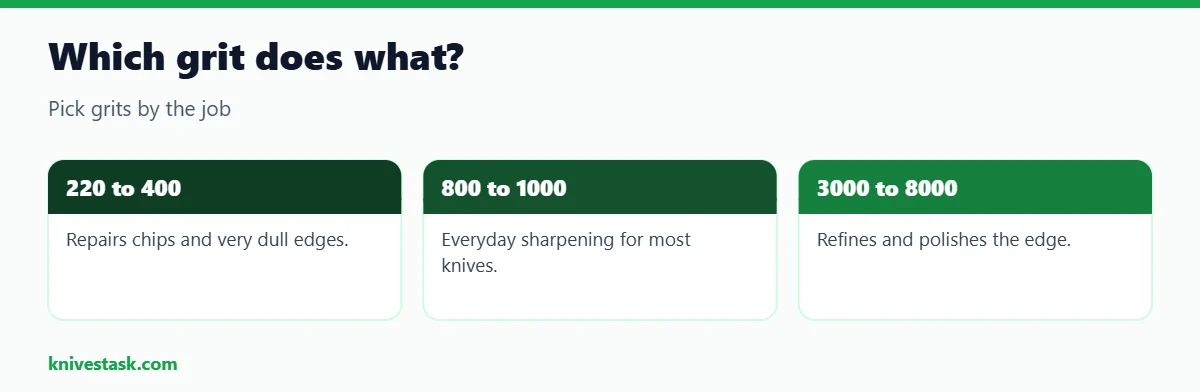
Grit numbers describe how coarse or fine the abrasive is. Lower numbers remove metal faster and leave a rougher edge; higher numbers remove less metal and leave a smoother, more polished edge.
- Coarse (220 to 400): repairing chips, reshaping broken tips and sharpening very dull knives.
- Medium (800 to 1000): the workhorse grit for regular sharpening. If you buy only one stone, make it a 1000.
- Fine (3000 to 8000): refining and polishing the edge after the medium stone. A 5000 or 6000 is plenty for kitchen knives.
For a deeper look at choosing grits, read our guide on what grit whetstone to use for kitchen knives.
Soaking Stones vs Splash-and-Go Stones
Soaking stones, such as most King stones, need to sit in water before use so they stay wet while you sharpen. Many owners soak a King 1000 for several minutes, and some King stones call for a longer soak. They tend to be softer, giving good feedback and a fast-forming slurry.
Splash-and-go stones, such as Shapton’s Kuromaku line, only need water on the surface. They are convenient for quick touch-ups and are usually harder, so they last longer. They often cost more.
Never leave a soaking stone sitting in water for days, and never soak a splash-and-go stone for long periods; some can crack. Always follow the maker’s instructions.
What Else You Need
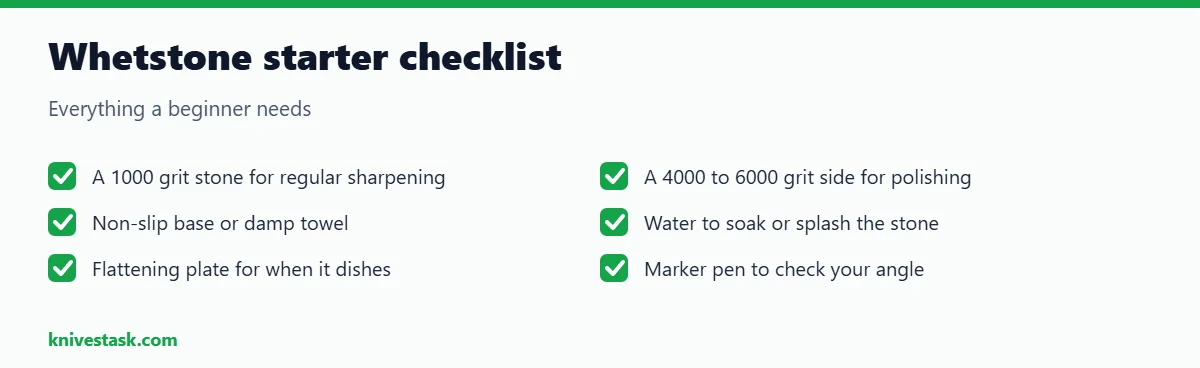
- A stable base: a rubber or bamboo holder, or a damp towel, keeps the stone from sliding.
- A flattening plate: stones wear unevenly over time. A flattening plate keeps the surface flat so your edge stays straight. See flattening plates.
- A marker pen: color the edge bevel, make a few strokes, and check where the ink was removed to confirm your angle.
- A strop (optional): a leather strop removes the final burr and adds polish. See leather strops.
How to Use a Whetstone: Beginner Steps
- Prepare the stone: soak or splash it according to type, and set it on a stable base with the coarser side up.
- Find your angle: most Western kitchen knives sharpen well around 17 to 20 degrees per side, and many Japanese knives around 15. See our guide on what angle to sharpen kitchen knives.
- Sharpen one side: push the edge across the stone in smooth strokes, covering heel to tip, until you can feel a small burr along the opposite side.
- Switch sides: repeat on the other side until the burr flips back.
- Refine: move to the fine grit and repeat with lighter pressure.
- Remove the burr: finish with a few very light alternating strokes or a strop.
- Clean up: rinse the stone, let it air dry fully, and flatten it when it starts to dish.
Our full walkthrough on how to sharpen kitchen knives with a stone covers each step in more detail.
Whetstone vs Other Sharpeners
Pull-through and electric sharpeners are faster, but they remove more metal and give you less control over the angle. Honing rods realign an edge between sharpenings but do not create a new one. A whetstone takes longer to learn, but it gives the sharpest, longest-lasting edge and works on almost any knife, including single-bevel Japanese blades. For a broader comparison, see our knife sharpener comparison.
Common Beginner Mistakes
- Too much pressure: let the stone do the work, especially on the fine grit.
- Changing angle mid-stroke: lock your wrist and move from the shoulder.
- Skipping the burr check: without a burr, you have not sharpened all the way to the edge.
- Letting the stone dry out: keep the surface wet so it cuts cleanly.
- Never flattening: a dished stone creates a curved, uneven edge.
Best Whetstone by Knife Type
Western chef’s knives (German-style)
Knives from brands like Wüsthof, Henckels and Victorinox use softer stainless steels that sharpen quickly. A King or Sharp Pebble 1000/6000 combination stone is ideal. These knives often have a slightly wider edge angle, so the polishing side does not need to go beyond 6000 grit.
Japanese knives (gyuto, santoku, nakiri)
Japanese knives usually use harder steels that hold a finer edge but can be slower to sharpen on soft stones. A harder splash-and-go stone like the Shapton Kuromaku 1000, followed by a 5000 or 6000 finishing stone, works especially well. Use lighter pressure to avoid chipping thin edges. Our guides to the best santoku knives and best gyuto knives cover these blades in more detail.
Outdoor and pocket knives
Thicker outdoor blades often benefit from a coarser 400 grit stone to reset the edge after heavy use, followed by a 1000. Smaller stones are easier to carry, but a full-size stone at home makes the work faster.
How to Care for and Flatten a Whetstone
Every whetstone wears as you use it, and the centre wears faster than the edges. Over time this creates a dip, or “dish,” that makes it hard to keep a straight edge. Check flatness by laying a straight edge across the stone. If you can see light under it, it is time to flatten.
- Wet both the whetstone and the flattening plate.
- Draw a pencil grid across the stone’s surface.
- Rub the stone on the flattening plate in figure-eight motions.
- Stop when all pencil marks are gone; the surface is now flat.
- Rinse off the slurry and let the stone dry fully at room temperature, away from direct heat.
Store stones dry and in their box or case. Avoid freezing temperatures for soaking stones, since absorbed water can expand and crack them.
How Much Should You Spend?
You can start sharpening well for under $40 with a King KW65 or Sharp Pebble combination stone. Spending more mainly buys harder stones that last longer, cut faster or skip soaking. Most home cooks will be very happy with a 1000/6000 combination stone and a flattening plate, and can add a dedicated splash-and-go stone later if they start sharpening often.
Frequently Asked Questions
What grit whetstone should a beginner buy first?
A 1000 grit stone, or a 1000/6000 combination stone. The 1000 handles regular sharpening and the 6000 polishes the edge.
Do I need to soak my whetstone?
It depends on the stone. Soaking stones like most King models need water absorbed before use. Splash-and-go stones like Shapton Kuromaku only need water on the surface.
How often should I sharpen kitchen knives on a whetstone?
For most home cooks, every one to three months is enough, with a honing rod in between. Sharpen sooner if the knife slips on tomato skin.
Can I use a whetstone on Japanese knives?
Yes. Whetstones are the preferred way to sharpen Japanese knives. Use a lower angle and light pressure. Our guide to the best Japanese kitchen knives explains their harder steels.
How long does a whetstone last?
Years for most home cooks. Harder stones last longer than soft ones, and flattening regularly keeps them useful.
Final Verdict
For most beginners, the King KW65 1000/6000 is the best first whetstone: affordable, Japanese-made and easy to learn on. Choose the Sharp Pebble Premium if you want an angle guide and base in one box, the Shapton Kuromaku 1000 if you hate soaking stones, the King KDS as a longer-lasting upgrade, and a 400/1000 stone if your knives are very dull. Add a flattening plate and a little practice, and your knives will be sharper than they were out of the box.
Browse whetstones for beginners on Amazon