
Gerber has made affordable, hard-working knives since 1939, and for many people a Gerber is their first real pocket knife or camp knife. The lineup is huge — fixed blades, folding knives, hunting knives, utility knives and multitools — so picking the best Gerber knife comes down to how you’ll use it. Below are nine standout Gerber knives for camping, survival, hunting, work and everyday carry (EDC), with blade steel, length, lock type and sheath details for each.
Quick Picks
- Best overall: Gerber StrongArm — full-tang 420HC fixed blade with a modular MOLLE sheath.
- Best survival knife: Gerber LMF II Infantry — thick partly serrated blade, sheath sharpener and leg straps.
- Best budget folder: Gerber Paraframe II — light frame-lock pocket knife.
- Best for hunters: Gerber Vital — replaceable scalpel-style blades.
- Good to know: most Gerber blades use 420HC or 7Cr17MoV — tough, rust-resistant and easy to sharpen.
Knives Task is reader-supported: if you buy through a link on this page, we may earn a small Amazon commission at no extra cost to you. That never changes which knives we recommend.
Our Picks at a Glance
| Knife | Type | Blade | Best for |
|---|---|---|---|
| Gerber StrongArm | Fixed | 4.8″ 420HC | Best overall |
| Gerber LMF II Infantry | Fixed | 4.84″ 420HC, part serrated | Survival |
| Gerber Prodigy | Fixed | 4.75″ 420HC | Emergency kit |
| Gerber Ghoststrike | Fixed | 3.3″ 420HC | Light fixed-blade carry |
| Gerber Freeman Guide Fixed | Fixed | 3.6″ drop point | Hunting and camp |
| Gerber Paraframe II Tanto | Folder | 3.5″ 7Cr17MoV | Budget folder |
| Gerber Flatiron | Folder | 3.6″ cleaver-style 7Cr17MoV | Food and package EDC |
| Gerber Vital | Folder | Replaceable blades | Field dressing |
| Gerber Prybrid X | Folder | Utility blade + pry bar | Work and DIY |
How we chose: we haven’t lab-tested these knives side by side. We compared blade length, shape and steel, tang and lock type, handle ergonomics, sheath design, Gerber’s published specifications and long-term owner feedback. Prices and versions change, so check before buying.
About Gerber Knives
Gerber Legendary Blades was founded in Portland, Oregon, in 1939 and has been owned by the Finnish tool company Fiskars since 1987. Gerber still makes some premium knives in Portland — such as the Fastball, Sedulo and Mark II — while most budget models are made overseas. Check each listing if country of manufacture matters to you.
Gerber Blade Steels Explained
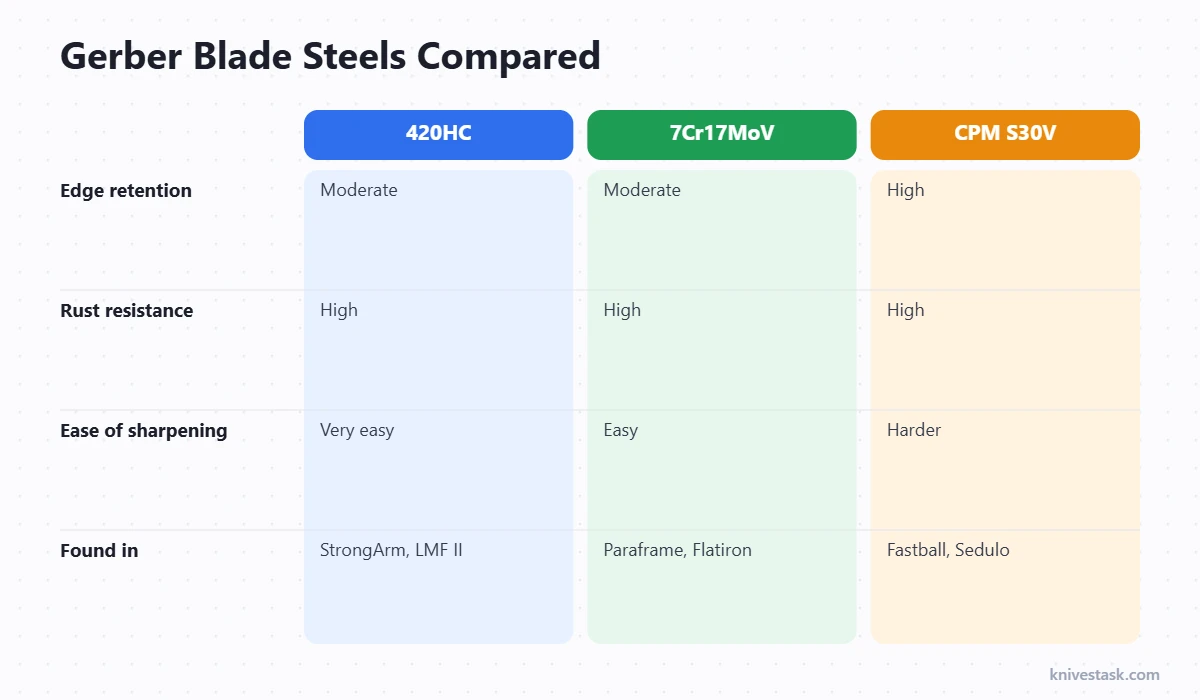
| Steel | Strengths | Trade-offs | Found in |
|---|---|---|---|
| 420HC | Tough, rust-resistant, very easy to sharpen | Needs sharpening more often | StrongArm, LMF II, Prodigy |
| 7Cr17MoV | Good corrosion resistance, inexpensive | Moderate edge retention | Paraframe, Flatiron |
| D2 | Better edge retention | Less stain-resistant | Some Flatiron variants |
| CPM S30V | Premium edge retention and toughness | Higher price, harder to sharpen | Fastball, Sedulo |
| Replaceable blades | Scalpel-sharp every time | Ongoing cost | Vital, EAB, Prybrid |
The Best Gerber Knives
1. Gerber StrongArm — Best Overall
Best for: campers, hikers and survivalists who want one dependable fixed blade.
The StrongArm has a 4.8-inch full-tang 420HC drop-point blade with a ceramic coating, in plain or partly serrated versions. The handle is glass-filled nylon with a diamond-texture rubber overmold and a striking pommel. Its modular sheath is the standout: it mounts vertically or horizontally on a belt, or on MOLLE webbing, so it works on packs and plate carriers alike. It’s strong enough for batoning small wood and making kindling, yet simple to sharpen in camp.
- Pros: full tang, versatile sheath, easy field sharpening
- Cons: heavier than a small EDC knife, 420HC needs regular touch-ups
Check the current price of the Gerber StrongArm on Amazon →
2. Gerber LMF II Infantry — Best Survival Knife
Best for: outdoor users who want a large, rugged knife with built-in extras.
Originally designed for aircrew survival, the LMF II has a 4.84-inch, 3/16-inch-thick 420HC blade with a partly serrated edge and a 10.59-inch overall length. The glass-filled nylon handle has a TPV overmold and a pommel that’s isolated from the tang to reduce electrical shock risk when cutting through wiring. The sheath includes a built-in sharpener and leg straps. It’s also sold as the LMF II Survival with a different sheath and color.
- Pros: thick strong blade, sheath sharpener, comfortable grip
- Cons: not full tang, large for everyday carry
Check the current price of the Gerber LMF II Infantry on Amazon →
3. Gerber Prodigy — Best for an Emergency Kit
Best for: vehicle and bug-out kits built around a mid-size fixed blade.
The Prodigy has a full-tang 420HC drop-point blade of about 4.75 inches with a partial serration, a rubber-overmolded handle for wet grip and a nylon sheath with belt loop and leg strap. It’s a sensible size for camp chores, rope and food prep without the bulk of the LMF II.
- Pros: full tang, grippy handle, versatile size
- Cons: basic nylon sheath, serrations harder to sharpen
Check the current price of the Gerber Prodigy on Amazon →
4. Gerber Ghoststrike — Best Light Fixed Blade
Best for: hikers and travelers who want a fixed blade they’ll forget they’re carrying.
The Ghoststrike has a 3.3-inch ceramic-coated 420HC blade and a skeletonized, rubber-wrapped handle. Its slim, low-profile sheath carries in several positions, including inside the waistband or on a pack strap. Think of it as a utility or backup blade rather than a chopper.
- Pros: very light, flexible carry, corrosion-resistant coating
- Cons: small handle, not for heavy work
Check the current price of the Gerber Ghoststrike on Amazon →
5. Gerber Freeman Guide Fixed Blade — Best for Hunting
Best for: hunters and campers who want an affordable drop-point skinner.
The Freeman Guide has a 3.6-inch stainless drop-point blade, a rubber-overmolded handle with a finger choil and a nylon sheath. The drop point is ideal for skinning, gutting and general field dressing, as well as camp food prep.
- Pros: useful drop-point shape, secure grip, affordable
- Cons: basic sheath, moderate edge retention
Check the current price of the Gerber Freeman Guide fixed blade on Amazon →
6. Gerber Paraframe II Tanto — Best Budget Folder
Best for: anyone who wants a light, inexpensive pocket knife.
The Paraframe II has a 3.5-inch 7Cr17MoV tanto blade and an open stainless frame with a frame lock. It opens with a thumb stud and rides in the pocket on a clip. The skeletonized frame keeps weight down but collects lint, and the clip isn’t reversible for left-handers.
- Pros: very affordable, slim and light, secure frame lock
- Cons: open frame collects debris, clip not reversible
Check the current price of the Gerber Paraframe II on Amazon →
7. Gerber Flatiron — Best Food-Prep EDC Folder
Best for: people who use a pocket knife mostly for food, packages and everyday cutting.
The Flatiron’s wide, cleaver-style 3.6-inch blade (7Cr17MoV, with D2 and Micarta variants) and frame lock make it a favorite for slicing apples, cheese and sausage, plus breaking down boxes. The blunt profile suits slicing far more than piercing.
- Pros: unique cleaver blade, great for food and boxes, solid lock
- Cons: limited point work, wide in the pocket
Check the current price of the Gerber Flatiron on Amazon →
8. Gerber Vital — Best for Field Dressing
Best for: hunters who want a scalpel edge without field sharpening.
The Vital takes replaceable scalpel-style blades — when one dulls, swap it. The blaze-orange handle is easy to find in leaves or snow, and the thin blades excel at skinning and caping. Spare blades are an ongoing cost, and they’re too thin for prying.
- Pros: always razor sharp, high-visibility handle, compact
- Cons: spare blades cost extra, fragile for heavy work
Check the current price of the Gerber Vital on Amazon →
9. Gerber Prybrid X — Best for Work and DIY
Best for: tradespeople and DIYers who want a pocket utility knife.
The Prybrid X holds a standard replaceable utility blade and adds a pry bar and bottle opener. Standard blades are cheap at any hardware store, and the pry bar keeps you from abusing a real knife for lifting and scraping.
- Pros: cheap standard blades, built-in pry bar, compact
- Cons: not for food or camp use, blades snap if twisted
Check the current price of the Gerber Prybrid X on Amazon →
Premium Gerber Knives Worth Knowing
If budget allows, Gerber’s USA-made models step up in materials: the Fastball (assisted-opening folder with a CPM S30V blade and aluminum handle), the Sedulo (S30V EDC folder) and the classic Mark II combat dagger. They cost more but offer noticeably better edge retention.
How to Choose a Gerber Knife
Fixed Blade or Folder?
Fixed blades like the StrongArm and LMF II are stronger and easier to clean, so they’re better for camping, bushcraft and hunting. Folders like the Paraframe and Flatiron are easier to carry every day. For more fixed-blade options, see our guide to the best fixed blade EDC knives under $100.
Blade Length and Shape
Blades under about 3.5 inches suit everyday carry and fine tasks; 4.5–5 inches handles camp chores, food prep and kindling. Drop points are the most versatile, tantos have strong tips, and cleaver or sheepsfoot shapes are safest for slicing.
Plain or Serrated Edge?
A plain edge is easier to sharpen and gives cleaner cuts. A partly serrated edge bites into rope, webbing and fibrous material but needs a tapered rod to sharpen. Our guide to serrated vs plain edges goes deeper.
Lock Type (Folders)
Gerber folders use frame locks, liner locks and button locks. A frame lock is simple and strong; check that the lock engages fully and there’s no blade play.
Sheath and Carry
On a fixed blade, the sheath matters as much as the knife. Gerber’s modular sheaths let you choose belt, horizontal or MOLLE carry.
Local Laws
Knife laws vary by country, state and city — including blade length, assisted-opening and fixed-blade carry rules. See knife legislation for an overview, and check local rules before carrying.
Best Gerber Knife by Use
| Use | Best Gerber pick | Why |
|---|---|---|
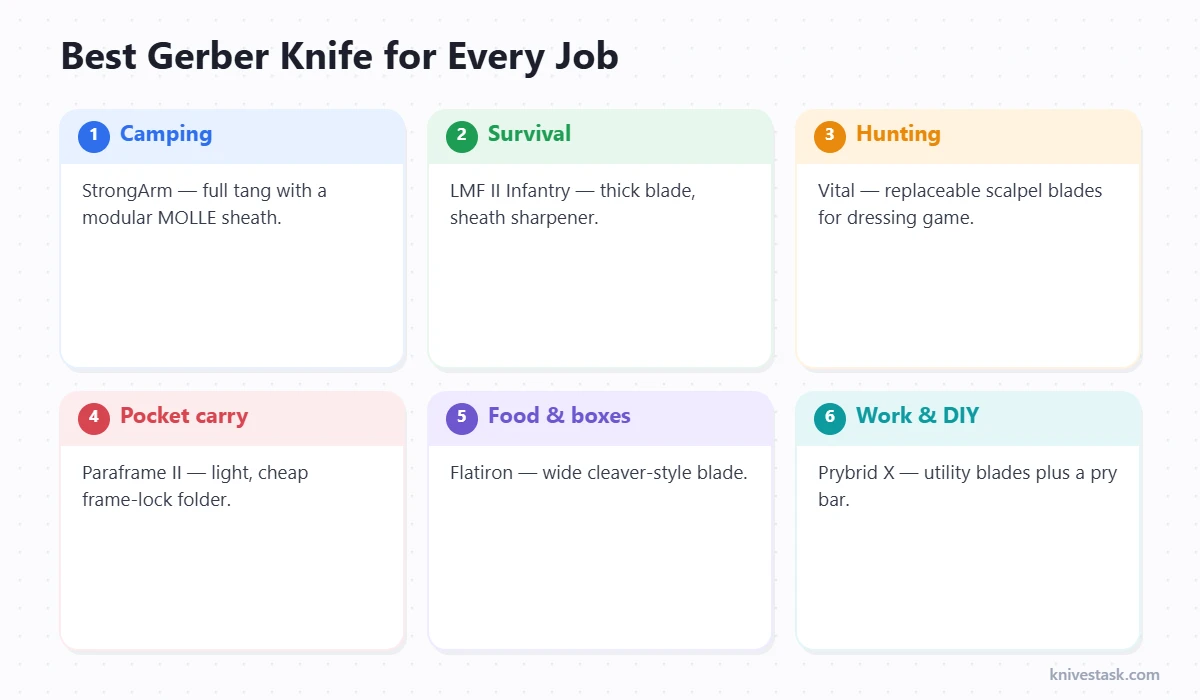
| Camping and bushcraft | StrongArm | Full tang, versatile sheath |
| Survival / emergency kit | LMF II or Prodigy | Large, rugged, partly serrated |
| Hunting | Vital or Freeman Guide | Fine edge for skinning and dressing |
| Everyday pocket carry | Paraframe II or Flatiron | Light and inexpensive |
| Premium EDC | Fastball | S30V steel, made in the USA |
| Work and DIY | Prybrid X | Cheap blades, pry bar |
Caring for a Gerber Knife
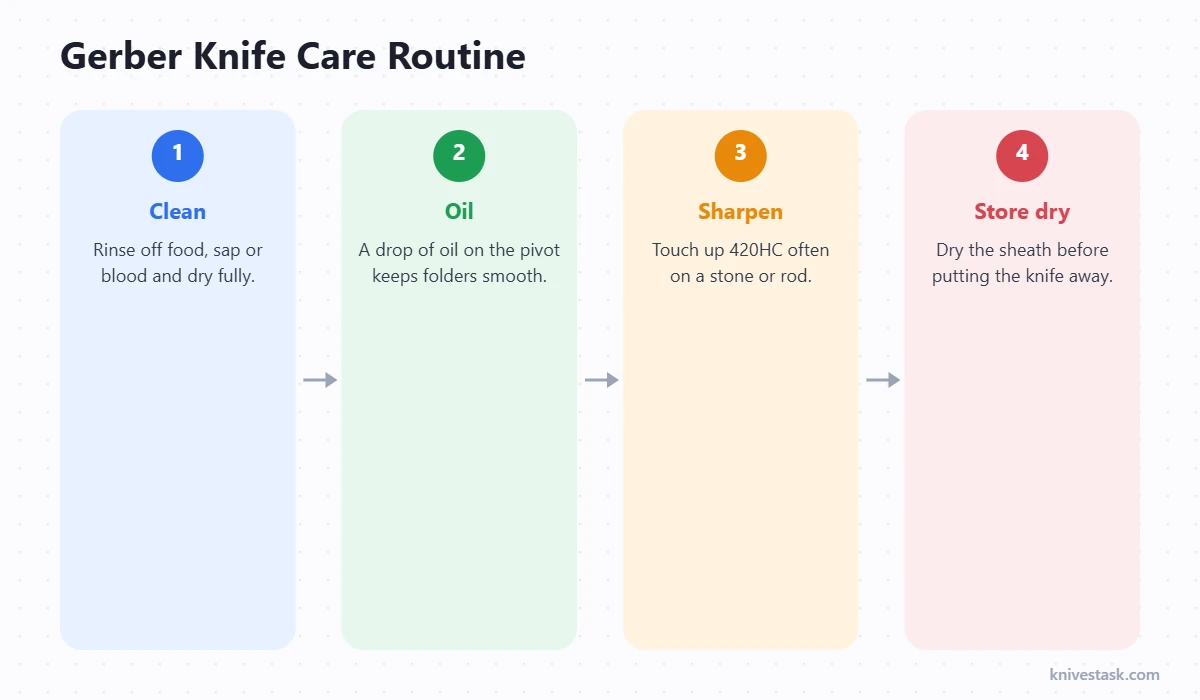
- Clean and dry the blade after use, especially after food or game.
- Put a drop of knife oil on folder pivots occasionally.
- Sharpen little and often — 420HC and 7Cr17MoV respond quickly to a stone or rod. See how to sharpen a Gerber knife.
- Use a tapered rod for serrations.
- Dry the sheath before storing the knife inside.
New to folders? Our guide on how to close a Gerber knife covers each lock type safely.
Gerber Warranty
Gerber offers a limited lifetime warranty against defects in materials and workmanship on most knives. It doesn’t cover normal wear, misuse, sharpening damage or loss. Check current terms at Gerber Gear and keep your receipt.
Gerber vs Other Budget Brands
Gerber competes with Buck, Kershaw, Morakniv, Schrade and CRKT. Morakniv knives are often sharper out of the box, and Buck tends to use harder heat treatments. Gerber’s strengths are practical designs, excellent sheaths and wide availability — if a Gerber is lost, it’s cheap and easy to replace.
Frequently Asked Questions
Are Gerber knives good?
Yes, for the money. They’re tough, practical and easy to sharpen, though most budget models don’t use premium steels.
Where are Gerber knives made?
Premium models are made in Portland, Oregon; many budget models are made overseas. Check each listing.
What steel does Gerber use?
Mostly 420HC and 7Cr17MoV, with D2 and CPM S30V on some higher-end models.
Is the Gerber LMF II full tang?
No. The tang stops short of the insulated pommel, but the knife is still very strong.
What is the best Gerber knife for survival?
The LMF II Infantry for a large survival knife, or the StrongArm for a full-tang all-rounder.
What is the best Gerber pocket knife?
The Paraframe II for value, the Flatiron for food and packages, and the Fastball if you want premium S30V steel.