
Kamikoto knives are sold in elegant ash-wood boxes with marketing built around Japanese craftsmanship and “Honshu steel.” But are Kamikoto knives actually made in Japan, what steel do they use, and are they worth the price? This Kamikoto knives review looks past the packaging at origin, steel hardness, single-bevel edges, pricing and better-value Japanese alternatives.
Quick Verdict
- Origin: Kamikoto names both Japan and China; independent reviewers report that most current knives are made in China, with only a small Japanese-made line.
- Steel: the Genten line is reported to use 420J2 stainless at about 53 HRC — far softer than typical Japanese knives (58–63 HRC).
- Edges: mostly single-bevel, which suits right-handers and takes more skill to sharpen.
- Value: beautiful presentation, but the steel doesn’t justify premium pricing.
- Better buys: Tojiro DP, Enso HD and Shun Classic offer real Japanese steel for similar or less money.
Knives Task is reader-supported: if you buy through a link on this page, we may earn a small Amazon commission at no extra cost to you. That never changes which knives we recommend.
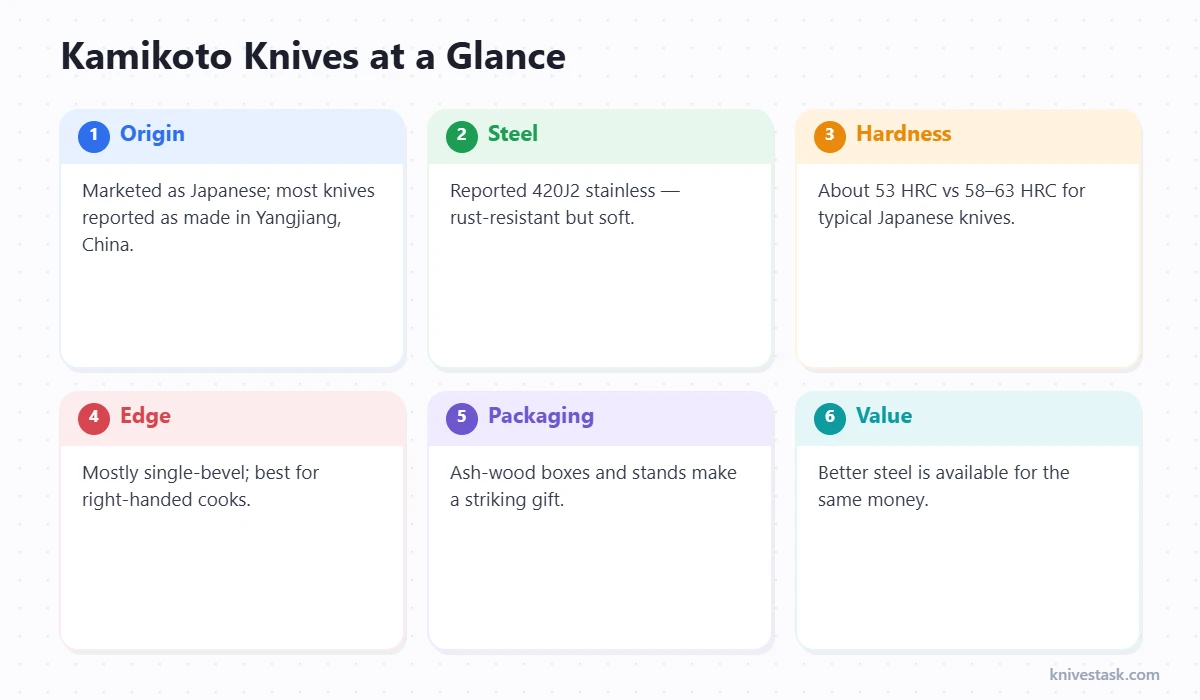
Kamikoto at a Glance
| Question | Short answer |
|---|---|
| Where are the knives made? | Japan (Niigata) and China (Yangjiang), with most reported as Chinese-made |
| Steel | Reported 420J2 stainless (Genten line) |
| Hardness | About 53 HRC |
| Edge grind | Mostly single-bevel |
| Warranty | Limited lifetime guarantee, according to the brand |
| Good value? | Not at full price |
How we evaluated: we haven’t lab-tested these knives side by side. We compared steel, hardness, edge grind, construction, handle design, published specifications and long-term owner feedback. Kamikoto doesn’t publish edge angles, so steel and hardness figures come from details reported by independent reviewers.
Where Are Kamikoto Knives Made?
Kamikoto’s branding — the name, the references to Niigata and Honshu steel, the minimalist Japanese aesthetic — strongly suggests a made-in-Japan knife. Its own pages, however, also mention craftsmen in Yangjiang, China, one of the world’s largest knife-making centers. Reviewers who contacted the company report that only a limited series (such as the Ganjo santoku) has been made in Japan, with the rest made in China.
Made in China isn’t a defect on its own — plenty of good knives come from Yangjiang. The issue is transparency: buyers paying Japanese-knife prices deserve a clear country of origin on the box and product page.
Kamikoto Steel and Hardness
Hardness, measured on the Rockwell C scale (HRC), tells you a lot about how a kitchen knife will behave. Here’s how Kamikoto’s reported steel compares:
| Brand / line | Steel | Typical hardness |
|---|---|---|
| Kamikoto Genten | 420J2 stainless (reported) | About 53 HRC |
| Victorinox Fibrox Pro | X50CrMoV15 | About 56 HRC |
| Wüsthof Classic | X50CrMoV15 | About 58 HRC |
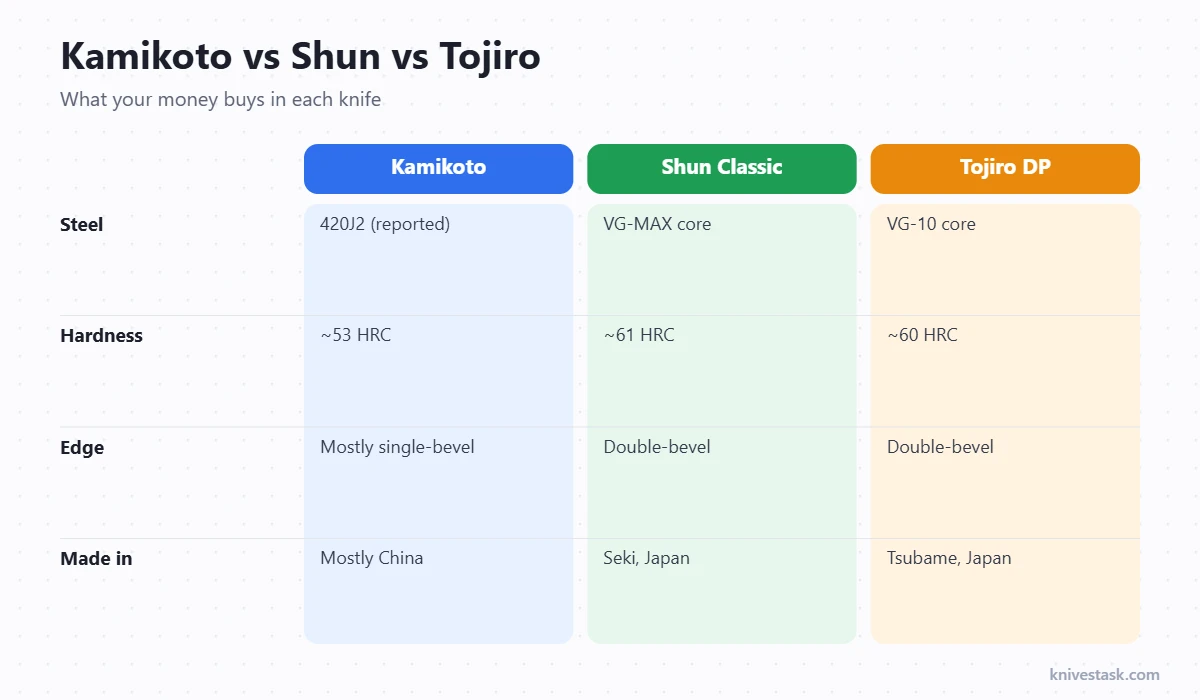
| Tojiro DP | VG-10 core | About 60 HRC |
| Shun Classic | VG-MAX core | About 61 HRC |
420J2 is a low-carbon martensitic stainless steel (see SAE steel grades) widely used in budget cutlery, scissors and tools. It’s extremely rust-resistant and easy to sharpen, but it can’t hold the thin, acute edge that defines Japanese cutlery. Expect to hone and sharpen far more often than with VG-10 or SG2 knives.
Popular Kamikoto Knives and Sets
Kamikoto Kanpeki Knife Set
Kamikoto’s best-known product: a 5-inch utility knife, a 7-inch nakiri-style vegetable knife and an 8.5-inch slicer in a gray ash-wood box. The satin-finished blades look clean and minimalist, and the single-bevel edges suit right-handed users. Left-handed cooks will find them awkward.
See the Kamikoto Kanpeki set on Amazon
Kamikoto Senshi Dual Knife Set
A 10-inch chef’s knife and a 5.5-inch utility knife with a wooden display stand. The long chef’s knife suits big cutting boards and confident hands, and the stand lets the knives air-dry on the counter.
See the Kamikoto Senshi set on Amazon
Kamikoto Kensei Set
A 9.5-inch knife and a 6.5-inch boning knife in a wooden box, aimed at cooks who break down a lot of meat and fish. The soft steel means edges need frequent touch-ups, especially around joints and cartilage.
See the Kamikoto Kensei set on Amazon
Kamikoto 7-Inch Santoku
The most practical single Kamikoto knife: a 7-inch santoku with a satin finish and, per the listing, a single-bevel edge. It’s a comfortable all-rounder for vegetables, fish and boneless meat, but plan on regular honing.
See the Kamikoto santoku on Amazon
Kamikoto Chuka Bocho and Yanagiba
Kamikoto also sells a Chinese-style chuka bocho (a thin vegetable cleaver, not a bone chopper) and a 13-inch yanagiba, a long single-bevel slicer for raw fish and sashimi. Neither should be used on bones or frozen food.
Pros and Cons of Kamikoto Knives
- Pros: clean minimalist design, beautiful boxes and stands, very rust-resistant steel, limited lifetime guarantee
- Cons: soft steel for the price, mostly single-bevel, unclear origin marketing, permanent “discounts” from inflated list prices
Kamikoto Sets Compared
| Set | Knives | Storage | Best for |
|---|---|---|---|
| Kanpeki | 5″ utility, 7″ vegetable, 8.5″ slicer | Ash-wood box | General home cooking |
| Senshi | 10″ chef’s, 5.5″ utility | Wooden stand | Large boards |
| Kensei | 9.5″ knife, 6.5″ boning | Wooden box | Meat and fish prep |
Is Kamikoto a Scam?
Kamikoto knives are real, usable kitchen knives, so it isn’t a scam in the sense of taking money and shipping nothing. The criticism — widespread among reviewers, knife forums and Amazon buyers — is about marketing that implies a Japanese pedigree, very high “list” prices that are almost always discounted, and ordinary steel for the money. Judge the knives by the price you’ll actually pay and compare that with what the same budget buys elsewhere.
Better-Value Japanese Alternatives
| Knife | Steel | Made in | Why it’s better value |
|---|---|---|---|
| Tojiro DP Gyuto | VG-10 core | Tsubame, Japan | Much harder steel at a lower price |
| Enso HD Chef’s Knife | VG-10, 37 layers | Seki, Japan | Damascus look with real performance |
| Shun Classic 8″ Chef’s | VG-MAX core | Seki, Japan | Premium steel, wide availability, sharpening service |
| Victorinox Fibrox Pro 8″ | X50CrMoV15 | Switzerland | Low price, excellent edge for the money |
For a head-to-head, read Kamikoto vs Shun. For broader picks, see our guide to the best Japanese kitchen knives.
Single-Bevel vs Double-Bevel Edges
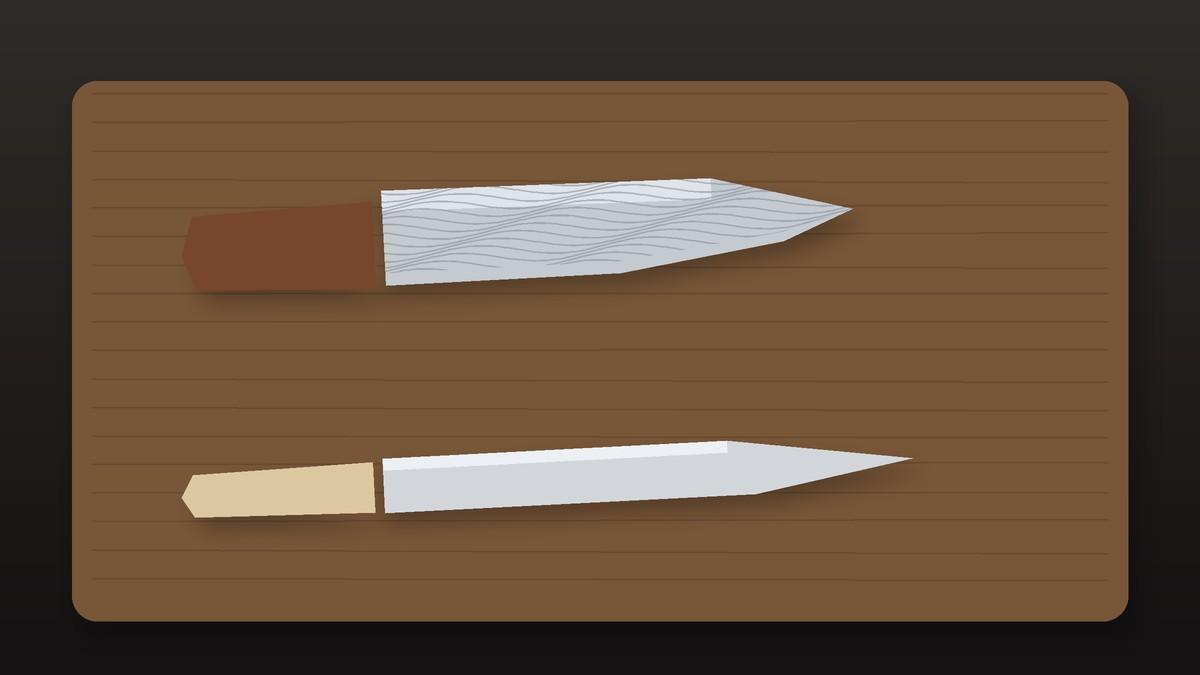
Traditional Japanese kitchen knives like the yanagiba, deba and usuba are single-bevel (kataba): sharpened on one side with a flat or slightly hollow back (urasuki). They make exceptionally clean slices but tend to steer in thick food and are made specifically for right- or left-handed users. Double-bevel (ryoba) knives are sharpened on both sides, cut straight and work in either hand.
| Feature | Single bevel | Double bevel |
|---|---|---|
| Sharpening | Main bevel plus flat back | Both sides equally |
| Handedness | Right- or left-specific | Either hand |
| Cutting path | Can steer in thick food | Straight |
| Best for | Sashimi, fine slicing | Everyday cooking |
What to Look For in a Japanese-Style Knife
- Named steel and hardness: look for VG-10, SG2, AUS-10, Aogami (blue) or Shirogami (white) steel at roughly 58–63 HRC. Vague claims like “premium Japanese steel” are a warning sign.
- Clear origin: reputable makers state where knives are made — Seki, Sakai, Tsubame-Sanjo and Echizen are Japan’s best-known knifemaking regions.
- Balance and fit: the balance point should sit near the bolster, with handle scales flush to the tang.
- Real warranty support: check what’s covered, who pays shipping and whether chips from normal use are included.
How to Care for and Sharpen Kamikoto Knives
- Hand wash and dry immediately; never use a dishwasher.
- Hone often on a ceramic rod to keep the soft edge aligned.
- Use an end-grain wood or soft plastic board.
- Store in the box, on the stand or on a magnetic strip.
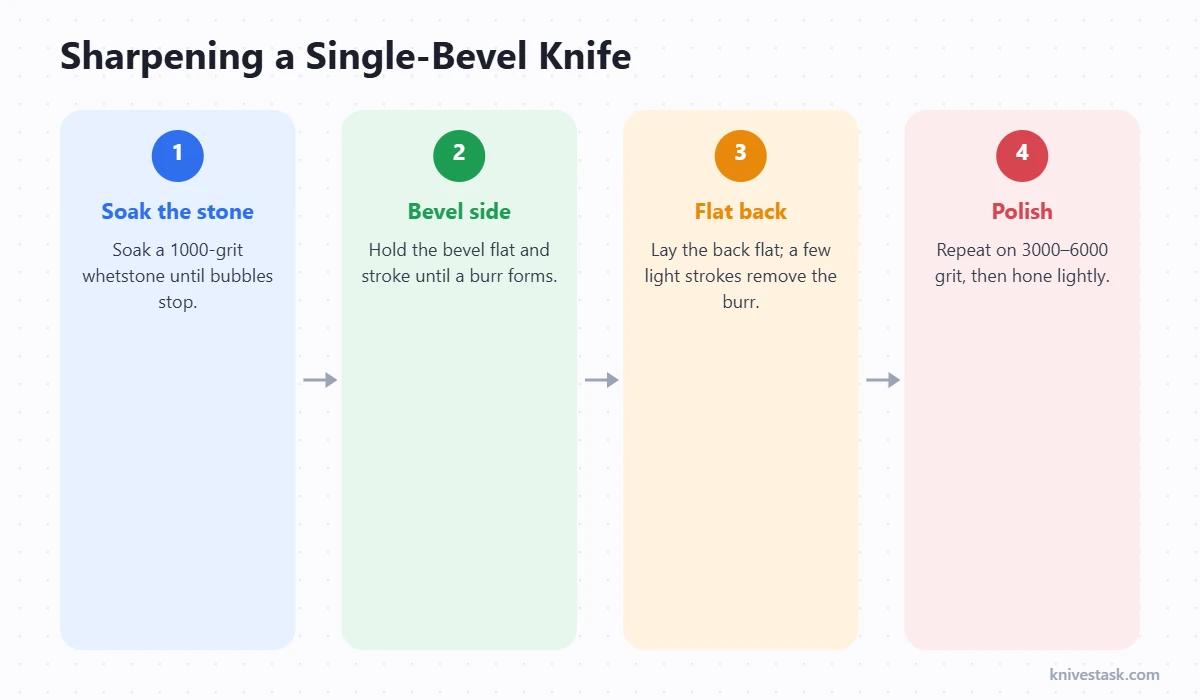
To sharpen a single-bevel edge, hold the bevel flat on a 1000-grit whetstone and work along the edge until a burr forms on the flat back, then take a few light strokes on the back to remove it. Finish on a 3000–6000 grit stone. Our guides to sharpening a single-bevel sushi knife and choosing whetstone grits explain each step. Avoid pull-through sharpeners, which damage single-bevel geometry.
Who Should Buy Kamikoto?
Kamikoto may suit right-handed buyers who value presentation — a gift box, a display stand — and plan light home cooking. If you want edge retention and real performance for your money, a Tojiro, Enso or Shun knife is the better buy.
Final Verdict
Kamikoto knives are handsome, well packaged and perfectly capable of cutting food. The problem is value: the same money buys knives with harder steel, clearer origins and double-bevel edges that are easier to live with. If you already own a Kamikoto set, keep it honed and enjoy it. If you’re shopping now, start with the alternatives above.
Frequently Asked Questions
Are Kamikoto knives made in Japan?
Kamikoto cites both Japan and China. Independent reviewers report that most current Kamikoto knives are made in Yangjiang, China.
What steel do Kamikoto knives use?
The Genten line is reported to use 420J2 stainless steel hardened to about 53 HRC.
Are Kamikoto knives worth it?
Not at their usual price. They’re attractive and usable, but similarly priced Japanese knives offer much harder steel.
Are Kamikoto knives single bevel?
Most are single-bevel and suited to right-handed users; a few models, such as bread and steak knives, are double-bevel.
Is Kamikoto a scam?
No, the knives are real. Criticism centers on misleading origin marketing, inflated list prices and modest steel quality.
Can Kamikoto knives go in the dishwasher?
No. Hand wash and dry them to protect the edge and handle.